
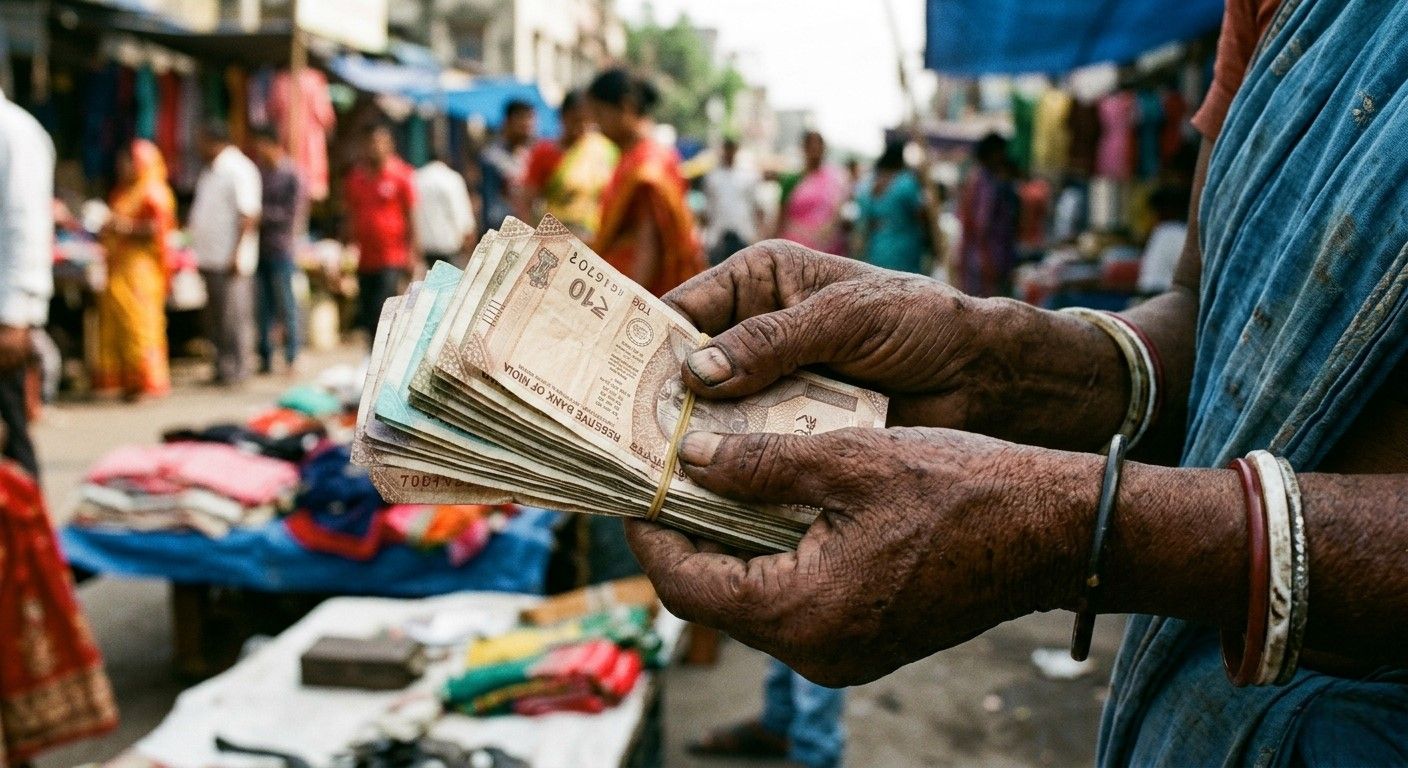

New Delhi: Laxmi earns ₹9,000 a month as a construction worker, without any contract or benefits. An employer was willing to hire her at ₹12,000 — a clear improvement, with better conditions and formal employment. But the law required him to pay ₹13,500. At that level, the offer was no longer viable for the employer. He did not hire her.
Nothing changed for Laxmi. She did not get the raise, the contract, or the security. The job simply never existed.
This illustrative example anchors the central argument of the Minimum Wages Hurt the Most Vulnerable Workers, published by the Foundation for Economic Development. It argues that well-intentioned wage floors are systematically excluding the very workers they aim to protect.
The conclusion is stark. Minimum wages, when set significantly above productivity levels, do not raise incomes — they eliminate opportunities. For India, where labour markets are already fragile and informality pervasive, the consequences are particularly severe. “Minimum wages legally mandate what employers must pay. Economic reality mandates what they can. When the two diverge, it is the worker who bears the cost,” highlights the report. “The assumption that employers will simply absorb higher wages is not borne out in real-world behaviour. Instead, they adjust in ways that reduce opportunities for the least productive workers.”
The gap between policy intent and economic outcome is where India’s labour crisis is quietly deepening.
A Floor Set Too High
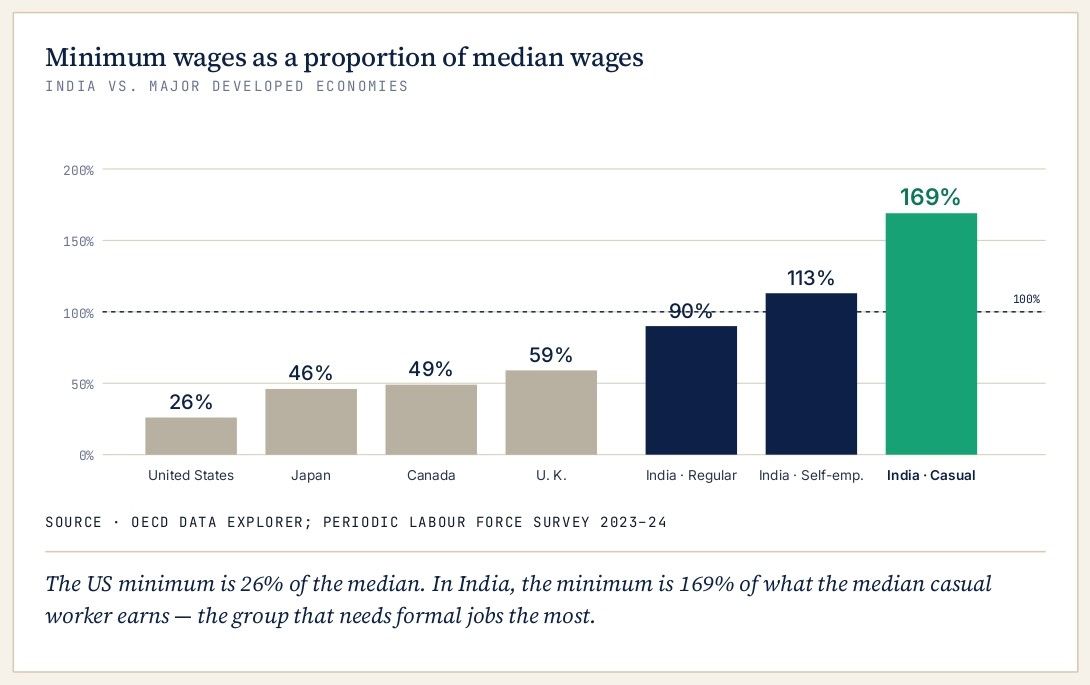
The FED report’s most compelling argument lies in the mismatch between India’s wage floor and the country’s economic reality. By multiple measures, India’s minimum wages are not just high, they are “unusually high” relative to both domestic earnings and international benchmarks.
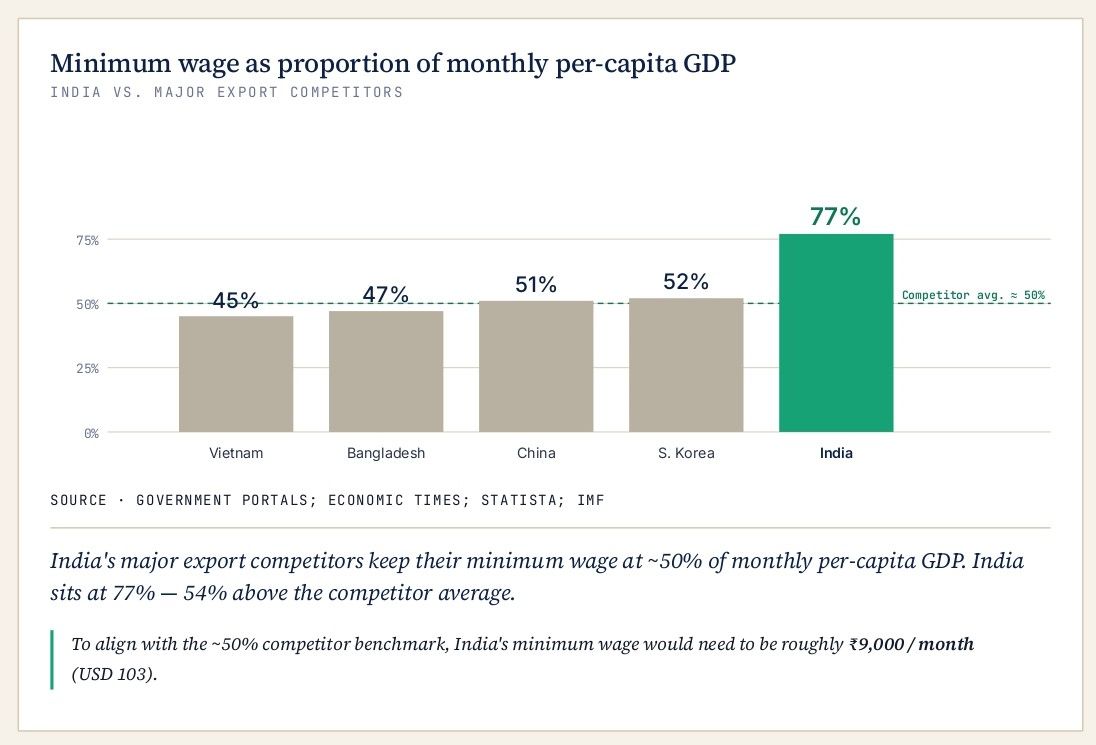
India’s minimum wage stands at 169% of the median earnings of casual workers — the very group most in need of formal employment. In comparison, minimum wages in developed economies range between 26% and 59% of median wages. Even when measured against per-capita GDP, India’s wage floor is 77%, compared to roughly 50% in competing economies such as Vietnam, Bangladesh and China.
This distortion has profound implications. “India’s floor is priced for an economy that does not yet exist. It sits well above what most workers can produce and what most firms can afford... When the minimum wage exceeds productivity, it does not lift workers up, it locks them out of formal employment entirely,” says the report.
The consequences are visible across the labour market. Between 40% and 79% of workers in India’s 14 largest states earn below the minimum wage. Nationally, the figure stands at 64%. Even more striking, for 47% of workers, a 30% wage increase over current earnings would still fall below the legal floor, making such employment technically illegal.
The result is not compliance, but circumvention. “Minimum wages are not acting as a binding floor at the bottom of the labour market. They are a line that most workers already sit under,” says the report. “The scale of non-compliance is not an anomaly; it is the normal state of employment across India.”
In effect, the law is not setting wages, it’s redefining what counts as formal employment, shrinking it in the process.
Economic Fallout
The FED report moves beyond theory to document macroeconomic consequences. When employers cannot legally hire at market-clearing wages, they adjust. And almost all adjustments harm workers.
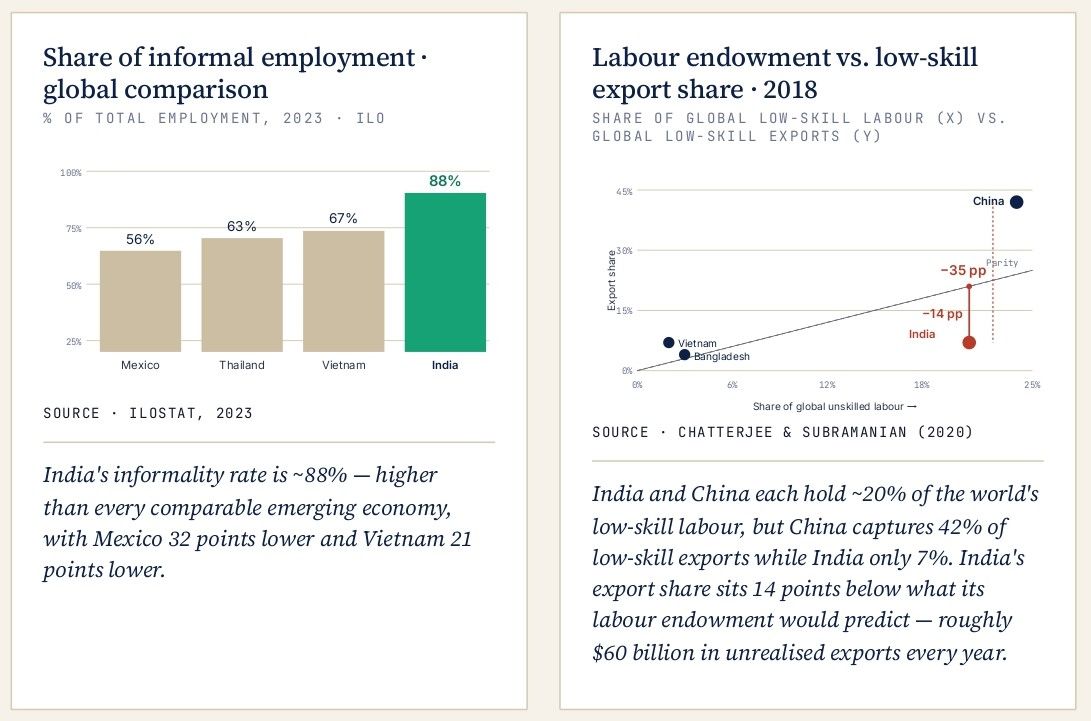
India’s labour market offers clear evidence of this mechanism. Nearly 88% of the workforce remains informal, a figure significantly higher than comparable economies such as Vietnam (67%), Thailand (63%), or Mexico (56%). Informality strips workers of contracts, social security, and legal protections… the very safeguards minimum wages are meant to guarantee.
“Firms facing unaffordable wage mandates do not simply comply. They automate, relocate, downsize, or move into informality,” reveals the findings of the report. “Of the nine realistic responses available to employers, only one — paying the higher wage — actually benefits workers. The rest reduce jobs or worsen conditions.”
The impact extends to India’s global competitiveness. Despite possessing roughly 20% of the world’s low-skill labour, India captures only 7% of low-skill exports. China, with a similar labour endowment, captures 42%. The gap translates into an estimated $60 billion annual shortfall in exports, representing millions of missing jobs.
Labour-intensive sectors that should absorb surplus workers — such as apparel, leather, and footwear — are underperforming. These sectors have grown at 7-9%, while capital-intensive industries like automobiles and metal parts have expanded at 13-14%.
The sectors that could absorb millions of low-skilled workers are growing the slowest. This is not coincidental. It’s a direct outcome of cost structures that discourage labour-intensive production, says the report. “High wage floors push firms toward capital-intensive models, leaving entry-level workers with fewer pathways into employment,” it adds.
The structural transformation of the economy has also stalled. Over three decades, India has moved only 19 percentage points of its workforce out of agriculture, compared to China’s 32 percentage points over a similar period, a 40% slower transition.
At the state level, the pattern persists. Regions with higher minimum wages relative to per-capita income tend to have fewer formal jobs and lower median wages. In some of India’s poorest states, the minimum wage exceeds the median wage, an indication that the policy is detached from economic realities.
Protection In Name
The FED report’s most forceful critique is not of the idea of worker protection, but of its execution. A wage floor that cannot be enforced without destroying jobs, it argues, becomes counterproductive.
The human consequences are illustrated through real-world scenarios. Workers unable to secure formal employment are pushed into informal arrangements — home-based work, casual labour, or self-employment with little security. Entry-level workers, in particular, face insurmountable barriers.
“Many workers are willing to start at lower wages to gain skills and experience. The minimum wage prevents this first step… By pricing entry-level labour above its productivity, the law removes the very ladder workers need to climb,” says the report.
The report also highlights a paradox within government policy. The wage under the rural employment guarantee scheme (NREGA) is often 1.3-2.2 times lower than statutory minimum wages. In other words, the state itself pays less than what it mandates private employers to pay.
If the government’s own safety-net wage sits below the legal minimum, it raises serious questions about whether the minimum reflects actual economic conditions. “A policy that cannot be applied even by the state that mandates it is unlikely to be viable for private firms,” says the report.
The cumulative effect is exclusion. Millions of workers remain outside the formal economy, unable to access better wages, social security, or upward mobility.
The report frames the policy choice in stark terms. “The choice is not between high wages and low wages. It is between jobs and no jobs,” says the report. A minimum wage set too high does not protect the vulnerable, it excludes them from the labour market altogether, it adds.
Road Ahead
India adds 8-10 million workers to its labour force every year. Absorbing this workforce requires rapid expansion in labour-intensive manufacturing and services — sectors that depend critically on competitive wage structures.
The FED report suggests a rethinking of wage policy. It advocates allowing greater flexibility in wage determination, supplementing incomes through targeted subsidies rather than mandates, and tailoring wage floors to regional conditions.
Underlying these recommendations is a simple principle: employment generation must take precedence over regulatory rigidity. “India will do far more for its workers by making it easier to create jobs than by mandating wages that hinder job creation,” says the report. “Protection in name is no substitute for opportunity in reality.”
For policymakers, the challenge is political as much as economic. Minimum wages are a visible commitment to worker welfare. But as the evidence mounts, the invisible costs — lost jobs, stalled industries, and entrenched informality — are becoming harder to ignore.
The story of Laxmi is not an exception. It is a pattern repeated across millions of workers... jobs that could exist, wages that could rise, opportunities that never materialise.
In the end, the question is not whether workers deserve higher wages. It’s whether the path chosen to achieve that goal is shutting the door on them instead.