


New Delhi: India’s ambition to emerge as a global manufacturing powerhouse is increasingly colliding with a structural bottleneck: the inefficiency of its industrial land governance ecosystem. Across states, land remains difficult to identify, acquire and operationalise, with investors navigating a maze of approvals, unclear titles, and delayed possession. What should be a foundational enabler of industrial growth has instead become a persistent drag on project timelines and capital efficiency.
The CII Land Mission: Framework to reform industrial land Management in India delivers an in-depth diagnosis of this challenge. The report underscores that industrial land acquisition processes —from search and allotment to acquisition and utilisation — remain fragmented and administratively complex. As India competes for global capital and supply chain diversification, these inefficiencies are no longer tenable.
Industrial land, the report notes, is the backbone of manufacturing expansion and infrastructure development. Yet, investors face multiple departmental touchpoints, non-standard documentation, and undefined timelines. Approval cycles stretch unpredictably, often extending project gestation periods by months or even years.
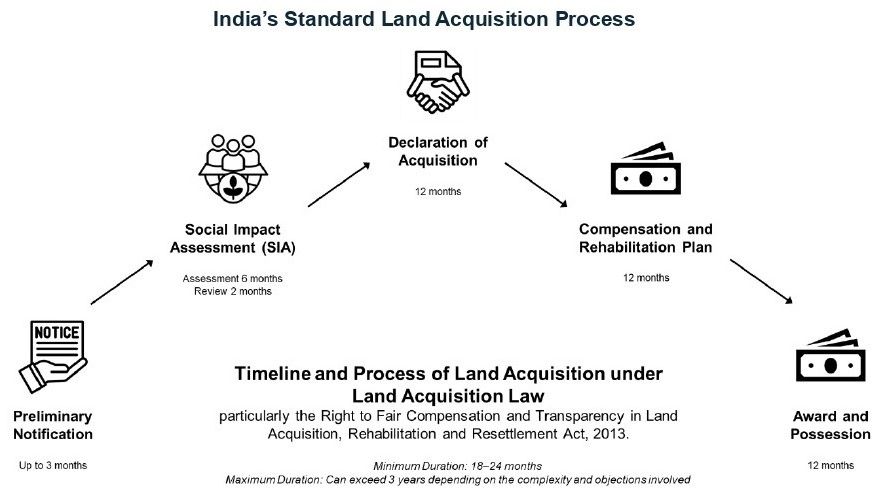
The consequences are tangible. “Overall, the land acquisition process in India generally requires a minimum of 18 to 24 months, though in complex cases involving disputes, objections, or large-scale displacement, the timeline can extend beyond three years. While lengthy, this timeline reflects the government’s intent to uphold fairness, transparency and accountability in the acquisition process, balancing developmental needs with the rights and welfare of affected communities,” says the CII report.
Environmental approvals can add another 6-12 months, says the report. Conversion of land use can take anywhere between 6 and 18 months, while acquisition compliance processes often extend to 18-36 months. These delays inflate capital costs, reduce internal rates of return, and disproportionately impact MSMEs and new entrants, it notes.
Cost escalation compounds the problem. Industrial land in India is estimated to be around 25% more expensive than in Thailand, while stamp duties range between 4-12%, compared to near-zero levels in some competing economies. Property registration itself requires nine procedures, takes 58 days, and costs 7.8% of property value. The result is a system where regulatory friction, rather than market logic, often determines investment decisions.
At the heart of the issue lies a paradox: while India has strengthened social safeguards through legislation such as the LARR Act, 2013, the resulting compliance burden has slowed industrial responsiveness. Mandatory consent requirements of 70-80% and lengthy social impact assessments, though well-intentioned, have extended timelines and increased uncertainty. Without systemic reform, India risks losing its competitive edge in global manufacturing, states the report.
Fragmentation Across Land Lifecycle
The report’s most significant contribution lies in its end-to-end diagnosis of the industrial land lifecycle, identifying nine key stages where inefficiencies persist. “From land search and application to acquisition, allotment, and post-allocation utilisation, structural weaknesses are embedded at every stage,” it notes.
One of the most critical gaps is in land information systems. Officials and industry stakeholders repeatedly point out that many states continue to maintain incomplete or outdated land banks, with very limited visibility on zoning, utilities, encumbrances, or environmental restrictions.The absence of reliable GIS-enabled databases makes land identification cumbersome and slows investment decisions. Even where digital portals exist, investors often complain that “systems are fragmented and poorly integrated… we are forced to navigate multiple platforms and resubmit the same data repeatedly”.
Title verification presents another major challenge. Partially digitised land records, inheritance disputes, and undisclosed encumbrances make every transaction a legal risk. Investors frequently encounter multiple claimants or hidden liabilities, with disputes taking years to resolve. Unsurprisingly, many respondents emphasised that “title clarity remains one of the highest-risk factors in industrial land transactions”.
Land acquisition itself remains a bottleneck. Compliance with statutory requirements — social impact assessments, public hearings, and compensation frameworks — often stretches timelines significantly. Operational issues such as encroachments, boundary disputes, and rights-of-way conflicts delay physical possession even after acquisition is complete. Reflecting this, the report notes that “most respondents experienced land acquisition as ‘difficult’ or ‘very difficult’”.
Institutional fragmentation exacerbates these issues. Multiple authorities — revenue departments, industrial development corporations, pollution control boards, and local bodies — operate with limited coordination. Investors frequently express frustration, stating that “different departments interpret policies differently, and there is no single point of accountability”. In some states, even after land allotment, investors face hurdles in obtaining physical possession, highlighting gaps in enforcement.
Post-allocation inefficiencies further undermine the system. A significant proportion of industrial land remains unutilised due to speculative holding, infrastructure gaps, or delays in downstream approvals. The CII report highlights: “A large share of allotted land remains locked in non-operational projects due to weak monitoring and absence of exit mechanisms.”
A Comptroller and Auditor General audit cited in the report found that only around 50% of allotted plots in certain zones became operational within mandated timelines.
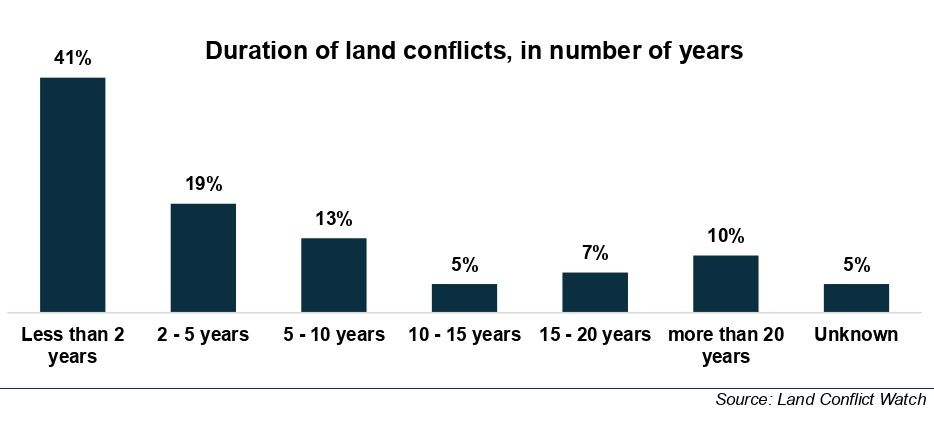
Land conflicts add another layer of complexity. The report highlights 128 recorded land conflict cases covering 129,820 hectares. As one summary insight puts it, “over 50% of these conflicts last more than two years, and several extend beyond two decades”. Government-led projects account for 57% of cases and nearly 68% of contested land, underscoring the scale of institutional challenges.
Blueprint For Structural Reform
Against this backdrop, the CII report proposes a comprehensive reform framework aimed at improving transparency, reducing timelines, and strengthening accountability. At its core is the idea of creating “an integrated, technology-driven, and standardised industrial land ecosystem”.
The most transformative recommendation is the creation of a unified GIS-enabled national industrial land bank. As envisioned, “this system would provide real-time information on parcel availability, zoning status, utilities, environmental constraints, and title clarity”. Standardised data fields and regular updates would enable investors to make informed decisions and significantly reduce search costs.
Equally important is the proposed digital single-window platform for land applications. Policymakers emphasise that “by integrating approvals across departments and enabling real-time tracking, procedural fragmentation can be eliminated”. The introduction of a designated case owner and service-level agreements, along with deemed approvals for non-sensitive clearances, is expected to compress approval timelines substantially.
Reforms in land allotment processes focus on predictability and transparency. The report recommends “time-bound handover protocols, where possession is granted within 15 days under defined service-level agreements”. Transparent pricing frameworks and real-time land bank updates would further enhance investor confidence. The development of plug-and-play industrial parks is described as “especially critical for MSMEs that require quick operational readiness”.
To address legal uncertainty, the report calls for nationwide digitisation of land records, GIS-linked cadastral mapping, and survey-level authentication prior to allotment. Experts suggest that “introducing title insurance and long-term digital verification workflows can significantly reduce litigation risks”.
Land acquisition reforms aim to balance speed with fairness. The report proposes “standardised social impact assessment templates with a six-month outer limit, along with fast-track acquisition cells at the district level”. A publicly accessible, GIS-linked dispute registry would improve transparency and enable early identification of risks.
On utilisation, the report advocates structured norms with defined timelines. As recommended, “plug-and-play units should become operational within 12 months, while greenfield projects should adhere to a 24- to 36-month window”. Parcels remaining unused beyond these thresholds would be subject to reversion and reallocation.
Building Institutional Capacity For Long Term
Perhaps the most ambitious aspect of the report is its focus on institutional reform. It proposes the creation of a National Industrial Land Council (NILC), modelled on a GST-like framework. As described, “this central body would establish national standards, harmonise regulations, and act as a dispute resolution authority”.
At the state level, dedicated State Land Authorities would serve as single-point implementation agencies. The report stresses that “replacing fragmented institutional structures with accountable, well-resourced bodies is essential for effective execution”.
It also emphasises the need for a central IT backbone. According to the framework, “a unified digital infrastructure integrating land records, approvals, and dispute management systems will enable seamless coordination and provide investors with a single interface.”
Capacity building is identified as a “critical enabler”. Many state industrial development corporations remain understaffed and lack technical expertise. The report highlights that “without targeted funding and structured training programmes, institutional reform will remain incomplete”.
Ultimately, the framework envisions a shift from a fragmented, opaque system to a transparent, predictable, and investor-friendly ecosystem. As the report concludes, “industrial land is not merely a factor of production—it is a strategic asset central to India’s manufacturing ambitions”.
If implemented effectively, these reforms could reduce project delays, enhance investor confidence, and improve utilisation of industrial land assets. More importantly, they could play a decisive role in enabling India’s long-term economic transformation and its aspirations to become a global manufacturing powerhouse.
(Cover photo by Dinesh Dixit on Unsplash)