
New Delhi: Three decades after the Beijing Declaration and Platform for Action called for gender equality in political decision-making, women’s representation in national parliaments continues to advance at a frustratingly slow pace. According to the Inter-Parliamentary Union’s report ‘Women in Parliament in 2025’, global progress has largely stagnated despite pockets of improvement, highlighting the persistent structural barriers that women face in political systems worldwide.
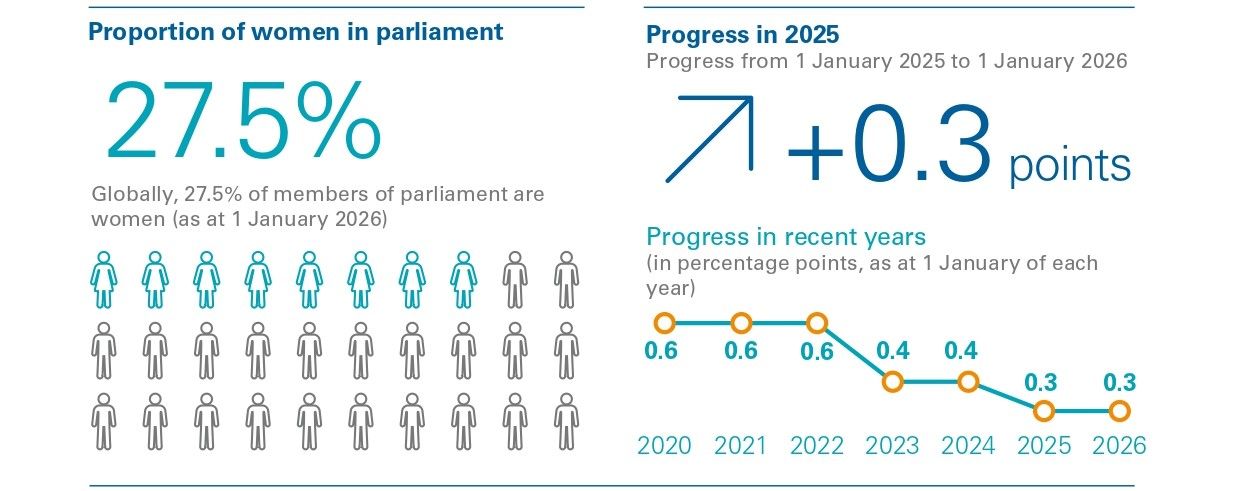
The report notes that for some years now, the global progress on women’s parliamentary representation has stagnated. As of January 1 this year, women accounted for 27.5% of all members of parliament worldwide, rising only slightly from 27.2% a year earlier, representing a gain of merely 0.3 percentage points.
This modest increase reflects a continuation of the sluggish trend observed in recent years. The study warns that if representation continues to grow at the same pace, achieving gender parity in parliaments could take decades. As the report starkly concludes: “If progress were to continue to move at this pace, it would take the world an estimated 75 years to reach gender parity.”
For policymakers and advocates, the findings underline a central paradox: while gender equality has become a widely accepted democratic principle, political institutions are still slow to translate that commitment into equal representation.
Uneven Pace of Change
The analysis in Women in Parliament in 2025 draws on election outcomes across the world. In 49 countries that held parliamentary elections or renewals for 62 chambers during 2025, women accounted for 29.5% of elected or appointed MPs, marking a 0.6-percentage-point improvement compared with previous polls in those chambers.
Although these results indicate incremental progress, they also reveal the uneven pace of change. In some countries, reforms and electoral shifts have led to significant gains, while in others representation has stagnated or even declined.
Among the most notable improvements was in Kyrgyzstan, which recorded the highest increase in women’s representation during 2025, with a jump of 12.9 percentage points. Saint Vincent and the Grenadines followed with an increase of 12.3 percentage points, while the upper chamber in Saint Lucia registered a 9.1-percentage-point improvement.
Such examples illustrate how institutional changes and political momentum can dramatically reshape gender representation in legislatures. However, the report also stresses that these gains remain exceptions rather than the rule.
Regional Differences Persist
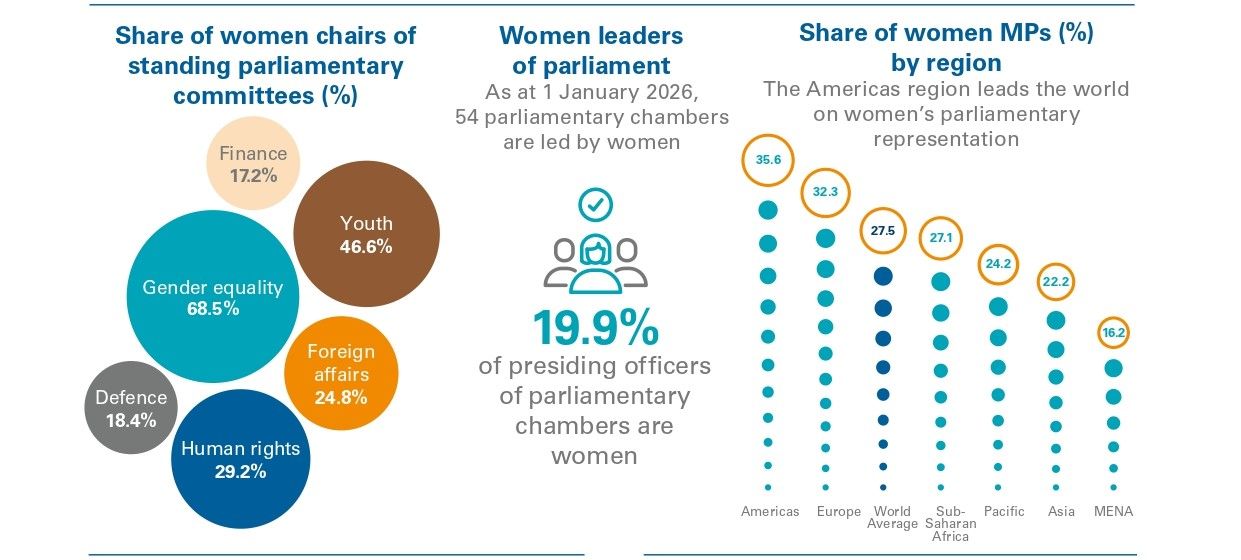
Regional disparities continue to shape the global landscape of women’s parliamentary participation. The Americas remain the global leader, with women comprising 35.6% of all MPs in the region as of January 2026.
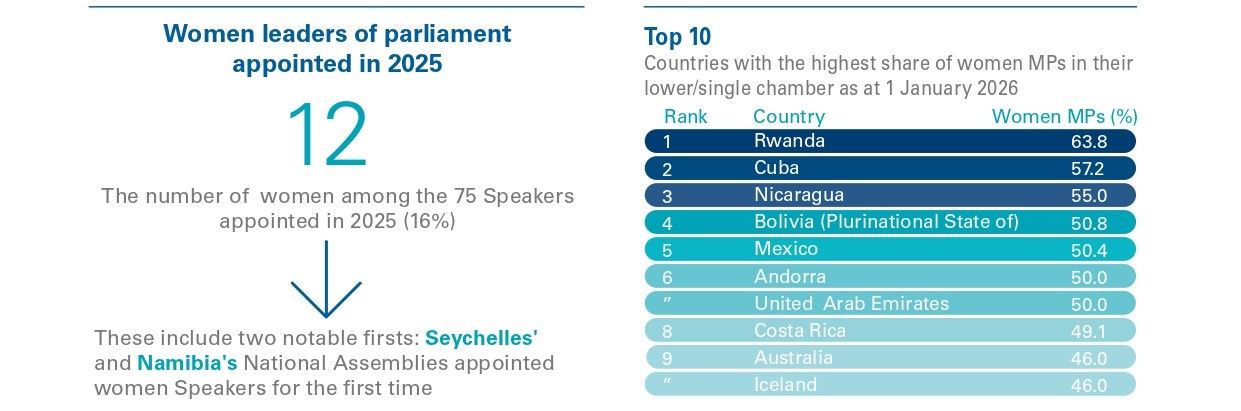
The region also hosts several of the world’s top-performing countries in terms of gender parity in parliament. Cuba, Nicaragua, Bolivia and Mexico are among the nations where women hold half or more of the seats in the lower or single chambers of parliament.
At the same time, progress in other regions remains uneven. In several countries, women continue to occupy a very small share of legislative seats. By the end of 2025, 21 countries had fewer than 10% women MPs, and in Oman, Tuvalu and Yemen there were no women in the lower or single chamber at all.
These stark contrasts demonstrate how political structures, electoral systems and cultural norms shape women’s access to political power.
Quotas Driving Representation
One of the clearest findings in the report is the role of gender quotas in boosting women’s representation. Parliaments that employ quotas — either legislated or voluntary party quotas — consistently elect more women than those that do not.
According to the study, chambers with some form of quota elected or appointed 30.9% women on average, compared with 23.3% in chambers without quotas.
The report emphasizes that well-designed quotas remain a powerful tool to accelerate change. However, it also cautions that poorly designed systems can limit progress rather than expand it. As the report notes, quotas can sometimes become “mere checkmarks when not designed well or followed in true spirit”, creating ceilings rather than floors for representation.
This insight has important implications for governments considering electoral reforms. Quotas alone may not guarantee equality unless they are paired with enforcement mechanisms and broader institutional support.
Male Leadership Dominance
While the proportion of women MPs has slowly increased, leadership positions in parliaments remain largely male-dominated.
The report highlights a decline in the share of women serving as parliamentary Speakers worldwide. As of January 2026, women presided over 54 parliamentary chambers globally, representing just 19.9% of all Speakers — nearly four percentage points lower than the previous year.
This decline underscores a persistent gap between representation and influence. Women may be entering parliaments in greater numbers, but they are still under-represented in positions that shape legislative agendas and institutional culture.
However, progress has been somewhat stronger in parliamentary committees. Women now hold 344 out of 1,058 committee chair positions globally, accounting for 32.5% of such roles across major policy areas.
Yet even this improvement masks structural patterns. When committees dedicated to gender equality are excluded, women chair only 25.7% of committees overall, indicating that women are still concentrated in social policy areas rather than core economic or security portfolios.
Violence and Harassment
Beyond structural barriers in electoral systems, women in politics also face a climate of hostility and harassment that can discourage participation.
The report highlights the prevalence of violence against women in politics, citing research conducted in the Asia-Pacific region. The study found that three in four women parliamentarians surveyed (76%) reported experiencing psychological violence, including sexist remarks, intimidation and online abuse.
Furthermore, 6 in 10 women reported online attacks, while a quarter said they had faced sexual violence and 13% reported physical violence.
Such findings reveal how political institutions themselves can become sites of gendered hostility. The report warns that “violence — often stemming from within parliaments — continues to remain a serious risk and very real threat preventing women from participating and thriving in politics on an equal footing with men”.
Addressing this problem requires not only legal reforms but also institutional culture change within political parties and legislative bodies.
Diversity within Representation
Another emerging trend highlighted in the report is the growing diversity among women entering parliaments. Some countries have elected unprecedented numbers of young women and women with disabilities, reflecting broader social changes.
For instance, recent elections have produced historic milestones such as the election of the first deaf member of Germany’s Bundestag and a record number of MPs with disabilities in the United Kingdom.
These developments suggest that gender equality debates are gradually expanding to include intersectional representation — ensuring that parliaments reflect not just gender balance but also social diversity.
However, progress remains inconsistent. The report notes that although more diverse women are entering politics, the overall share of seats held by young women actually declined between 2023 and 2025, indicating that gains in representation may not always be sustained.
Long Road to Parity
The findings of Women in Parliament in 2025 highlight both the achievements and limitations of the global push for gender equality in politics.
Thirty years after the Beijing Declaration, the share of women in parliaments has more than doubled — from about 11.3% in 1995 to 27.5% in 2026.
Yet the pace of change has slowed significantly in recent years. Without stronger reforms and political commitment, parity may remain decades away.
The report ultimately calls for more ambitious action, urging governments and parliaments to adopt stronger policies, address violence against women in politics and rethink representation from an intersectional perspective.
As it concludes, the future of gender equality in politics will depend on “the sincerity and intentionality of how these legal mandates are designed and delivered”, alongside efforts to ensure that parliaments “reflect their constituencies in their full diversity”.
For democratic institutions seeking legitimacy in 21st century, the message is clear: representation must evolve faster if politics is to truly mirror the societies it serves.