
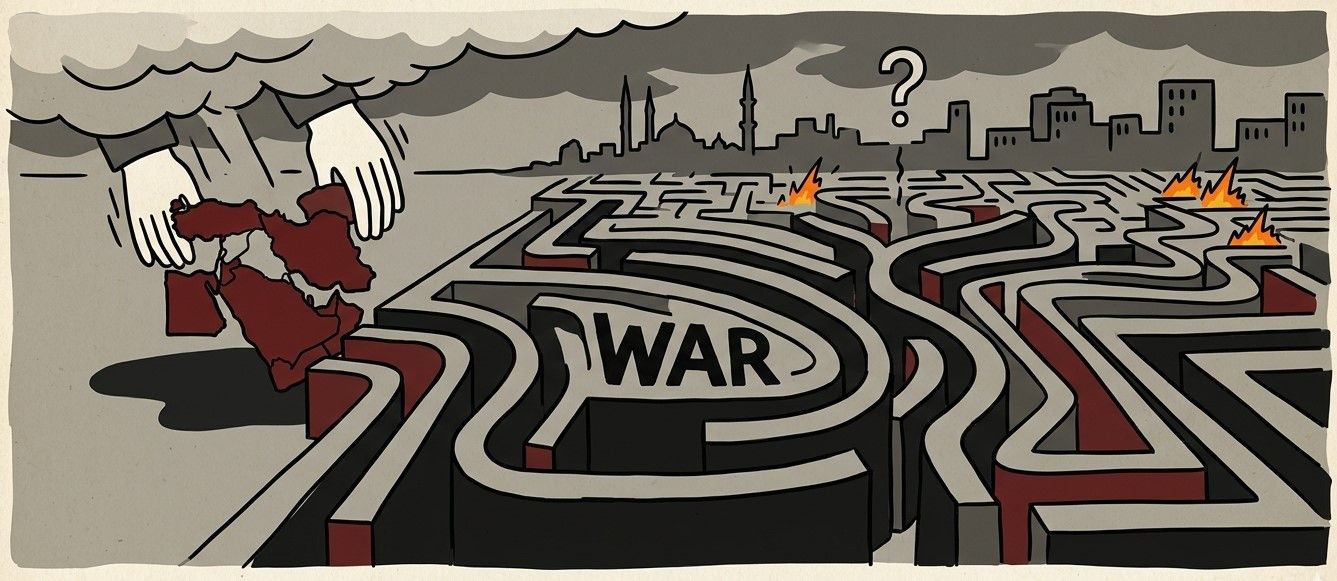

New Delhi: The latest round of Iran war negotiations has produced the familiar choreography of modern conflict diplomacy: cautious optimism in public, strategic rigidity in private. Washington says “significant progress” has been made. Tehran insists it “will not compromise” on sovereign rights. Between these positions lies a ceasefire so fragile that even its defenders appear unconvinced by its durability.
The guns may have briefly fallen silent across parts of West Asia, but it looks like the Iran war is entering a far more unpredictable stage. Behind the diplomatic statements and carefully choreographed negotiations lies a dangerous reality: neither Washington nor Tehran appears politically capable of backing down without claiming victory. That contradiction is now shaping the future of the conflict.
Three months after the first wave of US-Israeli strikes on Iranian military and nuclear targets, negotiators are still struggling to define what peace would even look like. American officials speak of “progress”. Iranian leaders speak of “resistance”. The distance between those two narratives remains vast.
US President Donald Trump has continued alternating between threats and diplomacy. “The clock is ticking,” Trump warned in a recent Truth Social post as pressure mounted on Tehran to accept a revised settlement proposal. In another statement, he declared there was a “very good chance” of securing a deal while simultaneously keeping military options open.
Iran’s leadership has responded with equal rigidity. Iranian Parliament Speaker Mohammad Baqer Qalibaf stated this week that Tehran “will not compromise” on what it considers national rights. The position reflects a wider doctrine inside the Iranian establishment that strategic retreat would invite further pressure rather than stability.
That belief hardened after the killing of senior Iranian figures earlier this year and repeated threats targeting Tehran’s nuclear infrastructure. Iran’s Supreme Leader Mojtaba Khamenei recently insisted that enriched uranium “must stay in Iran”, directly rejecting one of Washington’s core demands.
The ceasefire therefore resembles less a pathway to peace and more a pause between phases of confrontation. Military assets remain deployed. Gulf shipping routes remain vulnerable. Intelligence agencies across the region continue preparing for escalation scenarios.
Diplomacy is alive, but trust is absent.
Oil Markets Shaken
The most immediate global consequence of the Iran war is unfolding far from the battlefield. The Strait of Hormuz, which carries nearly 20% of the world’s traded oil, has become the conflict’s most volatile pressure point.
Every limited disruption has rattled energy markets.
Insurance premiums on commercial shipping through Gulf waters have surged, while crude prices remain vulnerable to every military statement emerging from Washington or Tehran. For economies already battling inflation and slowing industrial growth, the conflict has become an economic threat as much as a geopolitical crisis.
India, China, Japan and major European importers are watching developments with growing unease. A prolonged disruption in Hormuz could fundamentally reshape energy supply chains across Asia.
The larger concern, however, is strategic fragmentation. The war is accelerating the emergence of competing diplomatic blocs across the region. Pakistan’s mediation efforts, Qatar’s shuttle diplomacy and China’s quiet regional engagement point to a Middle East where American influence is increasingly contested rather than dominant.
Former US Secretary of State Henry Kissinger had once remarked: “There cannot be a crisis next week. My schedule is already full.” The line, often repeated for its irony, now captures the exhaustion surrounding Western crisis management in the Middle East. The problem is no longer the outbreak of conflict. It is the inability to end one decisively.
Washington’s position has also become politically complicated. The White House insists the military campaign weakened Iran’s operational capacity, yet Tehran continues projecting resilience. Analysts in the United States are openly questioning whether tactical gains are translating into strategic success.
Meanwhile, Israel’s calculations are becoming more precarious. Iranian proxy networks across Lebanon, Iraq and Syria remain operational despite sustained military pressure. The threat of multi-front escalation has not disappeared. It has merely become more diffuse.
Region Faces Reckoning
The central failure of the current negotiations is that they address symptoms while avoiding the core issue: Middle East still lacks a workable regional security framework acceptable to all major actors.
The United States wants deterrence without permanent military occupation. Iran wants strategic depth without isolation. Israel wants security without empowering Tehran diplomatically. Gulf monarchies want economic stability while avoiding direct confrontation. These ambitions collide rather than coexist.
That is why the present ceasefire feels unstable even during periods of calm.
Wars in the Middle East rarely remain confined to their original objectives. Iraq, Syria, Libya and Yemen all demonstrated how limited interventions can evolve into prolonged regional instability with global consequences. The Iran conflict is beginning to show similar patterns.
There are already signs that the next phase may rely less on direct military confrontation and more on cyber warfare, economic disruption, maritime pressure and proxy operations. The battlefield is expanding into trade corridors, energy infrastructure and financial systems.
Political fatigue is also growing. In the United States, another drawn-out conflict risks deepening public frustration over overseas military involvement. In Iran, sanctions and economic hardship are intensifying domestic pressure despite nationalist mobilisation strengthening the regime temporarily.
The danger lies in the belief, shared by all sides, that escalation can still be controlled.
History offers repeated warnings against such assumptions.
As former UN Secretary-General Ban Ki-moon once observed, “There is no military solution.” The phrase may sound diplomatic, even predictable, but the Iran war increasingly demonstrates its relevance. Every strike intended to force compromise has instead produced deeper mistrust, wider regional polarisation and greater economic instability.
The Middle East is now approaching a defining moment. Either the current negotiations evolve into a broader political settlement, or the region enters a prolonged cycle of managed instability where ceasefires become temporary interruptions between recurring crises.
At present, the second outcome appears far more likely.