

New Delhi: India has recorded substantial gains in child nutrition, maternal healthcare and immunisation coverage over the past five years, marking one of the sharpest improvements in public health indicators in recent decades. But even as the country slowly pushes back against stunting, wasting and underweight prevalence among children, a parallel health crisis is rapidly unfolding: rising obesity, diabetes and hypertension among adults.
The latest survey data show India is now confronting a complicated “double burden” of disease — where under-nutrition persists among vulnerable populations even as lifestyle-linked illnesses spread across urban and rural households alike. The shift is redefining India’s healthcare priorities, forcing policymakers to address both hunger and excess within the same public health framework.
These are findings of the National Family Health Survey - 6, conducted during 2023-24 by the Ministry of Health & Family Welfare (MoHFW) along with the International Institute for Population Sciences (IIPS). The NFHS report says child stunting declined to 29.3% from 35.5% in NFHS-5, while underweight prevalence among children under five fell marginally to 31.8% from 32.1%. Wasting also improved slightly, declining to 19% from 19.3%.
“The main objective of each successive round of the NFHS has been to provide high-quality data on health and family welfare and emerging issues in this area. NFHS-6 data will be useful in setting benchmarks and examining the progress the health sector has made over time,” says the report. “Besides providing evidence for the effectiveness of ongoing programmes, the data from NFHS-6 help in identifying the need for new programmes with an area specific focus and identifying groups that are most in need of essential services.”
Maternal & child health indicators
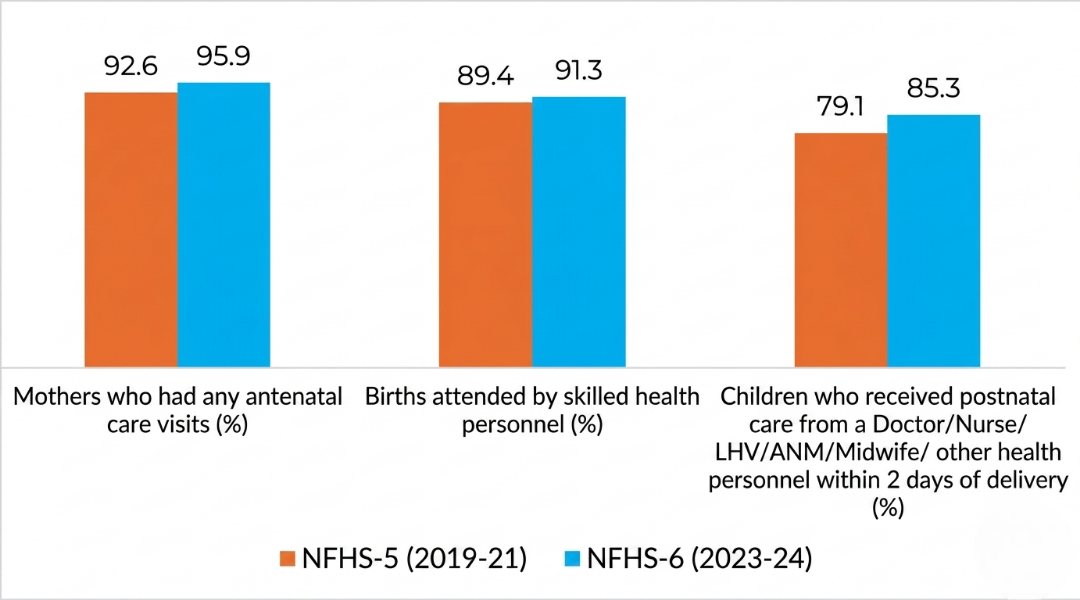
The NFHS report points to a visible strengthening of maternal healthcare systems across the country. Institutional births rose to 90.6% nationally from 88.6% in the previous survey, while births attended by skilled health personnel increased to 91.3%.
Antenatal care indicators also improved significantly. Mothers receiving at least four antenatal care visits climbed to 65.2% from 58.5%, while the proportion of women consuming iron folic acid tablets for 180 days or more during pregnancy rose sharply to 37.8% from 26%.
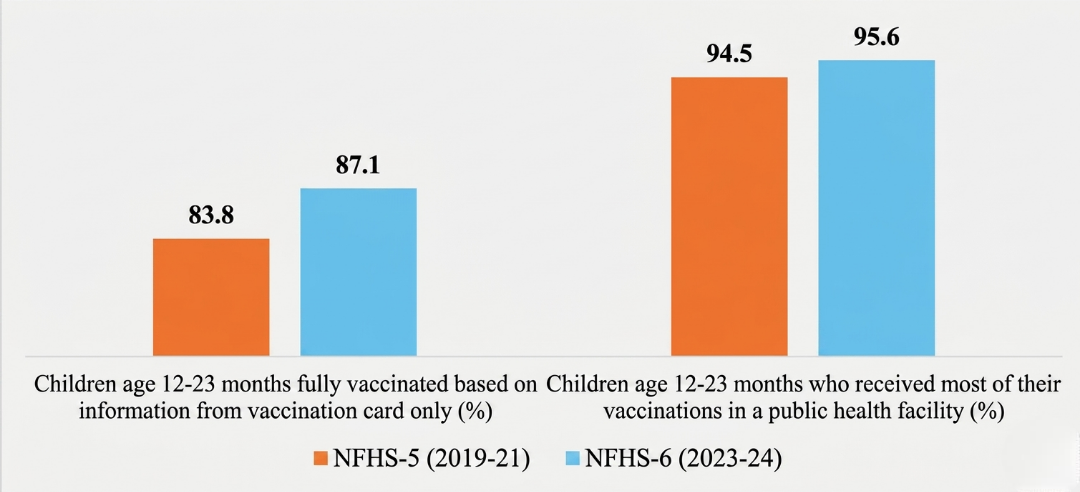
The survey also reflects a major expansion in immunisation coverage. Full vaccination among children aged 12-23 months increased to 82.6% from 76.6% in NFHS-5. Coverage of the rotavirus vaccine more than doubled to 85.4% from 36.4%, while the second dose of the measles-containing vaccine rose to 71.8% from 58.6%.
“Several standard protocols and strategies were adopted to minimize non-sampling errors and maintain data quality such as, multi-level monitoring and supervision of fieldwork, use of computer assisted personal interviewing (CAPI) for collecting data; centralised training for uniformity in survey implementation; standardised tools and procedures,” says the report. “Clinical, anthropometric, and biochemical (CAB) protocols followed as per international standards; secondary editing of data in the field; feedback on data quality to field teams based on real-time data, etc.”
The improvements are particularly significant because they come after years of concern over India’s poor nutrition outcomes despite economic growth. Public health experts say targeted welfare interventions, expanded frontline health networks, better vaccination outreach and increased institutional deliveries have collectively improved maternal and child health outcomes.
Obesity, Diabetes crisis Accelerating
Even as traditional indicators improve, the NFHS report reveals an alarming increase in obesity and diabetes across India. Among women aged 15-49 years, 30.7% are now overweight or obese, up from 24% in NFHS-5. Among men, the figure rose to 27.3% from 22.9%. The rise is no longer confined to metropolitan India; rural areas are also witnessing rapid increases.
The diabetes trend is equally concerning. The share of women with high or very high blood sugar levels, or taking medicine to control diabetes, climbed to 17.8% from 13.5%. Among men, the figure increased to 20.9% from 15.6%.
The survey also highlights growing hypertension prevalence. Nearly one in five women and more than one in five men now either have elevated blood pressure or are taking medication for hypertension.
Health experts say the data underscore a structural transformation in India’s disease profile, driven by sedentary lifestyles, processed food consumption, stress, reduced physical activity and changing dietary habits. What was once seen primarily as an urban affliction is now spreading deep into rural India.
The report itself flags the expanding scope of health monitoring. “NFHS-6 includes some new topics, such as direct bank transfer (DBT) and self-help group (SHG) coverage, digital literacy and financial transactions, etc. The scope of clinical, anthropometric, and biochemical testing (CAB) has also been expanded to include HIV testing,” it says. “The NFHS-6 sample has been designed to provide national, state/Union territory (UT) and district level estimates of various indicators covered in the survey.”
Next challenge: Managing Transition
The latest survey captures a country in epidemiological transition. India is still battling anaemia, poor diets and child undernutrition in several regions, but it is simultaneously confronting a surge in non-communicable diseases usually associated with middle-income economies.
The coexistence of malnutrition and obesity presents a major policy dilemma. While poorer households continue to struggle with access to nutritious food, calorie-dense and nutrient-poor diets are becoming increasingly common across income groups. Public health specialists warn that India could face a massive long-term healthcare burden if preventive strategies are not strengthened immediately.
The NFHS report also shows that dietary diversity among children remains weak despite improvements in nutrition indicators. Only 15.3% of children aged 6-23 months receive an adequate diet, according to the survey, indicating that food quality remains a critical concern.
At the same time, demographic and social indicators reveal broader changes underway. Child marriage rates have declined, fertility rates continue to fall and internet use among women has expanded significantly, reflecting wider social shifts that are influencing health outcomes.
“This fact sheet provides information on key indicators and trends for India. NFHS-6 fieldwork for India was conducted in two phases, phase one from 28 May 2023 to 26 February 2024 and phase two from 7 February 2024 to 31 December 2024,” says the report. “Readers should be cautious while interpreting and comparing the trends as some States/UTs may have smaller sample size. The results presented in the NFHS-6 Fact Sheets are provisional.”
For India’s public health system, the message is increasingly clear: the fight against hunger is no longer the country’s only health emergency. The next battle will be against diseases linked to prosperity, urbanisation and changing lifestyles — and that battle has already begun.