


New Delhi: In a country where the traditional family structure is often viewed as an impenetrable fortress of safety, a ground-breaking medical report is forcing a difficult conversation about what happens when that fortress fails. Published in the prestigious journal, The Lancet Regional Health - Europe, a new research has identified the specific “developmental bridges” that turn childhood trauma into adult relationship vulnerability — a finding with profound implications for India’s rising mental health crisis and its struggle with domestic violence.
While the study utilized a massive dataset of over 11,000 individuals, primarily collected from the Twins Early Development Study (TEDS), a population-based cohort of twins born in England and Wales between 1994 and 1996), its clinical revelations provide a roadmap for policymakers and health practitioners even in India. As India grapples with the complexities of the National Family Health Survey (NFHS-5) data, which consistently shows high rates of domestic discord, this report suggests that the solution to intimate partner violence (IPV) may actually lie in the paediatric wings and school counselling offices of the nation.
IVP, by definition, is a pattern of assaultive behaviour and coercive behaviour that may include physical injury, psychologic abuse, sexual assault, progressive isolation, stalking, deprivation, intimidation, and reproductive coercion.
The study, titled Personality and Mental Health as Mediators Linking Childhood Maltreatment to Intimate Partner Violence Victimization, sought to answer a question that has long haunted social workers: Why do victims of early-life abuse so often find themselves in abusive cycles as adults?
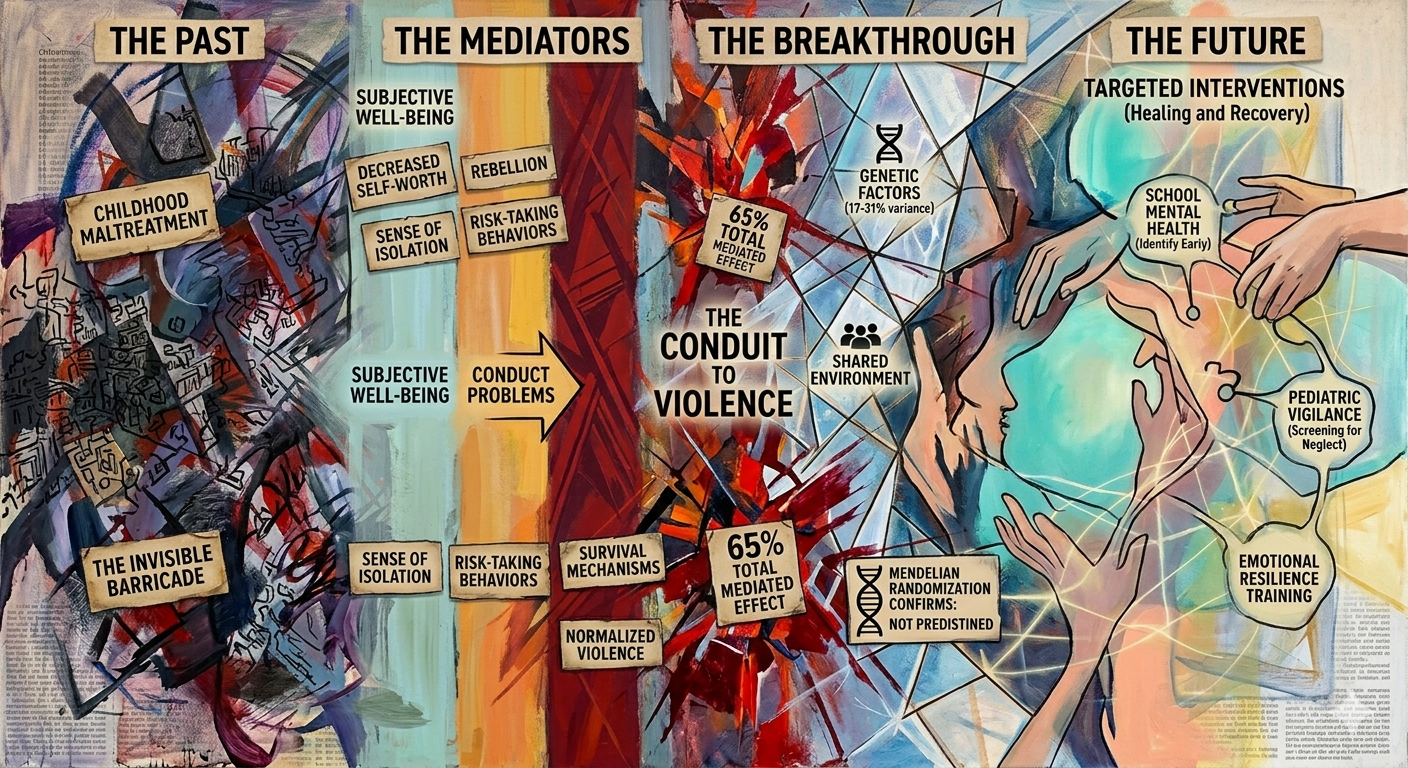
The researchers used advanced genetic and phenotypic modelling to prove that childhood maltreatment creates a “unique environmental risk” that fundamentally alters a person’s psychological development. According to The Lancet report, approximately 65% of the total effect linking childhood trauma to adult victimization is driven by three specific ‘mediators’: low subjective well-being, conduct problems, and aggression.
In the Indian scenario, where “childhood maltreatment” often remains under-reported due to social stigma, these findings are a wake-up call. They suggest that the psychological “scars” left by neglect or abuse are not just private pains, they are public health precursors to a lifetime of violence.
‘Well-being’ Gap
The strongest conduit for future risk identified by the study was a decline in “subjective well-being”; a person’s overall sense of happiness and self-worth. In many Indian households, where children are taught to prioritize family honour and obedience over individual emotional health, a decline in well-being can go unnoticed for years.
To explain the gravity of this psychological shift, the authors of the study in The Lancet report say, “Childhood maltreatment elevates risk of IPV victimization through its impacts on personality and mental health development, beyond risk conferred by shared genetic and environmental liabilities. Preventing IPV victimization among young people exposed to maltreatment requires greater understanding of how these psychological impacts operate within social transactional contexts.”
For a young woman or man in India entering the high-stakes world of arranged marriages or modern dating, a low sense of well-being can be catastrophic. If a child grows up believing they are unworthy of care, they are statistically less likely to recognize the red flags of an abusive partner later in life.
The report also sheds light on “conduct problems” and “aggression” during adolescence. In India, these behaviours are often dismissed as “rebellion” or handled with further discipline. However, the report views them as survival mechanisms that inadvertently place youth in high-risk environments.
“Maltreatment had a significant total effect on IPV victimization, with 65% of this effect explained by the mediators. Subjective well-being was the strongest mediator, followed by conduct problems and aggression,” the study explains.
This creates a “transactional” risk. An adolescent struggling with trauma-induced aggression may find themselves marginalized from safe social circles and pushed toward environments where violence is normalized, increasing their chances of meeting an abusive partner.
Debunking Myths
A common misconception in behavioural health is that some individuals are simply “born” to be in certain types of relationships. The researchers used a method called Mendelian randomization, which uses genetic variants to simulate a randomized controlled trial, to test this theory.
The verdict was clear: while genetics play a role in personality (accounting for about 17% to 31% of the variance), they are not a “predestined” map for victimhood. “The genetic makeup of one individual cannot directly influence the behaviour of another,” the researchers emphasize.
This is an essential message for the Indian medical community. It confirms that intervention works. Even if a child has a “difficult” or “sensitive” temperament, providing a supportive, healing environment can effectively “block” the genetic and environmental pathways toward relationship trauma.
For India, the study’s findings argue for a massive shift in how domestic violence funds are allocated. Currently, most resources go toward ‘crisis centres’ for adults. However, the data from The Lancet report suggests that if India wants to lower the rates of IPV, it must invest in “mechanistically informed” prevention for children.
This means:
School-Based Mental Health: Integrating well-being assessments into the Indian school curriculum to identify children with low self-worth or conduct issues early.
Paediatric Vigilance: Training Indian paediatricians to look beyond physical symptoms and screen for signs of emotional neglect or trauma.
Healing the Mediators: Rather than general “don’t hit” campaigns, focus on psychological support that builds “social competence” and “emotional resilience” in at-risk youth.
“The findings suggest that the association between childhood maltreatment and IPV victimization is not merely a reflection of shared genetic or environmental risks, but involves a direct pathway that can be potentially interrupted through targeted psychological support,” the report says.
(Cover photo by Sherise Van Dyk on Unsplash)