

New Delhi: India’s labour market entered the new financial year on a note of cautious stability, with the latest Periodic Labour Force Survey (PLFS) indicating that while employment conditions remained broadly resilient in April 2026, signs of softening participation in the workforce have begun to emerge across both rural and urban India.
The latest monthly bulletin released by the National Statistical Office under the Ministry of Statistics and Programme Implementation paints a picture of an economy that is holding its ground despite persistent pressure on household incomes, uneven rural demand and uncertainty in sections of the informal economy. The data, drawn from more than 3.74 lakh individuals surveyed across the country, marks the thirteenth monthly release since the revamped PLFS methodology came into effect in January 2025.
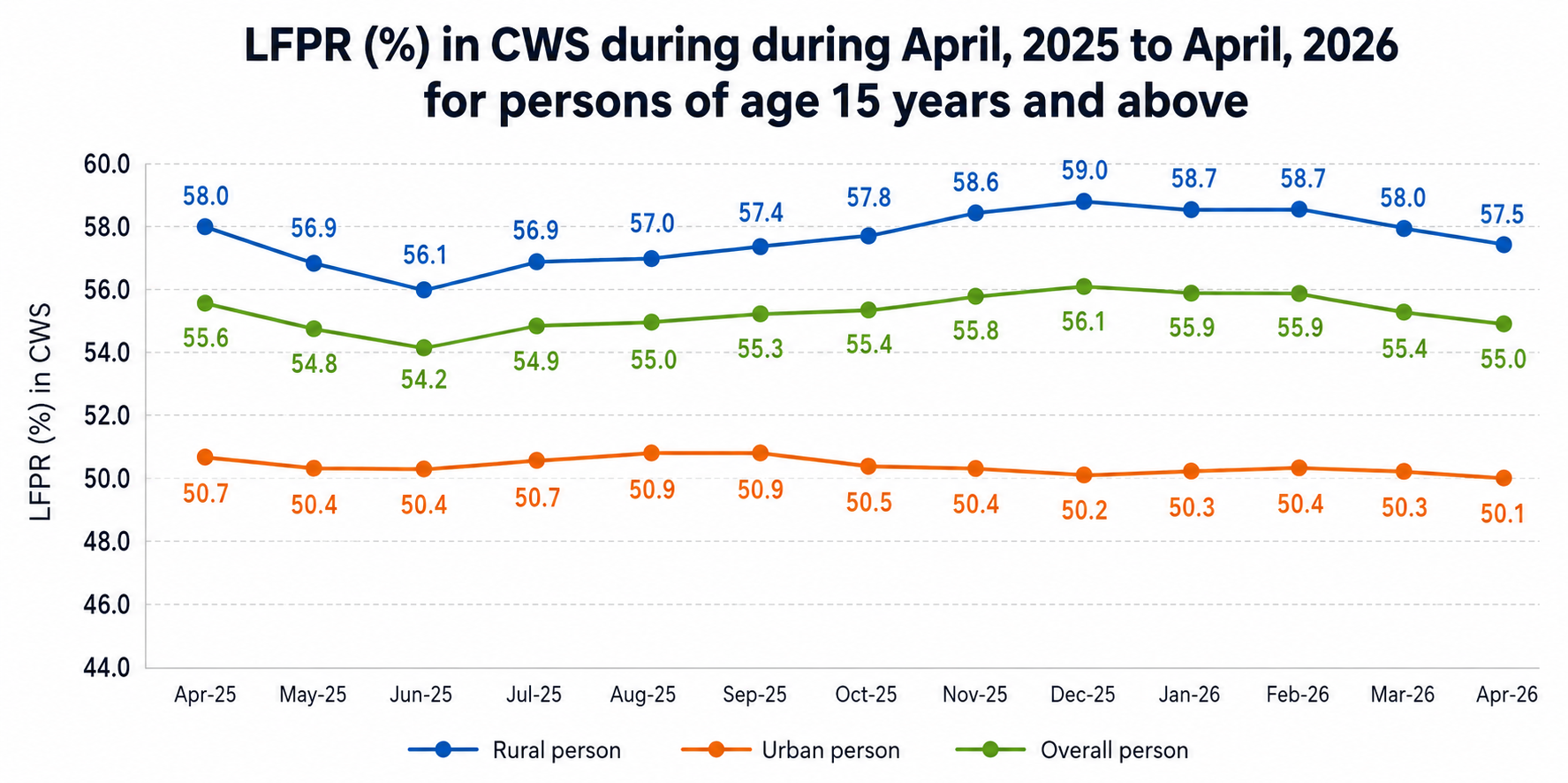
The headline number — the Labour Force Participation Rate for persons aged 15 years and above — slipped marginally to 55% in April from 55.4% in the previous month. Compared to April last year, the decline was sharper at 0.6 percentage points, signalling that fewer Indians are either employed or actively seeking work than a year ago.
The moderation was visible across geographies. Rural participation fell to 57.5%, while urban India recorded a participation rate of 50.1%. Though the decline appears modest on paper, economists often view movement in participation rates as an important indicator of confidence in the labour market. A shrinking labour force can sometimes suggest that discouraged workers are stepping away from job searches altogether.
Women’s participation in the labour market also reflected this gradual cooling trend. Female LFPR fell to 33.9% in April from 34.4% a month earlier. Yet the broader picture remained relatively stable when viewed over a longer horizon. Compared with April 2025, female participation declined only marginally by 0.3 percentage points.
The rural-urban divide among women continued to stand out sharply. Rural female participation remained significantly higher at 38.2%, compared with just 25% in urban areas. Even so, urban women appeared to face greater volatility in employment opportunities, with participation in cities declining by 0.7 percentage points over the year.
Behind these numbers lies a more complex story of changing work patterns. In rural India, women often remain engaged in agriculture, livestock and unpaid family work, activities that are captured within labour force definitions. Urban women, by contrast, continue to confront structural barriers ranging from limited flexible employment opportunities to concerns around safety, mobility and care responsibilities.
The Worker Population Ratio — a direct measure of the share of employed persons in the population — also reflected a mild weakening in labour absorption. At the national level, WPR eased to 52.2% in April 2026 from 52.6% in March and 52.8% a year earlier.
What was significant, however, was the remarkable steadiness of urban employment. Urban WPR remained unchanged at 46.8% for the second consecutive month, reinforcing the impression that city-based labour markets may be finding a firmer footing after several years of post-pandemic adjustment.
Rural India, meanwhile, continued to experience greater fluctuations. Rural WPR slipped to 54.9% from 55.5% in March, suggesting some softening in seasonal or agricultural employment opportunities at the start of the summer period.
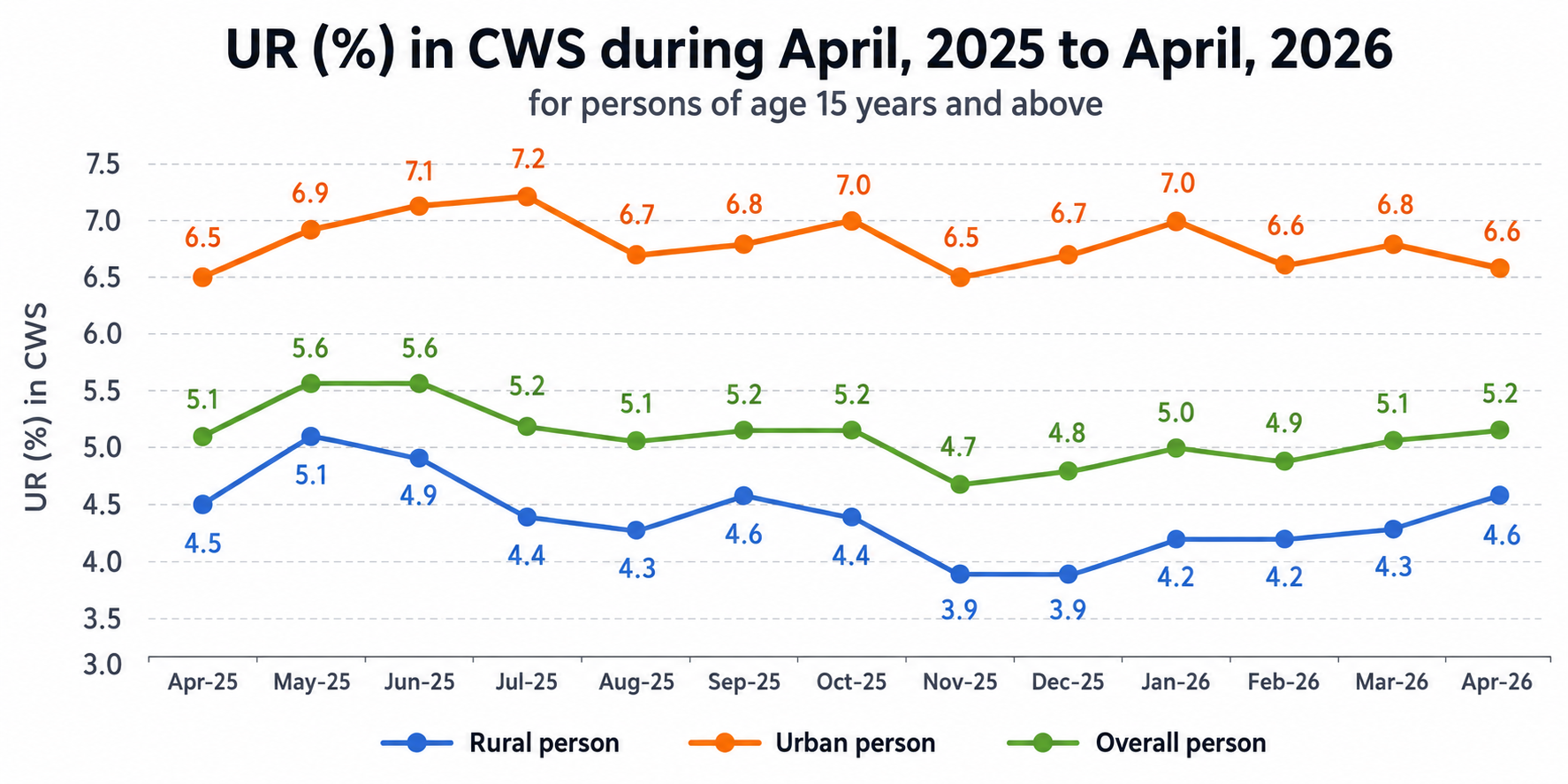
Despite these shifts in participation and employment ratios, unemployment itself remained largely contained. The overall unemployment rate stayed broadly stable at 5.2% in April, compared with 5.1% in both March 2026 and April 2025.
Urban India offered one of the more encouraging signals in the report. Urban unemployment declined marginally to 6.6% from 6.8% in March, indicating that hiring conditions in cities may be stabilising despite slower participation growth.
The improvement was especially visible among women. Urban female unemployment dropped to 8.5% in April from 9% a month earlier, marking its lowest level since April 2025. Although female unemployment remains significantly higher than male unemployment, the decline suggests that women who are actively participating in the urban labour market may be finding jobs more easily than before.
Among men, urban unemployment also eased modestly to 5.9% from 6.1% in March. Rural male unemployment, however, moved higher to 4.7%, underscoring continuing fragility in parts of the countryside.
Economists tracking labour trends are likely to interpret the April numbers as evidence of a labour market that is neither accelerating sharply nor deteriorating meaningfully. The broad stability in unemployment indicates that India’s economy continues to generate work opportunities at a pace sufficient to prevent major labour distress.