


New Delhi: The debate about whether travellers will use and trust AI is effectively over. What remains unresolved is the speed of adoption, and across Asia, the evidence points to acceleration that is faster than many expected.
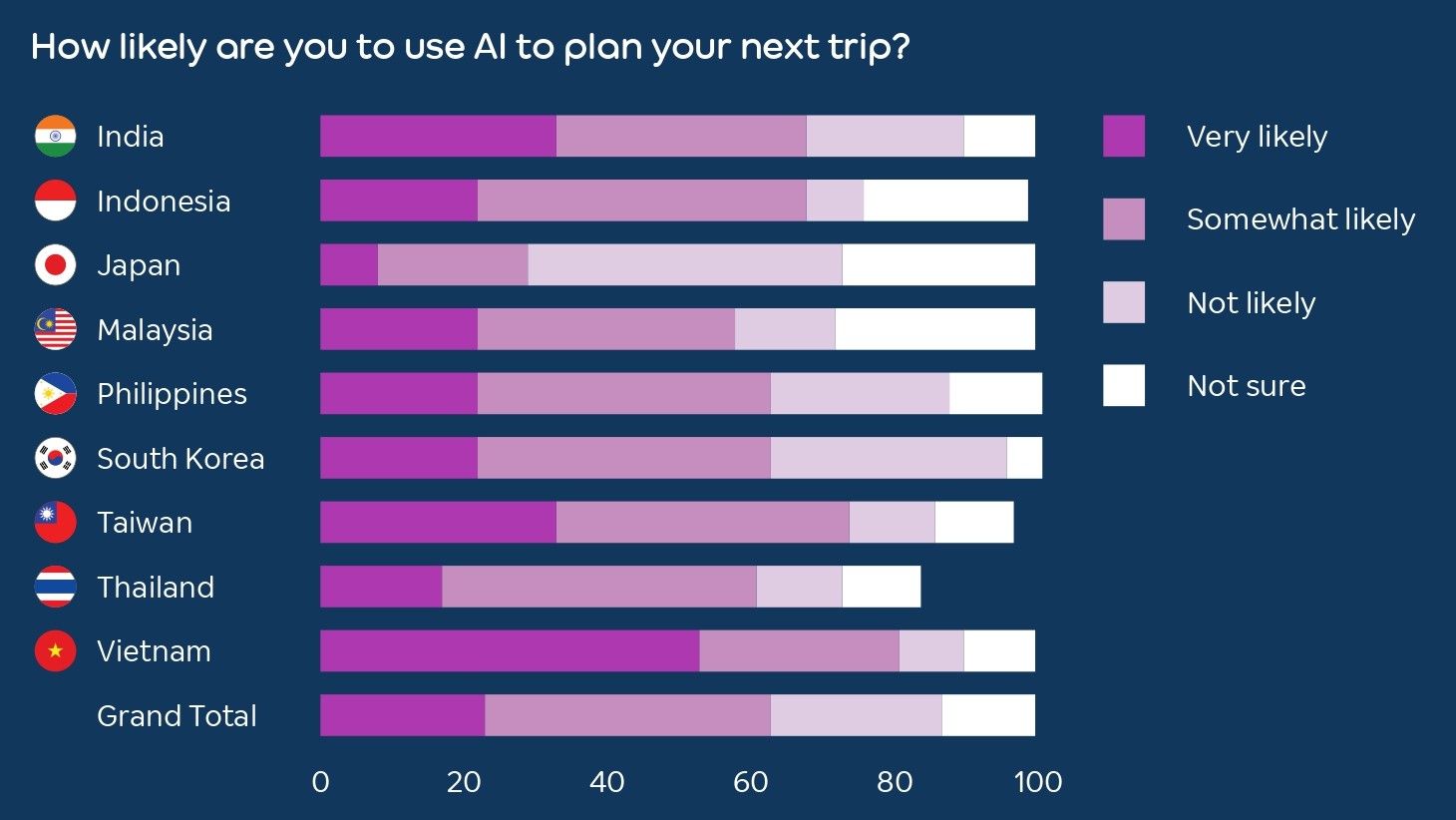
According to Agoda’s 2026 Travel Outlook Report, the latest data compiled by the travel agency shows that 63% of Asian travellers are likely to use AI to plan their next trip, a striking signal that AI-driven travel planning is moving from novelty to norm. Trust, while still developing, is already meaningful: 44% of respondents say they somewhat or completely trust AI-generated information, while another 46% are neutral rather than negative. This combination suggests a large cohort of travellers who are open to persuasion through better performance, accuracy and transparency.
From an India perspective, this momentum aligns with broader digital behaviour patterns. Indian travellers are already accustomed to mobile-first ecosystems, digital payments, and super apps, making them structurally well positioned to adopt AI-assisted travel planning. India also sits at the crossroads of Asia’s travel growth, both as a massive outbound market and a fast-growing domestic one. In such an environment, even incremental gains in AI trust can translate into millions of users engaging with AI-powered tools at scale.
What is driving this enthusiasm is not fascination with technology for its own sake, but the promise of simplicity. Travellers want AI to reduce decision fatigue by cutting through endless options. Agoda’s research shows that the most desired AI use cases are highly practical: 32% of travellers want recommendations for local attractions and activities, 29% want personalized travel itineraries, and 28% want destination suggestions. These figures reflect a desire for contextual intelligence rather than generic advice.
For Indian travellers, who often juggle budget sensitivity, time constraints, and family or group travel needs, this kind of tailored assistance has especially high perceived value.
From Assistant to Agent: Next Phase of AI Maturity
The travel industry is now moving through three distinct stages of AI maturity, with 2026 expected to mark the transition from stage two to stage three. The first stage -- basic personalization -- is already mature. Platforms such as Agoda routinely tailor search results using AI models trained on user preferences, historical behaviour, and contextual signals. This capability is now table stakes across global travel platforms and increasingly expected by Indian consumers accustomed to personalized recommendations in retail, entertainment and finance.
The second stage, where most of the industry operates today, involves gradually adding AI-driven services that go beyond search. AI systems can answer complex questions, translate languages, and recommend activities. ‘Ask Me’ bots are an example of this stage in action. Travellers can ask detailed, practical questions such as whether a hotel’s parking can accommodate a camper van or whether breakfast is included. The bot responds instantly using insights drawn from millions of reviews and structured property data, effectively eliminating hours of manual research. For Indian travellers, who often rely heavily on reviews and peer feedback, this synthesis of large-scale data into immediate answers directly addresses a long-standing pain point.
The most transformative shift, however, lies in stage three: Agentic AI. Unlike today’s assistants that respond only when prompted, Agentic AI systems act autonomously. In a travel context, this means monitoring flights, weather, reservations, and local conditions in real time, then proactively suggesting or even executing changes. If a flight is delayed, the AI could automatically adjust hotel check-in times, move restaurant reservations, and rebook airport transfers. If weather conditions deteriorate, it could reschedule outdoor activities and recommend indoor alternatives. This level of autonomy demands not only advanced intelligence but also deep integration with real-time, verified data sources.
Trust becomes the critical bottleneck at this stage. Autonomous decision-making is only acceptable if outcomes are consistently better than manual planning. For Indian travellers, who often plan complex itineraries involving multiple cities, tight schedules, and cost optimization, the potential upside is enormous, but so is the downside if errors occur. This is why 2026 is shaping up as a proving ground for Agentic AI, testing whether platforms can cross the threshold from helpful to dependable.
Early signs of this future are already visible. Travel agencies are partnering with services such as Alipay+ Voyager, an AI-powered travel companion embedded into digital wallets and super apps used across Asia. These conversational interfaces allow travellers to plan and book trips in their local language, a particularly important factor in India’s linguistically diverse market. The ability to interact naturally, without navigating complex interfaces, lowers friction and accelerates adoption.
Trust, Infrastructure & India’s Pragmatic AI Culture
Despite strong enthusiasm, trust in AI varies widely across Asia. Agoda’s research highlights stark contrasts: 51% of travellers in the Philippines and 44% in Taiwan report high confidence in AI, while only 9% in Japan and 33% in South Korea do the same. These disparities suggest that AI adoption will follow different trajectories across markets, requiring localized strategies rather than uniform rollouts. India, while not explicitly quantified in this traveller trust breakdown, shows strong indirect signals through its developer ecosystem and digital behaviour.
The root of the trust gap is not AI capability but consistency. Agoda’s AI Developer Report, which surveyed developers across Southeast Asia and India, reveals that 95% of developers use AI tools on a weekly basis. This figure underscores how deeply AI is embedded in daily workflows. However, 79% of these developers cite inconsistent output as the biggest barrier to broader adoption. The parallel with traveller behaviour is striking: enthusiasm is high, but reliability must improve before AI can be fully trusted with critical decisions.
In India, this tension is particularly visible. Developers and organizations tend to adopt AI pragmatically, using it to accelerate tasks such as writing, testing, and debugging code, while maintaining human oversight for quality and correctness.
AI has shifted from being a productivity booster to a fundamental part of how developers think and build software. Indian developers, along with their peers in Southeast Asia, exemplify a culture that balances speed with discipline. Gains in efficiency are paired with careful review processes to ensure standards remain high.
This mindset has direct implications for travel platforms. Transparency is emerging as a competitive advantage. AI systems that clearly communicate uncertainty, admit when they do not know something, and escalate to human agents when confidence is low tend to build trust faster than systems that produce confident but incorrect answers. In travel, where a wrong booking time or incorrect policy detail can derail an entire trip, accuracy matters more than raw speed.
Behind the scenes, a massive infrastructure transformation is enabling this AI-driven future. Platforms like Agoda perform up to one trillion price checks per day and analyze around 12 petabytes of data each month. This computational scale allows personalization to move beyond static filters into dynamic, behaviour-driven recommendations. Instead of presenting identical search results to every user, platforms can prioritize options based on budget signals, past travel patterns, and inferred preferences. For Indian travellers, who often seek value optimization rather than luxury alone, this backend intelligence significantly reduces the cognitive load of planning.
Looking ahead, the central challenge for 2026 and beyond is managing risk, particularly the risk of hallucinations. In travel, inaccurate AI outputs can have immediate and costly consequences. The industry’s focus is therefore shifting from experimentation to execution, ensuring that AI systems draw from real-time, verified data and are embedded within robust governance frameworks. India’s developer ecosystem, characterized by high adoption and cautious validation, offers a blueprint for how this balance can be achieved.
AI in travel is entering a practical phase. For India, the convergence of traveller readiness, developer maturity, and scalable infrastructure positions the market as a key driver of Asia’s AI-powered travel future. Success will depend not on how advanced AI becomes in theory, but on how reliably it simplifies choices, manages complexity, and earns trust at every step of the traveller journey.