


New Delhi: India’s job market is entering a more selective, skills-driven wage cycle, with salary growth increasingly tied to specialized capabilities rather than broad-based hiring momentum, according to the Adecco India 2026 Salary Guide.
Based on a survey conducted in late 2025 across sectors including banking, ITeS, consulting, engineering, electric vehicles (EV), FMCG, healthcare, AI and digital technology, manufacturing, finance, legal, procurement and sales, the report captures a labour market transitioning from post-pandemic salary inflation to calibrated, performance-linked pay growth.
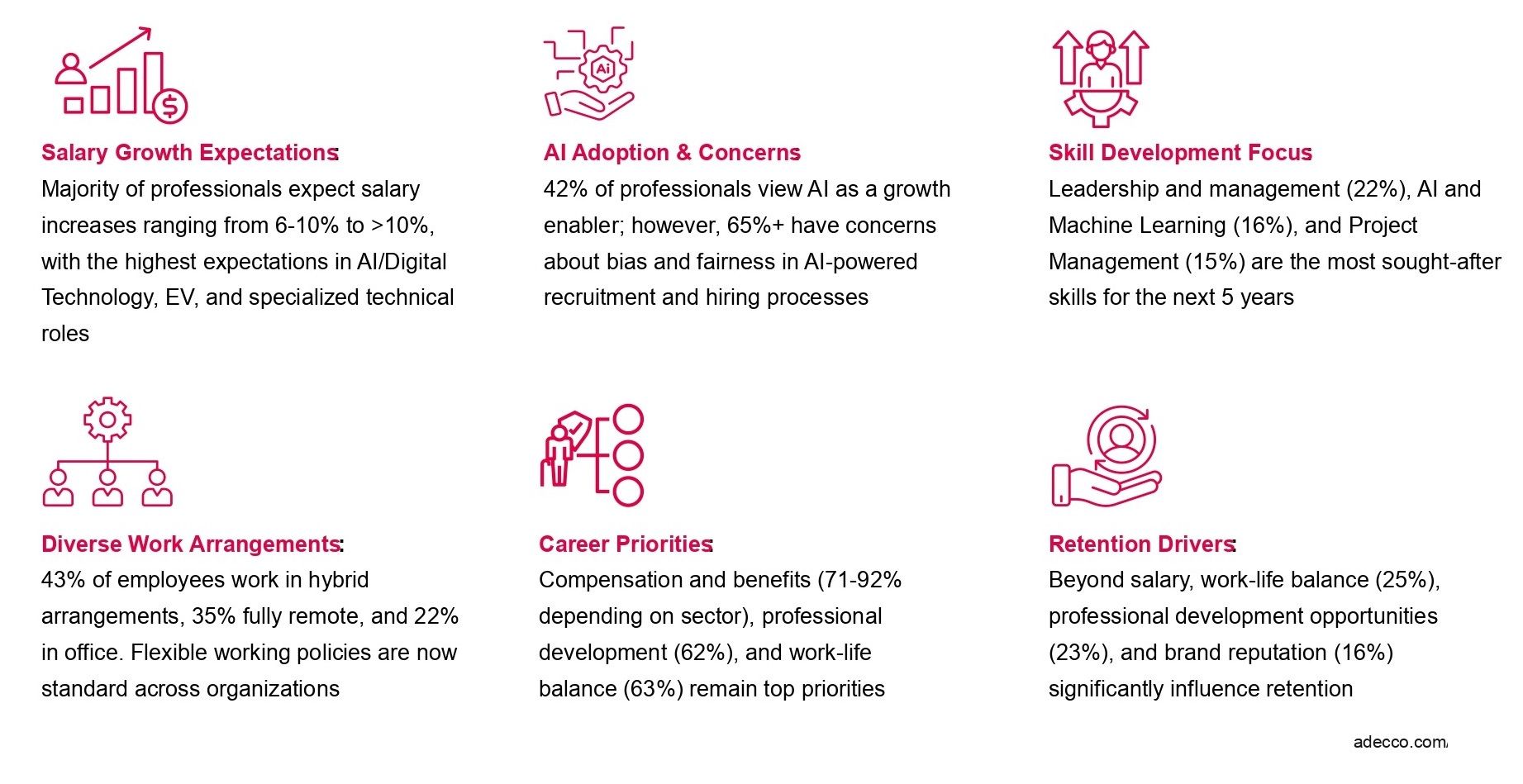
Salary increments in 2026 are expected to average between 6% and 10% across most sectors, reflecting moderation after the aggressive hiring rebound of recent years. However, high-impact domains such as AI and digital technology are projected to see increases of 12-15%, while the EV sector leads with anticipated hikes of 15-20%. Healthcare and life sciences, as well as global capability centres, are expected to record 10-12% growth. Traditional functions such as banking, consulting, FMCG, finance and accounting are forecast to see 8-10% increases, while human resources, ITeS and core IT roles may see 7-9%.
Talent Mobility
The report notes that 42% of professionals are actively seeking new jobs and another 47% are open to opportunities, underlining persistent talent mobility despite macroeconomic caution. At the same time, employers report acute shortages of niche skilled professionals, difficulties in hiring management-level candidates and pressure from high salary expectations.
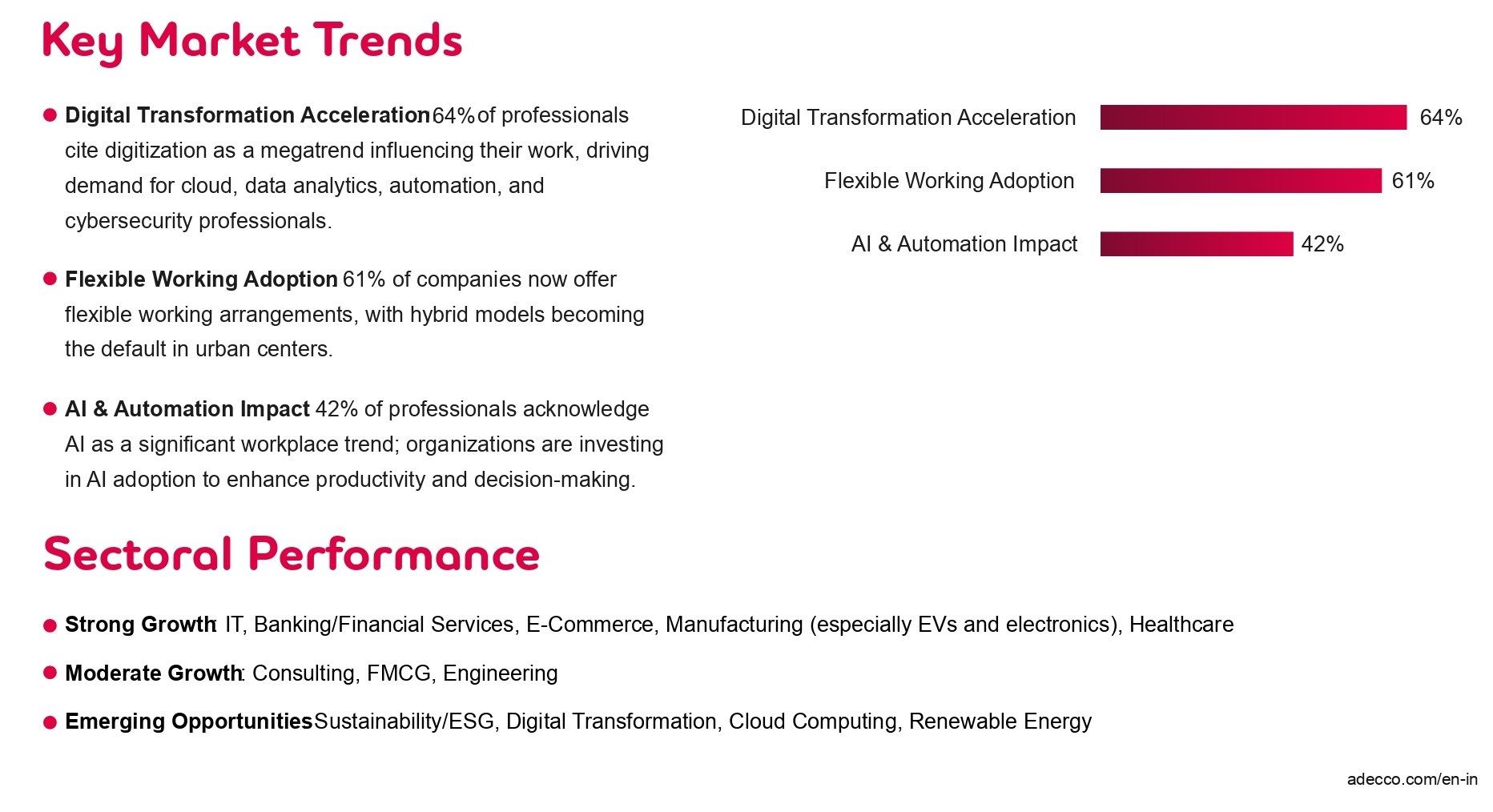
Adecco India Country Manager Sunil C says, the employment landscape is undergoing a decisive shift towards precision hiring as digital transformation and automation reshape workforce requirements. He indicated that while overall increments remain moderate, professionals with expertise in generative AI, data science, cloud computing, cybersecurity, blockchain, 5G, Internet of Things, quantum computing and augmented reality are likely to command premium pay over the next three to five years.
“As we look ahead to 2026, three key themes emerge: Continued importance of competitive salaries paired with non-monetary benefits; Critical need for skills development and upskilling programs; Imperative to create inclusive, purpose-driven workplaces that appeal to a multi-generational workforce,” he says.
The data suggest that organisations are building leaner, high-performance teams rather than expanding headcount aggressively. Variable pay, retention bonuses and performance-linked incentives are increasingly replacing uniform annual hikes, with compensation more closely aligned to measurable business outcomes, innovation and risk management. Senior leadership packages are also being tied to long-term value creation, sustainability goals and governance benchmarks.
Widening Pay Dispersion
Sectoral benchmarks illustrate the widening pay dispersion. In EV, battery technology specialists with 10-15 years’ experience can earn ₹45-65 lakh annually. In healthcare and life sciences, quality managers with over 15 years’ experience command ₹50-70 lakh. Supply chain managers with 10-15 years’ experience earn ₹55-80 lakh, while talent acquisition managers in the 7-10 year bracket receive ₹30-45 lakh. Pay packages of national heads and business heads with 15+ years’ experience can reach ₹1-1.5 crore.
Entry-level software engineers earn ₹6-12 lakh, while relationship managers in banking with 3-7 years’ experience earn ₹5-8 lakh. At the upper end, CFO compensation ranges between ₹2-5 crore, reflecting the premium placed on strategic financial leadership.
Geographically, metros such as Bengaluru, Mumbai, Delhi-NCR and Hyderabad continue to command 10-20% salary premiums. However, the guide observes that tier-two cities are gradually narrowing the compensation gap in high-skill domains as hybrid and remote models mature.
Currently, 43% of employees work in hybrid arrangements, 35% are fully remote and only 22% are entirely office-based, making flexibility a standard rather than a perk.
Beyond pay, retention dynamics are evolving. While 71-92% of employees rank compensation and benefits as key drivers, 25% cite work-life balance as the primary non-monetary factor, followed by professional development at 23%, brand reputation at 16%, company culture at 14% and comprehensive benefits at 13%.
Employers appear to be responding: 23% of organizations emphasize personalized career development plans and 19% prioritize technical upskilling, though structured mentorship remains underutilized at 10%.
The AI Factor
AI is both an opportunity and a concern. Around 42% of professionals see AI as a growth enabler, and 15-20% of organizations are extensively integrating it into recruitment and operations. Yet more than 65% express concerns about bias, fairness, job security and the erosion of human interaction in hiring. Although 30-40% of companies report implementing bias audits and human oversight mechanisms, the report indicates that many still lack robust frameworks for ethical AI deployment.
Diversity, equity and inclusion initiatives are gaining traction, with 46% of organizations prioritizing flexible work policies, 39% conducting pay equity reviews and 38% running diversity training programmes. Younger cohorts, particularly Gen Z and Millennials, are exerting greater influence on workplace culture and transparency expectations.
The report concludes that broader macroeconomic backdrop of global growth uncertainty, geopolitical tensions and cautious capital flows is shaping corporate behaviour. Salary budgets are being deployed strategically toward roles that directly contribute to revenue generation, digital capability and compliance. The report warns that while this selective wage cycle may improve productivity metrics, it could widen income disparities between high-skill and lower-skill segments of the workforce.
Adecco India’s 2026 salary outlook signals stabilization rather than stagnation. Compensation growth continues, but in a disciplined, performance-oriented format. For employers, the message is to align pay with future-ready capabilities and inclusive workplace practices. For professionals, continuous learning, digital fluency and demonstrable impact are emerging as the primary determinants of salary progression in India’s next phase of economic expansion.
(Cover photo by litoon dev on Unsplash)