


New Delhi: The recent alleged suicide of three teenage sisters in Ghaziabad, reportedly following restrictions on their consumption of online games and Korean dramas, has once again drawn urgent attention to the fragile relationship between young minds and digital ecosystems. While the incident is under investigation, it highlights a broader and deeply troubling pattern: Indian children and adolescents are increasingly vulnerable to the psychological, social and criminal risks associated with unregulated online exposure.
Over the past year, multiple reported cases across India have revealed how minors are being lured, exploited and abused through social media platforms, gaming applications and messaging services. From sexual assault cases initiated through online gaming platforms to organized abuse facilitated through messaging apps and social networks, the digital space has become a high-risk environment for children. Law enforcement agencies across the country have registered hundreds of FIRs in 2025 alone related to child pornography and digital sexual exploitation, often triggered by international alerts.
Against this backdrop, LocalCircles, on the occasion of Safer Internet Day on February 10, released one of the largest urban parent surveys in India to understand the scale and nature of children’s exposure to online harms. The findings provide a sobering, data-driven picture of systemic vulnerabilities.
The LocalCircles study received over 89,000 responses from urban Indian parents of children aged 9-17 across 302 districts. The scale, diversity and geographic spread of the survey lend significant credibility to the findings. Importantly, the study captures parental perceptions and lived experiences, which are often underrepresented in formal crime statistics and regulatory reports.
Exposure to Inappropriate Content, Bullying
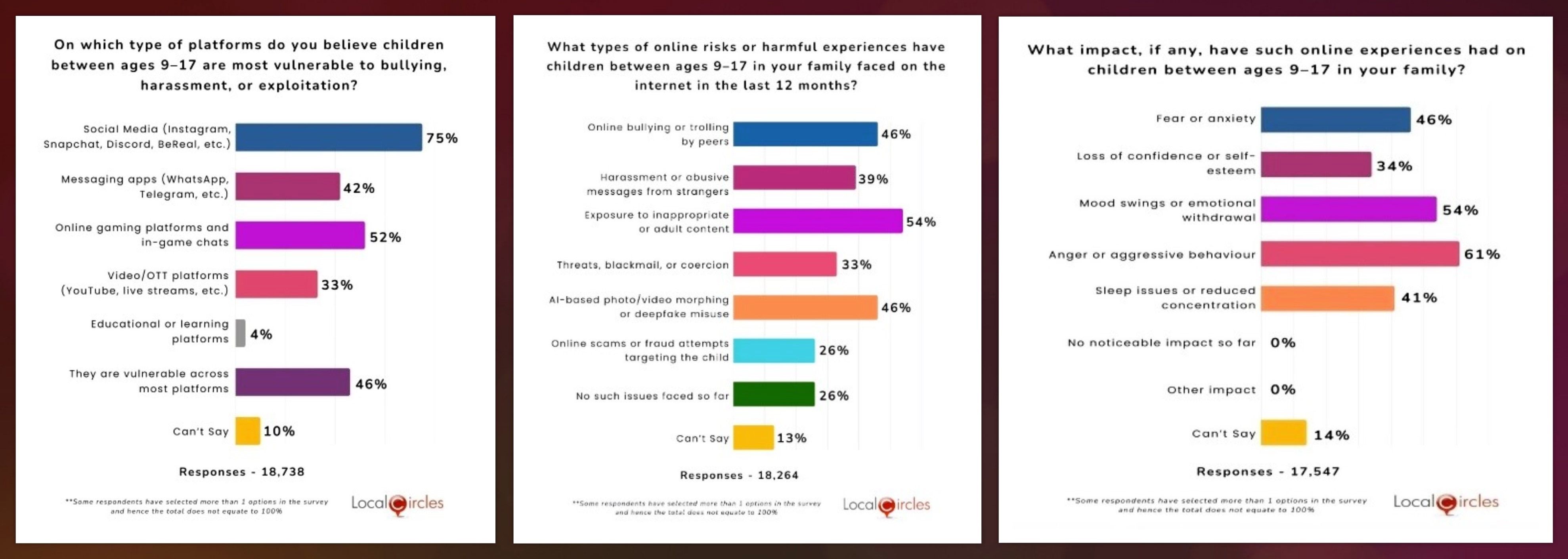
One of the most alarming findings of the LocalCircles survey is that 54% of these parents reported that their children had been exposed to inappropriate or adult content in the past 12 months. This indicates that more than half of urban Indian children in this age group are encountering content beyond their emotional and developmental readiness.
Equally concerning is that 46% of parents reported that their children had faced online bullying or trolling. The digital ecosystem — designed to maximize engagement — has simultaneously become a space where peer harassment, public shaming and sustained psychological pressure are normalized.
The LocalCircles data further reveals layered vulnerabilities. Parents reported exposure to AI-based photo and video morphing or deepfake misuse at 46%, harassment or abusive messages from strangers at 39%, and threats, blackmail or coercion at 33%. These are not isolated incidents; they reflect structural weaknesses in platform governance and age-verification mechanisms.
Only 26% of respondents said their children had faced no such issues, suggesting that digital harm is now a mainstream experience rather than an exception.
The vulnerability of children is amplified by their unsupervised digital access. Whether for study, entertainment or social interaction, children often navigate complex and potentially predatory environments without adequate safeguards or digital literacy skills.
Social Media -- Primary Risk Zone
When LocalCircles asked parents which platforms posed the greatest vulnerability, 75% identified social media platforms such as Instagram, Snapchat, Discord and BeReal as the highest-risk environments for bullying, harassment or exploitation.
Online gaming platforms followed closely at 52%, reflecting the increasing overlap between gaming and social networking features such as chat rooms, voice interaction and anonymous messaging. Messaging apps like WhatsApp and Telegram were identified by 42% of respondents as high-risk spaces.
These findings are significant because they point to environments where children spend the most time. The platforms most integral to teenage identity formation and peer validation are simultaneously the platforms where they are most exposed to harm.
LocalCircles’ data underscores that vulnerability is not confined to one digital category; rather, children are navigating a cross-platform ecosystem where exploitation can begin on one platform and escalate on another.
Psychological & Behavioural Impact
Perhaps the most disturbing insight from the LocalCircles survey relates to the emotional and behavioural consequences of online harm.
Among parents whose children had faced bullying, harassment or harmful experiences, 61% reported anger or aggressive behaviour. 54% observed mood swings or emotional withdrawal. 46% reported fear or anxiety, and 41% noted sleep issues or reduced concentration. A further 34% reported loss of confidence or self-esteem.
These numbers suggest that digital harm is not episodic; it has sustained psychological repercussions. The data aligns with broader national and global studies linking excessive screen time and online harassment to anxiety disorders, attention deficits and behavioural dysregulation among adolescents.
Children between 9 and 17 are in critical stages of cognitive, emotional and social development. Exposure to humiliation, coercion, sexualized content or digital manipulation during this formative phase can alter self-perception, trust patterns and resilience.
LocalCircles’ findings indicate that one in two parents whose child experienced online bullying or harassment observed serious emotional distress. This is not merely a technological issue; it is a public health concern.
Reporting Mechanisms: System Parents Don’t Trust
Despite the operationalization of the Digital Personal Data Protection Act, 2023, and the introduction of the DPDP Rules, 2025, which mandate verifiable parental consent for minors’ data processing, LocalCircles found overwhelming dissatisfaction with complaint redressal mechanisms.
A striking 82% of parents said reporting online bullying, harassment or harmful content involving children in India is difficult, slow, unclear or that they are unaware of any clear reporting mechanism. Only 8% described reporting as very easy and effective.
This perception gap is critical. Regulatory frameworks may exist on paper, but if parents perceive enforcement as inaccessible or ineffective, underreporting will continue. Many children, moreover, do not confide in parents when facing online threats, compounding the reporting deficit.
LocalCircles’ findings suggest that regulatory reform without operational clarity and public awareness risks becoming symbolic rather than protective.
Demand for Structural Reform
The survey also explored what parents believe should be prioritized to ensure faster and more effective complaint redressal. Over 75% of respondents called for time-bound mandatory responses from platforms on child safety complaints; 78% demanded stronger penalties for platforms ignoring child safety issues.
There was also strong support for a single national helpline or portal for child online safety complaints and for dedicated child safety units within cyber police cells. The demand for mandatory human review, rather than AI-only moderation, reflects parental skepticism about automated systems’ ability to understand context and nuance in child safety cases.
LocalCircles’ data indicates that parents are not merely alarmed; they are proposing actionable reforms centered on accountability, responsiveness and institutional clarity.
The Government of India’s DPDP Rules, 2025 require verifiable parental consent for children under 18 to access services processing personal data. Several states, including Andhra Pradesh and Goa, are studying Australia-style bans on social media use for children under 16.
While age-based restrictions may reduce exposure, enforcement complexities remain unresolved, particularly regarding existing accounts with misrepresented ages.
The Economic Survey 2025-26 has also identified digital addiction among youth as a major concern, recommending age-based regulation and digital literacy campaigns.
The LocalCircles survey reinforces that regulation alone is insufficient. Parents consistently emphasize the need for awareness, digital literacy, real-time responsiveness and coordinated multi-agency action.
Urgent Action Needed
The vulnerability of children in India’s rapidly expanding digital landscape is no longer a marginal issue. It is systemic. While regulatory initiatives such as the DPDP Rules represent important steps, the LocalCircles findings suggest that effective child protection will require stronger enforcement, clearer reporting channels, faster platform accountability, digital literacy initiatives and sustained parental engagement.
As India marked the Safer Internet Day, the LocalCircles study serves as both evidence and warning. The digital world offers unprecedented opportunity, but without urgent structural reform and coordinated vigilance, it also exposes children to escalating risks.
Protecting young users must move from policy intent to operational urgency. The vulnerability of children cannot be treated as collateral damage of digital growth.
(Cover photo by Thomas Park on Unsplash)