

New Delhi: Economic inequality is no longer just a debate about wealth gaps and taxation. In the world’s richest countries, it is increasingly shaping how children eat, learn, socialise, dream and survive.
A major new analysis by Unicef’s office of strategy and evidence, Innocenti, has found that children growing up in unequal societies face worse physical health, weaker academic outcomes, lower life satisfaction and deeper social disadvantages — even in nations with vast economic resources.
Unicef’s Report Card 20: Unequal Chances – Children and Economic Inequality examined 44 OECD and high-income countries and paints a stark portrait of modern childhood in affluent societies. Across these countries, households in the top 20% of earners take home more than five times the income of households in the bottom 20%, while nearly one in five children continues to live in income poverty.
“Inequality profoundly affects how children learn, what they eat, and how they feel about life,” said Bo Viktor Nylund. “To limit the worst impacts of inequality, we need urgently to invest more in the health, nutrition and education of children in the most deprived communities.”
Hidden Childhood Divide
The findings dismantle the assumption that prosperity automatically protects children. Instead, the report argues that widening economic divides are quietly reshaping childhood itself.
Children growing up in the most unequal countries are 1.7 times more likely to be overweight than those in the most equal nations, reflecting poorer diets, food insecurity and limited access to healthier lifestyles. The five countries with the highest inequality levels also record child mortality rates that are, on average, 2.4 times higher than those in the five most equal countries.
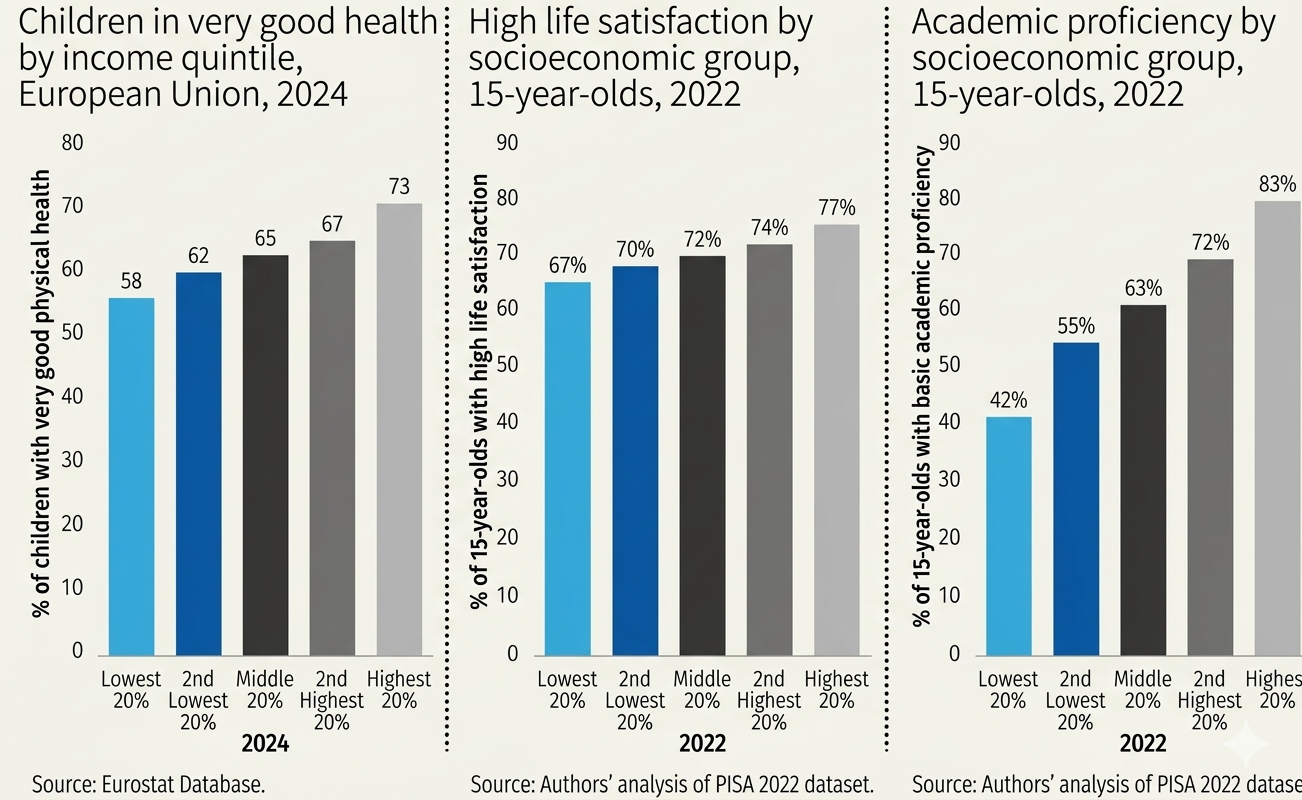
The disparities are visible even within the European Union. Only 58% of children from families in the bottom fifth of earners are reported to be in very good health, compared with 73% among the top fifth.
The report also traces how disadvantage compounds over time. Children raised in low-income households during their first five years were found to suffer poorer health later in childhood and adolescence, including higher rates of infections, obesity, hospitalisation and chronic illness.
The crisis extends beyond physical health. Unicef’s analysis found consistent links between inequality and children’s mental wellbeing. Across wealthy countries, 77% of children from the most advantaged families reported high life satisfaction, compared with just 67% among the most disadvantaged.
The report warns that economic stress seeps into every layer of a child’s life — from housing conditions and neighbourhood safety to family relationships and school experiences. In the European Union, almost one in seven children lives in material and social deprivation, lacking essentials ranging from adequate clothing to opportunities for leisure and celebration.
Classroom Lines Harden
Food insecurity has emerged as another defining feature of childhood inequality. According to PISA 2022 data cited in the report, one in 11 children across surveyed countries admitted they had skipped meals in the previous month because there was not enough money for food.
Housing conditions reveal similarly disturbing divides. Children in poorer households are far more likely to live in overcrowded homes plagued by damp, mould and poor heating — conditions strongly linked to worse physical and developmental outcomes. In 2023, 27% of children below the poverty threshold in the European Union lived in homes with leaking roofs, damp walls or rotting floors.
Education, however, remains the report’s most alarming battleground.
Countries with wider income gaps consistently recorded lower academic performance among children. On average, children from wealthier families were almost twice as likely to achieve basic proficiency in reading and mathematics by age 15 than those from poorer families — 83% compared with 42%.
The divide is replicated within schools themselves. Countries with greater socioeconomic segregation between schools also recorded lower academic proficiency and wider achievement gaps. Nations such as Norway, Iceland and Finland displayed lower levels of school segregation, while Colombia, Hungary and Slovakia ranked among the highest.
Everyday Routines Affected
The report also reveals how inequality changes children’s everyday routines. Children from disadvantaged households were less likely to eat breakfast daily, consume fruit and vegetables or exercise regularly, while being more likely to consume sugary drinks.
At the same time, poorer children were more likely to engage in paid work before or after school. Around 32% of children from the most disadvantaged households reported working for pay, compared with 26% among the wealthiest groups. Those working were also less likely to complete homework and less likely to achieve academic proficiency.
Perhaps the report’s most striking dimension is its inclusion of children’s own voices — the first time the UNICEF Report Card series has directly incorporated testimony from people under 18. Focus groups conducted between October 2025 and January 2026 across Chile, Colombia, Ireland, Italy, Spain and Switzerland revealed children possessed a sharp awareness of inequality and discrimination.
“If you’re poor and your friends invite you out, you might get left out if you don’t have any money to go with them” -- Child in Colombia
“There are schools that when a girl is Roma, as they are accustomed that [sic] Roma girls don’t study, they place them in support classes even if they get good grade” -- Child in Spain
“Give children the right to vote and more money for social aid for children” -- Child in Switzerland
The testimonies reveal that children understand inequality not only as a matter of money, but also through race, gender, disability, migration status and social exclusion. One child in Chile described inequality as rooted in systems that “privilege certain groups while marginalizing others”.
The report argues that inequality functions through two powerful mechanisms: deprivation and stress. Poorer children often grow up with fewer resources, weaker public services and harsher neighbourhood environments, while families living under economic pressure face higher stress levels that can damage relationships and emotional wellbeing.
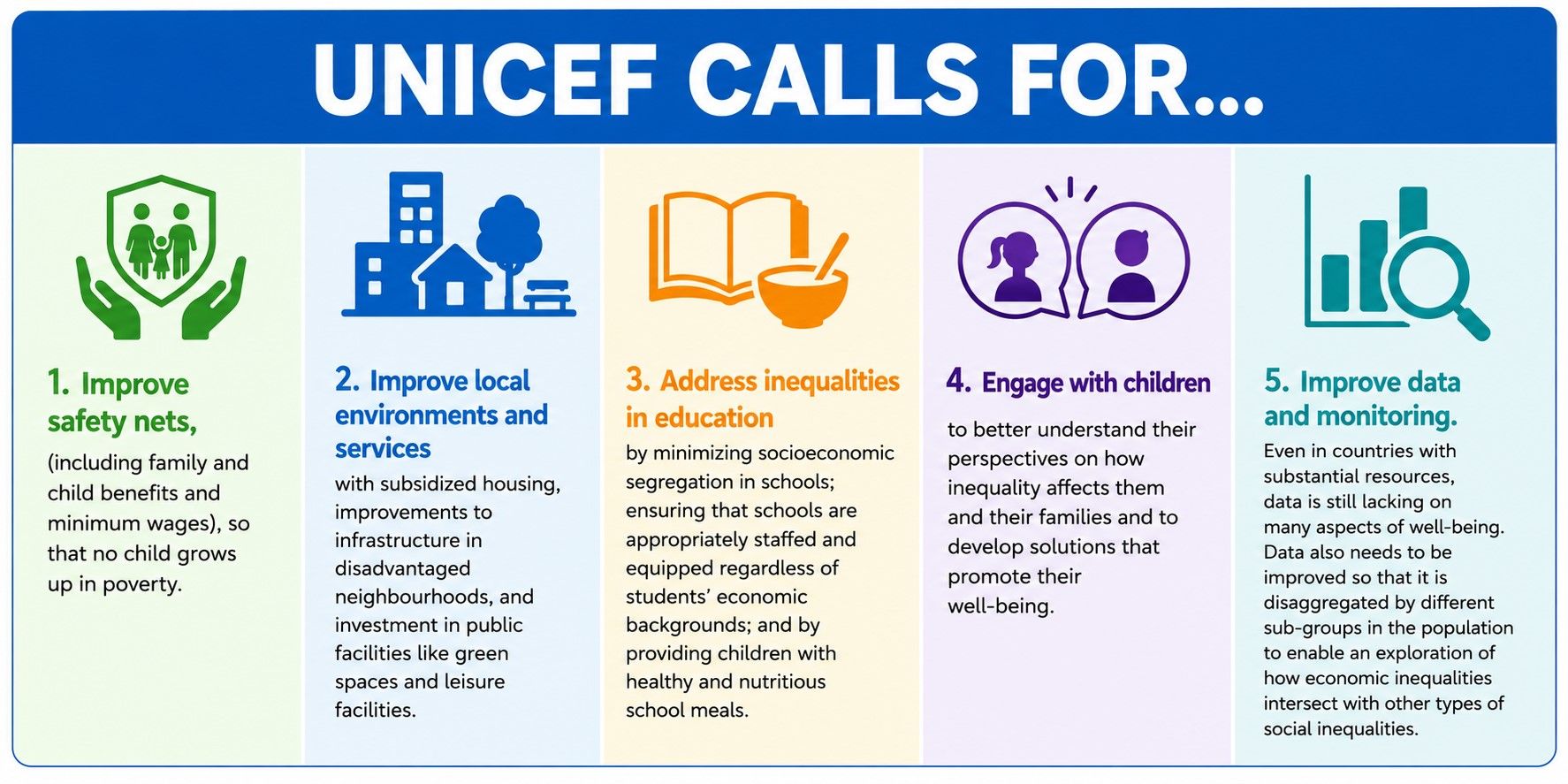
Unicef is urging governments to respond through stronger social safety nets, higher family and child benefits, better housing support, reduced school segregation and expanded investment in public spaces and child nutrition programmes.
The organisation also calls for policymakers to involve children directly in shaping anti-poverty policies — a recognition that those living through inequality may understand its realities better than the institutions attempting to solve it.
Behind the statistics lies a broader warning. Wealth alone does not guarantee healthy childhoods. In many of the world’s richest nations, prosperity is becoming increasingly unevenly distributed, and children are paying the price first.
(Cover: Original cover photo by Beth Macdonald on Unsplash)