

New Delhi: India’s automotive market is entering a decisive software moment. Even as the country notched record passenger vehicle sales in 2025, the more profound transformation is unfolding beneath the surface: cars are increasingly being evaluated not just as mechanical products, but as upgradable digital platforms.
The Deloitte 2026 Global Automotive Consumer Study underscores this shift with a striking data point — 95% of Indian consumers say they would be willing to pay for software-defined vehicle (SDV) features. That level of openness signals a powerful demand for connected, intelligent, and continuously evolving cars, positioning India at the forefront of the software-led mobility transition.
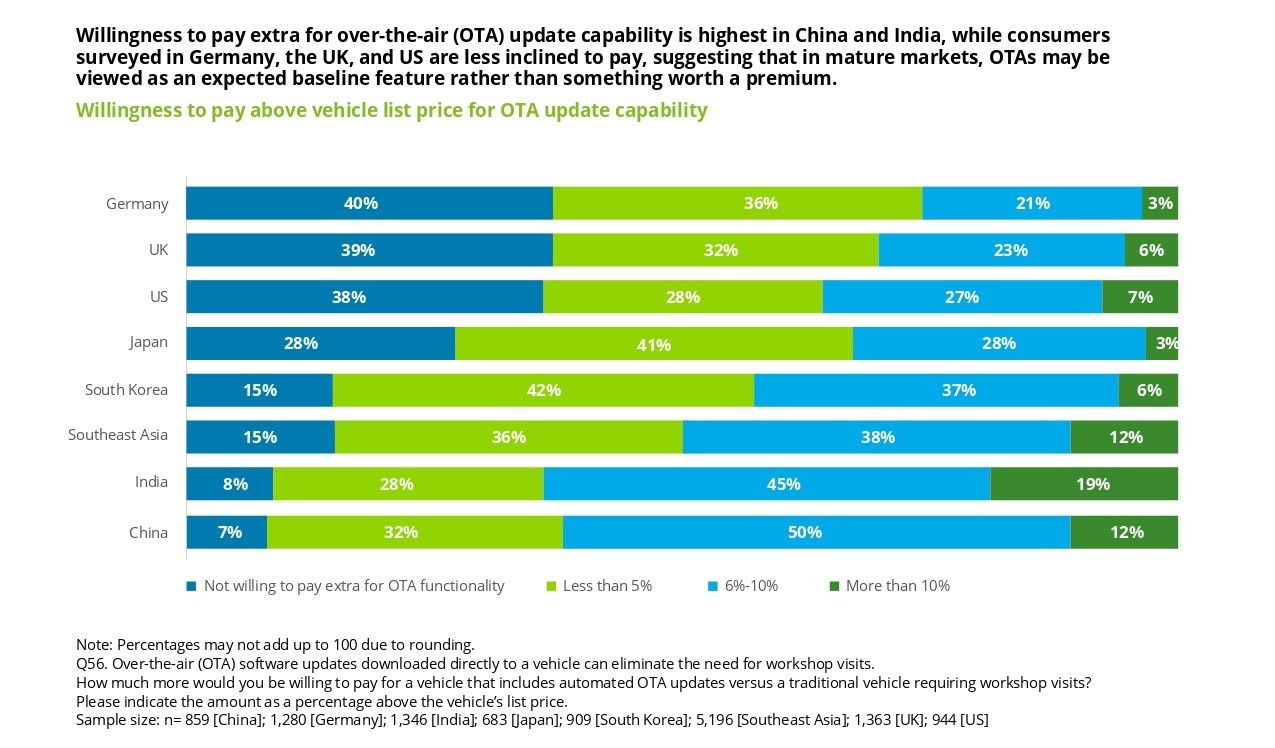
This willingness to invest in SDV capabilities reflects how rapidly Indian buyers are embracing digital ecosystems in everyday life. Smartphones, UPI payments, and app-based services have conditioned consumers to expect seamless updates, personalization, and constant improvement. Increasingly, they expect the same from their vehicles. In the study, many consumers across markets expressed interest in over-the-air (OTA) updates that can add new features, enhance safety, or improve performance over time. In India, that receptivity is particularly strong, with buyers seeing software not as an add-on but as integral to long-term value.
Globally, consumers are also warming to the concept of software-defined vehicles, but India’s 95% willingness-to-pay figure stands out for its intensity. Across North America, Europe, and parts of Asia, interest in SDVs is growing steadily, especially when updates promise tangible benefits such as advanced driver assistance improvements or energy-efficiency gains. However, cost sensitivity and data privacy concerns temper enthusiasm in some mature markets. In contrast, India’s consumers appear more optimistic about the benefits of integrated digital services, viewing SDVs as a natural evolution of the connected lifestyle they already inhabit.
This appetite for software is emerging even as electrification trends remain nuanced. Internal combustion engine vehicles continue to dominate Indian purchase intentions, with hybrids ranking as the preferred transition technology. Interest in battery electric vehicles (BEVs) is visible but steady rather than accelerating sharply. Globally, too, BEV demand is uneven. In markets such as China and parts of Europe, adoption momentum remains strong, while in others affordability concerns, charging infrastructure gaps, and range anxiety continue to influence decisions. Hybrids are gaining traction worldwide as consumers balance practicality with environmental aspirations.
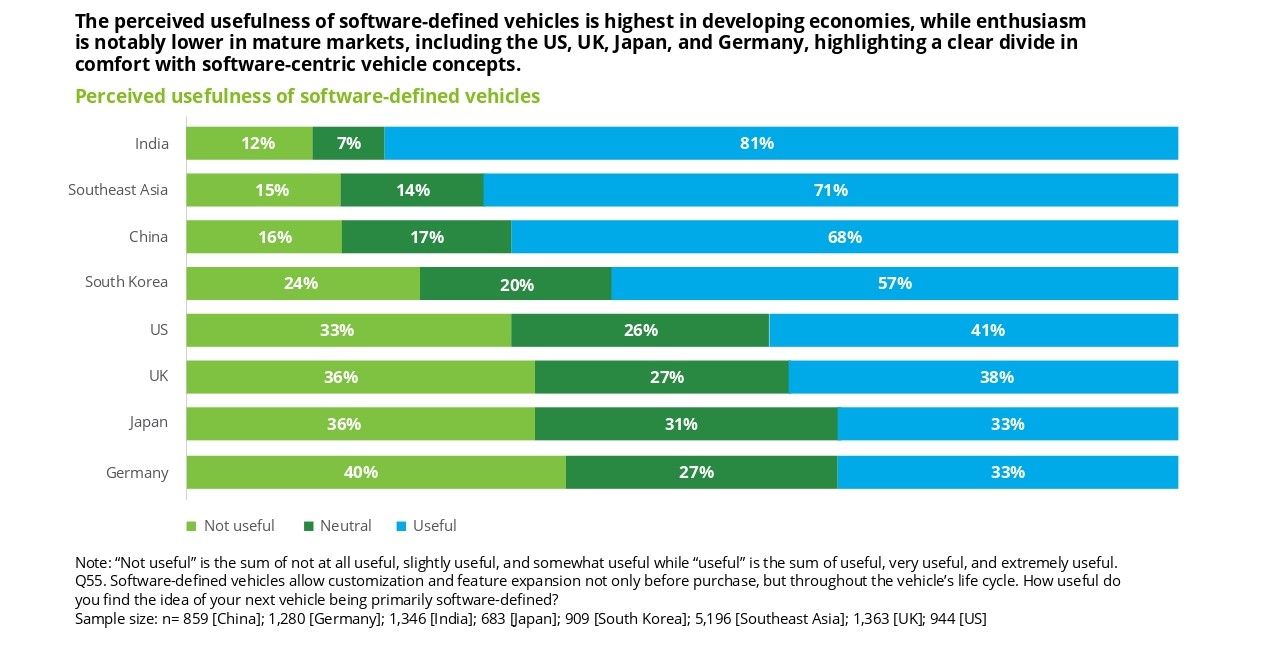
Yet the SDV story cuts across powertrain choices. Whether a vehicle runs on petrol, diesel, hybrid, or battery electric technology, software now shapes the ownership experience. Consumers in India and elsewhere are increasingly drawn to AI-driven personalization that adapts seating positions, infotainment settings, and driving modes automatically. They value OTA updates that extend a vehicle’s relevance and reduce the need for physical upgrades. A significant share indicate they would keep their vehicles longer if software improvements continued throughout ownership. For automakers, this signals not only a pathway to deeper loyalty but also a recurring revenue stream built on digital services.
Connectivity preferences reveal further alignment between India and global markets. Safety and security features consistently outrank entertainment or convenience add-ons. Indian consumers show the strongest willingness to pay for emergency assistance, anti-theft tracking, and automatic vehicle and pedestrian detection. Globally, similar patterns emerge. Connected technologies that demonstrably enhance safety generate far greater acceptance than purely lifestyle-oriented features. At the same time, concerns about data sharing remain elevated across regions, underscoring the need for transparent data governance frameworks.
The rise of SDVs also intersects with shifting brand dynamics. In markets such as Japan, brand loyalty remains strong. However, in India, China, and Southeast Asia, switching intent is significantly higher, partly due to a growing base of first-time buyers and a rapidly expanding array of choices. As consumers become more open to changing brands, product quality, performance, and digital sophistication gain prominence. Software capability increasingly becomes a differentiator, not merely a supplementary feature. Automakers that can demonstrate a robust digital ecosystem — frequent updates, intuitive interfaces, reliable connectivity — may secure competitive advantage in these high-switching markets.
Purchasing behaviour continues to blend digital and physical touchpoints. Dealer visits and manufacturer websites remain primary research sources in India and globally. Consumers still value physically experiencing a vehicle before buying, and getting a good deal with transparent pricing remains central to decision-making. Notably, over three quarters of Indian customers intend to spend under Rs 25 lakh on their next vehicle, reinforcing the country’s value-driven orientation. Even within these price sensitivities, however, digital features hold appeal. The readiness of 95% of consumers to pay for SDV functionalities suggests that buyers perceive software as enhancing value rather than inflating cost.
Service and aftersales dynamics further highlight the importance of trust and transparency. Across markets, authorized dealers remain the most common service destination, though independent workshops maintain a strong presence. Consumers prioritize quality of work, clear explanations of pricing, and confidence in the provider. As vehicles become more software-intensive, service ecosystems will need to adapt. OTA updates can reduce some maintenance needs, but they also require robust digital infrastructure and cybersecurity safeguards. Automakers that integrate software support seamlessly into the ownership journey may reinforce customer trust and retention.
Electrification and software are also converging in new ways. Lower fuel costs motivate many consumers to consider electrified options, yet concerns around driving range, charging time, public-charging availability, and battery performance persist globally. Most EV intenders prefer home charging, and cost remains a decisive factor in public charging usage. Additionally, uncertainty around responsibility for end-of-life battery management signals ecosystem gaps that policymakers and industry players must address. SDVs can play a role here by optimizing battery performance, providing predictive maintenance alerts, and enhancing energy efficiency through intelligent software controls.
India’s position in this landscape is distinctive. The domestic market is both cost-conscious and innovation-ready. While ICE vehicles remain dominant, buyers are not resistant to change; rather, they are pragmatic. Hybrids appeal as transitional solutions, and software features that deliver tangible safety or convenience benefits find receptive audiences. The high willingness to pay for SDV features indicates that Indian consumers are not merely adopting technology passively but are actively valuing it.
For original equipment manufacturers, the implications are profound. Vehicles are evolving from static products into dynamic platforms capable of continuous enhancement. Revenue models may shift from one-time hardware margins to lifecycle software subscriptions and feature unlocks. Competitive differentiation will hinge on the ability to deliver reliable connectivity, intuitive user interfaces, strong cybersecurity protections, and transparent data policies. In markets with high brand switching intent, software quality could be decisive in winning or losing customers.
The coming year is likely to see accelerated investment in AI-driven personalization, advanced driver assistance systems, and integrated digital ecosystems. As consumers worldwide grow more accustomed to technology that adapts and improves over time, expectations for vehicles will rise accordingly. India’s 95% willingness to pay for SDV features stands as a powerful indicator of where demand is headed.
The automotive industry’s next chapter will not be defined solely by engines or batteries, but by code. In India and beyond, software is becoming the connective tissue that binds safety, performance, personalization, and profitability. For an industry long rooted in mechanical engineering excellence, the future increasingly belongs to those who can master digital intelligence — and Indian consumers appear more than ready to embrace that shift.