


New Delhi: India has emerged as the most confident labour market in Asia-Pacific on job security, offering a striking contrast to the anxiety gripping workers across much of the global economy. At a time when AI is reshaping workplaces, economic uncertainty is clouding business outlooks and workers worldwide are increasingly worried about their future, Indian employees remain among the most optimistic about the safety of their jobs.
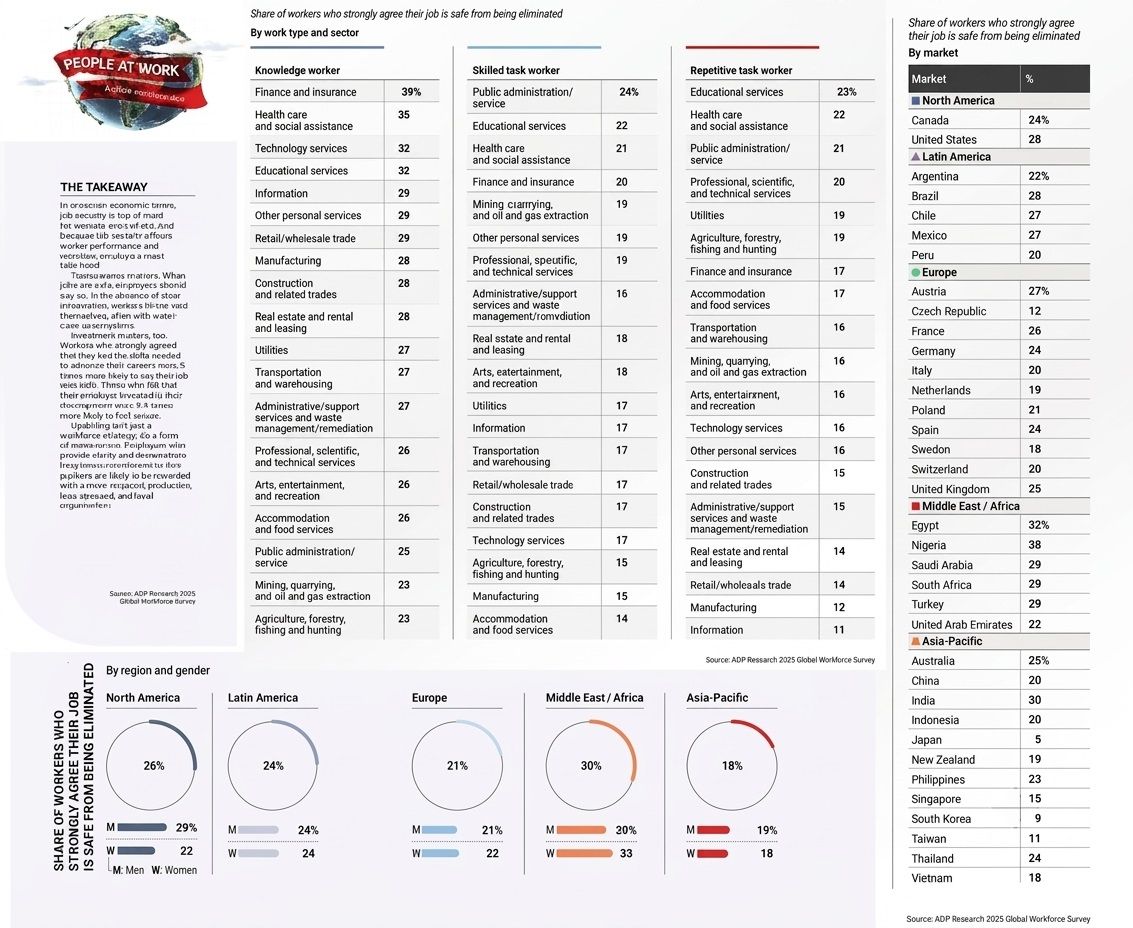
According to ADP Research’s People at Work 2026: A Global Workforce View, 30% of workers in India strongly agreed that their job is safe from elimination, the highest share among major Asia-Pacific economies and well above the regional average of 18%. The figure places India ahead of Australia (25%), Thailand (24%), the Philippines (23%), China (20%) and Singapore (15%). Globally, only Nigeria, at 38%, recorded a higher level of confidence.
The findings come from one of the world’s largest workforce studies, based on responses from more than 39,000 workers across 36 economies surveyed between July and August 2025. Despite historically low unemployment rates in many countries, the survey found that confidence in job security remains surprisingly weak worldwide.
“Even with worldwide unemployment at its lowest level in decades, fewer than 1-in-4 workers globally confidently say yes,” the report noted. “Among our global workforce survey respondents, just 22% strongly agreed that their job was safe from elimination. Anxiety over job security was particularly acute among lower-paid repetitive task workers and people at the bottom of the employer hierarchy.”
India’s performance suggests that workers continue to draw confidence from the country’s relatively strong economic growth, expanding formal employment opportunities and sustained demand for skilled talent across technology, financial services, manufacturing and digital sectors. Yet the data also reveals a significant gap between improving employment conditions and employees’ perceptions of long-term career stability.
“India is outperforming global and regional averages in job security confidence; however, the data still indicates a clear gap between employment conditions and how employees perceive their long-term job security,” said Rahul Goyal, Managing Director, ADP India and Southeast Asia.
"In today’s environment, employees are not just focused on job continuity; they are increasingly concerned about job relevance. As technology reshapes the nature of work, many are questioning whether their current roles will remain viable in the future," he added.
Security Drives Performance
The report found that job security is no longer merely an employee sentiment indicator but an increasingly important determinant of workplace performance.
“This insecurity has consequences for employees and employers alike,” ADP Research said. “Our data shows that people who fear losing their jobs are less engaged at work, more stressed, less productive, and much more likely to be spending time and energy looking for work elsewhere.”
The relationship works strongly in the opposite direction as well. Workers who feel secure in their positions consistently outperform those who do not. Globally, employees who believed their jobs were safe were six times more likely to be fully engaged, 6.3 times more likely to be highly motivated and committed, and 3.3 times more likely to describe themselves as highly productive. They were also twice as likely to say they had no intention of leaving their employer.
“Job security has become a business issue, not just a workforce sentiment measure,” said Dr. Nela Richardson, Chief Economist, ADP. “When employees feel confident about their future with an organisation, they are more likely to stay committed, perform at their best and contribute more effectively.”
For Indian employers facing persistent talent shortages in key sectors, the findings suggest that workforce confidence could become a competitive advantage in retaining skilled employees and sustaining productivity.
Skills Shape Confidence
The survey also revealed substantial differences in job-security perceptions across occupations and industries. In India, 37% of knowledge workers expressed confidence that their jobs were safe, compared with only 18% of skilled task workers and 17% of repetitive task workers.
The pattern mirrors global trends. Across markets, 30% of knowledge workers reported feeling secure, compared with 18% of skilled task workers and 16% of repetitive task workers. Workers employed in finance, insurance, healthcare and technology services reported the highest confidence levels, while those in manufacturing, agriculture, accommodation and food services felt significantly less secure.
The report identified skills development as one of the strongest predictors of job-security confidence.
“Workers who strongly agreed that they had the skills needed to advance their careers were five times more likely to say their job was safe,” the report observed. “Those who felt that their employer invested in their development were 5.3 times more likely to feel secure. Upskilling isn’t just a workforce strategy; it’s a form of reassurance.”
Goyal said bridging the confidence gap would require action from both employers and employees. “Closing this confidence gap will require a dual focus. Employees must prioritise continuous upskilling to stay competitive, while employers need to be far more transparent about how roles are evolving,” he said.
“Clear communication, combined with sustained investment in skills development, will be critical to strengthening employability, driving productivity, and building long-term workforce resilience.”
The AI Paradox
India’s leadership in job-security confidence becomes particularly noteworthy against the backdrop of rapid technological change. The country leads the world in generative AI adoption, with 41% of workers using AI tools nearly every day, the highest share among all markets surveyed.
Yet rather than undermining confidence, AI appears to be reinforcing it. The report found that frequent AI users generally reported higher engagement and lower levels of workplace stress. Many workers viewed technology as a tool for enhancing employability rather than a threat to their jobs.
The findings suggest that Indian workers increasingly believe they can adapt to technological disruption through skills acquisition and career mobility. That confidence may explain why fears of job displacement have not translated into widespread anxiety despite accelerating automation.
Optimism With Caveats
Beneath the strong headline numbers, however, India’s labour market presents a more nuanced picture. While workers feel relatively secure about retaining their jobs, they are not necessarily becoming more engaged.
The same ADP study found that employee engagement in India fell to 15% in 2025 from 19% in 2024 and a record 23% in 2023. Long working hours, digital overload and widening skill gaps were among the factors weighing on workplace engagement. The debate around a Right to Disconnect framework has further highlighted concerns over work increasingly spilling into personal time.
The contrast points to a growing distinction between job security and job satisfaction. Workers may feel confident that their jobs are safe, but they are simultaneously grappling with evolving workplace expectations and rising performance pressures.
For policymakers, India’s position at the top of Asia-Pacific job-security rankings underscores the resilience of the country's labour market. For employers, the message is equally clear: workers who feel secure are healthier, more productive and more likely to stay.
As global businesses navigate economic uncertainty, demographic shifts and technological disruption, India’s workforce is sending an unusually optimistic signal. Despite the rapid pace of change, many workers remain convinced that their jobs — and their careers — are here to stay.
(Cover photo by Kelum Chathuranga on Unsplash)