

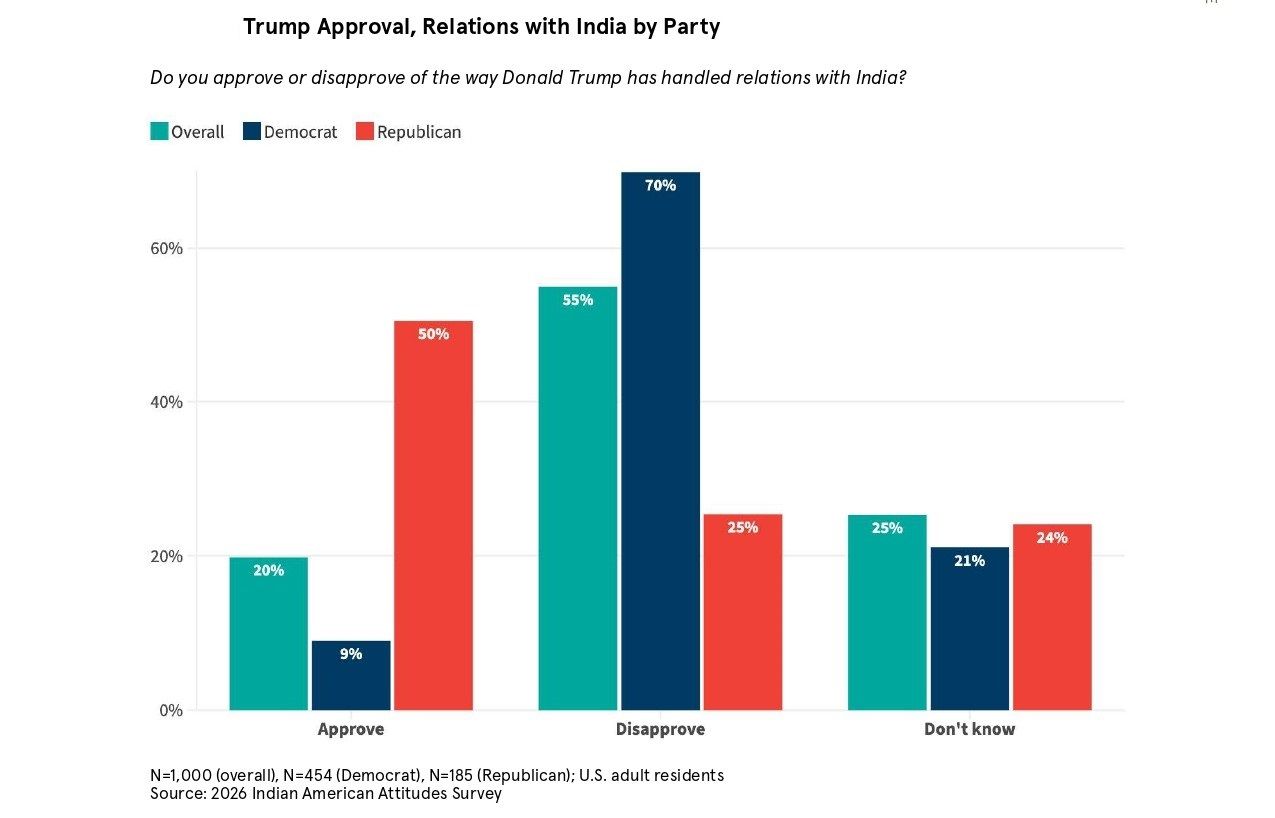
New Delhi: Just 20% of Indian Americans approve of President Donald Trump’s handling of relations with India, while 55% disapprove, signalling sharp discontent one year into his second term and raising fresh questions about the political direction of one of America’s most influential immigrant communities.
The findings, from the 2026 Indian American Attitudes Survey released by the Carnegie Endowment for International Peace, underscore mounting unease not only with the trajectory of US-India ties but also with the broader domestic climate. Conducted with YouGov, the nationally representative online survey polled 1,000 Indian American adults between November 25, 2025 and January 6, 2026.
Approval of Trump’s India policy has fallen from 35% in 2020, during his first term, to 20% now. By comparison, 48% had supported Joe Biden’s handling of bilateral ties in late 2024. At the same time, 25% express no opinion on Trump’s management of US-India relations, suggesting that while symbolic diplomacy matters, bread-and-butter issues at home weigh more heavily on political attitudes.
Indeed, the survey shows that dissatisfaction extends well beyond foreign policy. Large majorities disapprove of Trump’s overall performance, including his handling of the economy and immigration — issues that directly affect a community deeply embedded in professional sectors and reliant on skilled migration pathways. Yet this discontent has not translated into an automatic consolidation behind the Democratic Party.
Voter Demographics
Indian Americans — more than 5.2 million strong — remain predominantly Democratic, but the political glue binding them to the party is weakening. Democratic identification has slipped from 52% in 2020 to 46% in 2026. Republican identification has risen modestly from 15% to 19%, while independents now account for 29%. The data suggest less a Republican surge than a gradual loosening of partisan attachment, with more voters parking themselves in the ideological middle. Moderates constitute the single largest bloc.
The 2024 presidential election was a revealing moment. While most Indian Americans backed the Democratic ticket, Trump improved his showing compared with 2020, particularly among younger men. In 2026, that uptick has softened, but Democratic support has not rebounded proportionately. Politically, this points to a community that is skeptical of Trump yet not fully persuaded by the Democrats’ alternative.
Partisan divides over India policy are especially stark. Among Democratic-leaning respondents, who make up 46% of the sample, 70% disapprove of Trump’s handling of bilateral ties, with fewer than 10% approving. Among Republican identifiers, now 19% of the community, 50% approve. The split reflects how views on India are increasingly filtered through domestic ideological lenses rather than ethnic solidarity alone.
Generational and migration differences further shape these trends. Indian Americans aged 18-29, including young men who tilted toward Trump in 2024, have shifted back toward the Democrats. More recent immigrants and US-born individuals from families that arrived in the past two decades lean somewhat more Democratic, while longer-settled families show signs of political diversification. Hindus, the largest religious group in the diaspora, continue to favour Democrats, whereas Indian American Christians have moved more decisively toward Republicans, a shift that could influence debates around immigration and cultural issues.
Alongside electoral churn, the survey highlights the persistence of bias. Half of respondents report facing personal discrimination since early 2025, broadly unchanged from 2020. Of these, 36% cite skin colour, 21% country of origin and 17% religion as the basis. One in four say they have been called a slur — a reminder that identity remains a visible fault line in American politics.
Digital spaces amplify these anxieties. As many as 48% report frequently encountering anti-Indian racism online. The reactions are telling: 50% say they feel anger, 33% anxiety and 31% fear. In response, many are recalibrating their public engagement — 31% avoid political discussions online, 21% refrain from displaying political signs and 19% avoid wearing Indian attire in certain contexts. Political participation, in other words, is being quietly reshaped by social pressures.
Even so, there is little appetite for withdrawal from the United States itself. Most respondents say they do not plan to leave and would still recommend the country as a place to work. Economic opportunity and institutional stability continue to anchor the community, even amid diplomatic friction and domestic polarization.
The Carnegie report portrays Indian Americans as navigating a politically-charged environment with caution rather than rupture. They remain largely Democratic and broadly centrist, but more fragmented and more critical of leadership across party lines. In a closely contested American political landscape, that fluidity, rather than firm partisan loyalty, may prove to be the most consequential shift of all.