
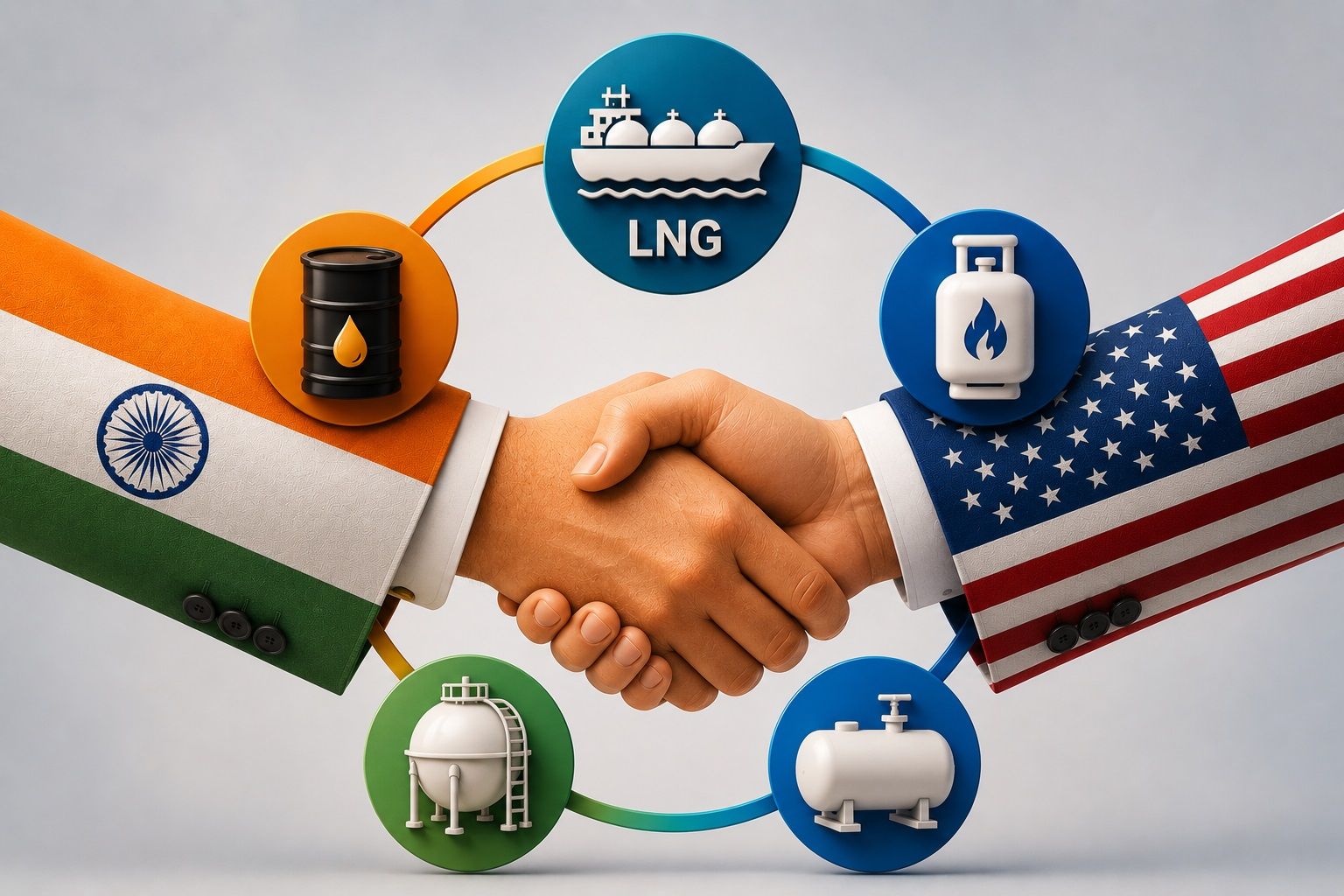

New Delhi: The India-US energy partnership is emerging as one of the strongest pillars of the two countries’ ambition to expand bilateral trade to $500 billion by 2030, with hydrocarbons expected to play a pivotal role in driving investment, technology collaboration and long-term economic growth. As India’s energy demand continues to rise and the United States consolidates its position as a leading global energy producer, policymakers and industry leaders see the relationship moving well beyond a conventional buyer-seller arrangement into a deeper strategic alliance.
The shift comes at a time when both economies are seeking to strengthen supply chains, improve energy security and create new avenues for industrial growth. Growing trade in liquefied natural gas (LNG), crude oil, liquefied petroleum gas (LPG), ethane and propane is expected to provide a strong foundation for achieving the ambitious bilateral trade target while supporting the energy transition priorities of both countries.
The report, Strengthening the India-US Energy Partnership, released by the US-India Business Council (USIBC) in collaboration with Grant Thornton Bharat (GTB), argues that hydrocarbons can become a major catalyst for expanding economic engagement between the world's largest and fifth-largest economies. According to the report, the India-US energy relationship is evolving from a traditional trade partnership into a comprehensive framework encompassing investment, infrastructure, technology and energy security across the hydrocarbon value chain.
“The evolution of the India-US energy relationship reflects the broader trajectory of our bilateral partnership, moving from transactional engagement to deeper strategic integration. As trusted partners, India and the United States are uniquely positioned to collaborate across energy, technology and investment to strengthen energy security, support economic growth, and create new pathways for expanding bilateral trade in the years ahead,” said Rahul Sharma, Managing Director, USIBC India.
Hydrocarbons Drive Growth
The USIBC-GTB report identifies significant opportunities to scale the volume and value of bilateral hydrocarbon trade while creating a more predictable investment climate for energy companies in both countries. It also underscores the importance of diversifying supply chains to improve resilience against geopolitical disruptions and market volatility.
For India, the opportunities extend across upstream exploration and production, LNG infrastructure, city gas distribution networks, gas-based power generation and downstream petrochemical projects. Bigger American investment in these sectors could help India meet its rapidly expanding energy requirements while supporting industrialisation and economic growth.
Indian companies, meanwhile, are expected to find attractive opportunities in the US energy sector through investments in LNG export terminals, upstream oil and gas assets, shale resources and petrochemical feedstock supply chains. Such cross-border investments could deepen commercial integration while creating a more balanced and sustainable energy partnership.
“The India-US energy partnership is entering a new phase, one that extends beyond commodity trade to deeper collaboration across investment, technology, infrastructure and supply chains. As India’s energy needs continue to grow and the United States expands its role as a leading energy producer, hydrocarbons can serve as a powerful catalyst for advancing the shared goal of $500 billion in bilateral trade by 2030. The opportunity now is to build a more integrated energy ecosystem that strengthens energy security, accelerates industrial growth and creates long-term value for both economies,” said Amit Kumar, Partner and Energy and Renewables Industry Leader, GTB.
Technology Strengthens Ties
A key feature of the USIBC-GTB report is its emphasis on technology-led collaboration as the next frontier in the India-US energy relationship. It recommends establishing an India-US AI-Powered Energy Task Force to accelerate the adoption of advanced digital technologies across the hydrocarbon sector.
The proposed platform could promote cooperation in AI-driven energy forecasting, seismic data interpretation, exploration optimisation, predictive maintenance and digital twin technologies for real-time monitoring of energy assets. Industry experts believe such technologies could improve operational efficiency, reduce costs and enhance productivity across the hydrocarbon value chain.
The report also calls for deeper cooperation on Strategic Petroleum Reserves (SPRs), highlighting their growing importance in protecting economies from global supply shocks. Joint initiatives in storage infrastructure, emergency response planning, inventory management and reserve financing could enhance energy resilience while strengthening broader strategic ties between the two countries.
The recommendations reflect a broader recognition that energy security is increasingly intertwined with economic security and supply chain stability. By expanding cooperation beyond fuel trade, India and the US could build a more integrated energy ecosystem capable of responding to future geopolitical and market disruptions.
Trade Ambition Accelerates
The India-US energy partnership is being viewed as an important lever for achieving the broader economic objectives shared by New Delhi and Washington. Bilateral trade has expanded significantly over the past decade, but reaching the $500 billion milestone by 2030 will require new growth engines capable of generating sustained investment and commercial activity.
Hydrocarbons offer one such opportunity by linking trade with infrastructure development, advanced technology, manufacturing and supply chain integration. As India expands its natural gas consumption and the US increases LNG export capacity, the two countries are well positioned to build one of the world’s most consequential energy partnerships.
The report suggests that aligning policy priorities, encouraging investment flows and strengthening technology collaboration can create long-term economic value while reinforcing energy security objectives for both nations. If translated into concrete policy and commercial action, the evolving hydrocarbon partnership could become a defining feature of India-US economic relations and a critical driver of the shared goal of $500 billion in bilateral trade by the end of the decade.