
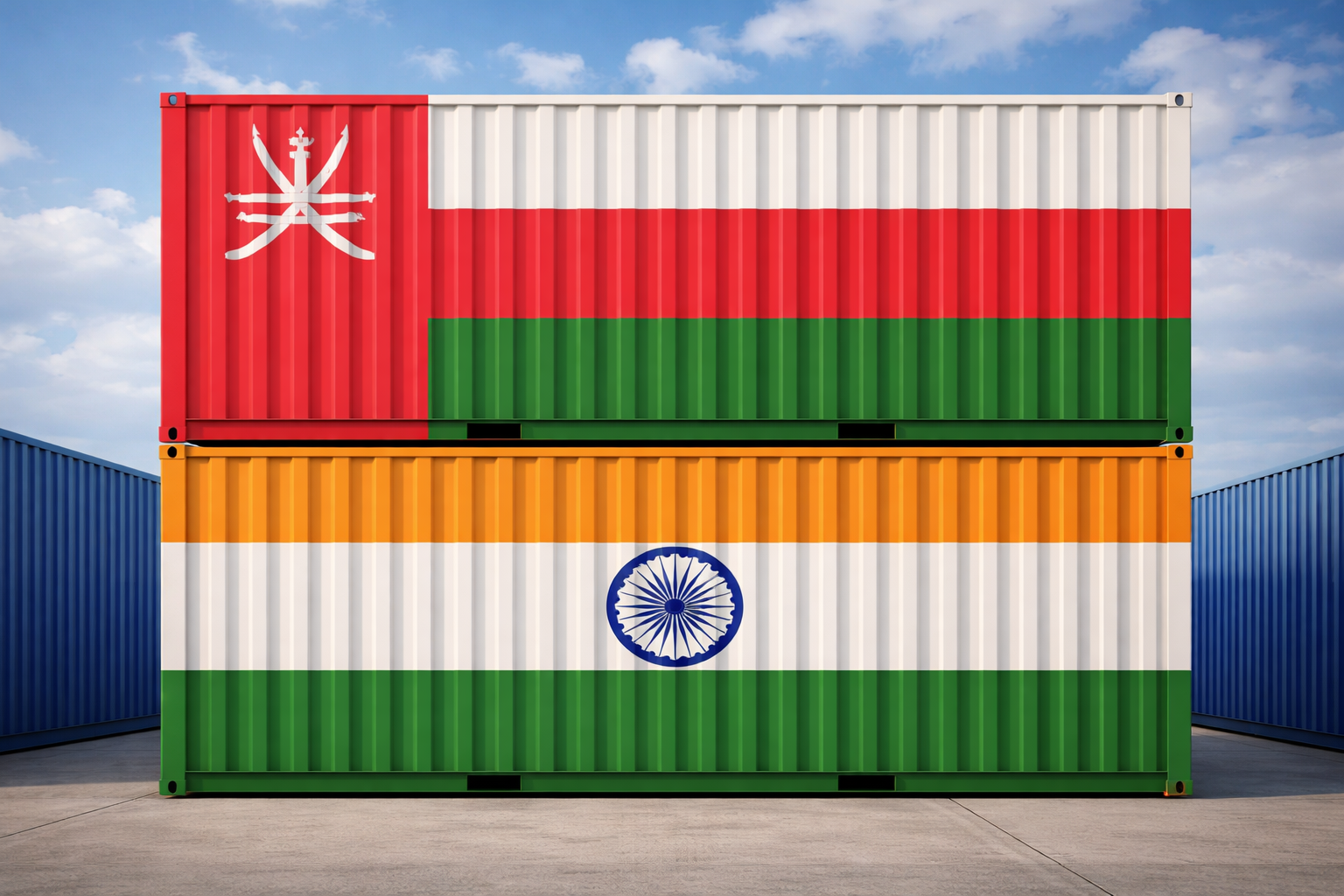

New Delhi: The India-Oman Comprehensive Economic Partnership Agreement (CEPA) entered into force on June 1, ushering in what could become one of the most consequential trade developments in India’s engagement with the Gulf region.
Signed in Muscat on December 18 last year, the agreement significantly expands market access for Indian exporters, strengthens services trade and investment flows, and positions the Sultanate as a strategic gateway to both the Gulf Cooperation Council (GCC) and East African markets.
The timing is significant. As global supply chains, primarily due to the Iran-US war, are being reconfigured and countries seek trusted economic partnerships, the India-Oman CEPA establishes a long-term framework that extends well beyond tariff reductions. Covering goods, services, professional mobility, investment facilitation, regulatory cooperation and non-tariff barrier disciplines, the agreement reflects New Delhi’s broader strategy of building resilient trade corridors that support manufacturing growth, export competitiveness and integration into global value chains.
Bilateral trade between India and Oman reached $11.18 billion in FY26, up from $10.61 billion in FY25, underlining the growing importance of the relationship. Oman is already India’s second-largest trading partner in the Gulf region and its modernised logistics infrastructure at Sohar, Duqm and Salalah offers Indian businesses a direct platform to access wider regional markets.
Speaking on the operationalisation of the agreement, Union Commerce and Industry Minister Piyush Goyal said, “The India-Oman CEPA marks a defining milestone in India’s engagement with Oman and reflects Prime Minister Narendra Modi’s vision of forging trade partnerships that deliver gains for farmers, fishermen, youth, women, entrepreneurs and MSMEs. This agreement will be a force multiplier in the Gulf region. With 99.38% of India’s exports receiving duty-free access, the agreement unlocks new opportunities for our exporters and professionals gain opportunities.”
The centrepiece of the CEPA is its market access package. Duty-free access will now be available for 99.38% of India’s exports by value, covering 98.08% of Oman’s tariff lines. Under the earlier Most Favoured Nation (MFN) regime, only 15.33% of Indian exports entered Oman duty-free. The shift provides an immediate competitive advantage to Indian suppliers in a market that imports nearly $28 billion worth of goods annually.
The benefits are expected to be particularly pronounced for labour-intensive sectors. Gems and jewellery, textiles, leather products, footwear, pharmaceuticals, marine products, engineering goods and processed foods stand to gain from the elimination of duties that previously ranged up to 5%. The agreement also gives Indian exporters a stronger footing against competitors that do not enjoy preferential access to the Omani market.

Enhanced mobility provisions under the CEPA are expected to support nearly 6,000 India-Oman joint ventures. Business visitors may stay in Oman for up to 90 days, independent professionals for up to 180 days and intra-corporate transferees for up to four years. (Photo by GEORGE DESIPRIS on Unsplash)
Sectoral Export Push
Among the biggest winners could be the gems and jewellery sector. Oman’s annual gems and jewellery import market is valued at more than $1 billion, yet India’s exports currently account for only a fraction of that figure. With duties removed from day one, exporters from Surat, Jaipur, Mumbai, Kolkata and Chennai are expected to aggressively target market share gains. Industry estimates suggest exports could rise six-fold to $150 million within three years.
Agriculture and food processing also emerge as major beneficiaries. India already holds a dominant position in several product categories, including bovine meat and fresh eggs. Duty-free access is expected to improve competitiveness for basmati rice, cashew kernels, honey, butter, condiments and sweet biscuits, while premium mango varieties such as Alphonso, Kesar and Dasheri are likely to gain stronger traction in Gulf markets.
The marine products sector receives a significant boost as all seafood exports, including shrimp, fish and cuttlefish, now enjoy immediate duty-free treatment. With Oman’s seafood imports still relatively underpenetrated by Indian exporters, the agreement opens opportunities for coastal states such as Andhra Pradesh, Kerala, Tamil Nadu and Gujarat to expand exports and strengthen their role in regional food supply chains.
Engineering goods and electronics exporters are also positioned to benefit. Oman imported around $1.7 billion worth of electronics products in 2025, while India’s exports to the country stood at just $146 million. The removal of tariffs across all electronics and engineering categories is expected to help Indian manufacturers, including those operating under the Production Linked Incentive (PLI) framework, capture a larger share of the market.
The pharmaceutical sector may derive advantages that go beyond tariff elimination. Faster regulatory approvals, acceptance of Good Manufacturing Practice inspection reports and streamlined market authorisation procedures are expected to significantly reduce compliance costs and accelerate market entry for Indian drug-makers in Oman’s growing healthcare market.
Strategic Economic Corridor
The agreement’s significance extends well beyond merchandise trade. Oman has made commitments across 127 services sub-sectors, representing one of the most comprehensive services market access packages secured by India from any GCC nation.
Commerce Secretary Rajesh Agrawal highlighted the broader strategic context. “At a time when global trade patterns are being reconfigured by supply-chain diversification, shifting production networks and the emergence of new economic corridors, the CEPA positions India and Oman to leverage these structural changes. By fostering closer integration across trade, services, investment, and logistics, the agreement creates a framework for more resilient value chains, greater economic competitiveness and a stronger strategic partnership with regional and global relevance.”
The services chapter is particularly important for Indian professionals and businesses. Sectors ranging from information technology and engineering to healthcare, education, financial services and construction will benefit from improved market access. For the first time in a bilateral trade agreement, Oman has undertaken binding commitments covering specific professional categories, creating clearer pathways for Indian talent.
Enhanced mobility provisions under the CEPA are expected to support nearly 6,000 India-Oman joint ventures. Business visitors may stay in Oman for up to 90 days, independent professionals for up to 180 days and intra-corporate transferees for up to four years, providing much-needed certainty for cross-border commercial activity.
The agreement also seeks to lower non-tariff barriers through recognition of Indian certification systems, streamlined sanitary and phytosanitary procedures and faster cargo clearance mechanisms. Such measures are increasingly critical in determining export competitiveness, particularly for agricultural and perishable products.
Agrawal underscored the evolving nature of modern trade agreements. “The India-Oman CEPA brings new energy to our bilateral economic engagement, anchored in complementary strengths, deeper regulatory cooperation and a shared commitment to growth. The agreement is tariff liberalization PLUS: it enhances market access, facilitates service trade and provides greater predictability for businesses operating across both markets.”
For India, the CEPA represents more than another free trade agreement. It creates a strategic economic corridor linking Indian manufacturing, services and investment capabilities with one of the Gulf’s most important logistics hubs. As New Delhi pursues its Viksit Bharat 2047 vision, the India-Oman CEPA could emerge as a template for future trade partnerships that combine market access with deeper economic integration and long-term strategic relevance.