

New Delhi: India’s Free Trade Agreement (FTA) strategy is rapidly becoming one of the country’s biggest economic gambles. As New Delhi races to lock in deals with major economies, a new assessment suggests the costs may be rising faster than the benefits.
The central argument is uncomfortable. While FTAs have expanded India’s market access and strategic reach, they have also widened trade deficits, encouraged imports, complicated domestic manufacturing and exposed policymakers to a new generation of regulatory obligations.
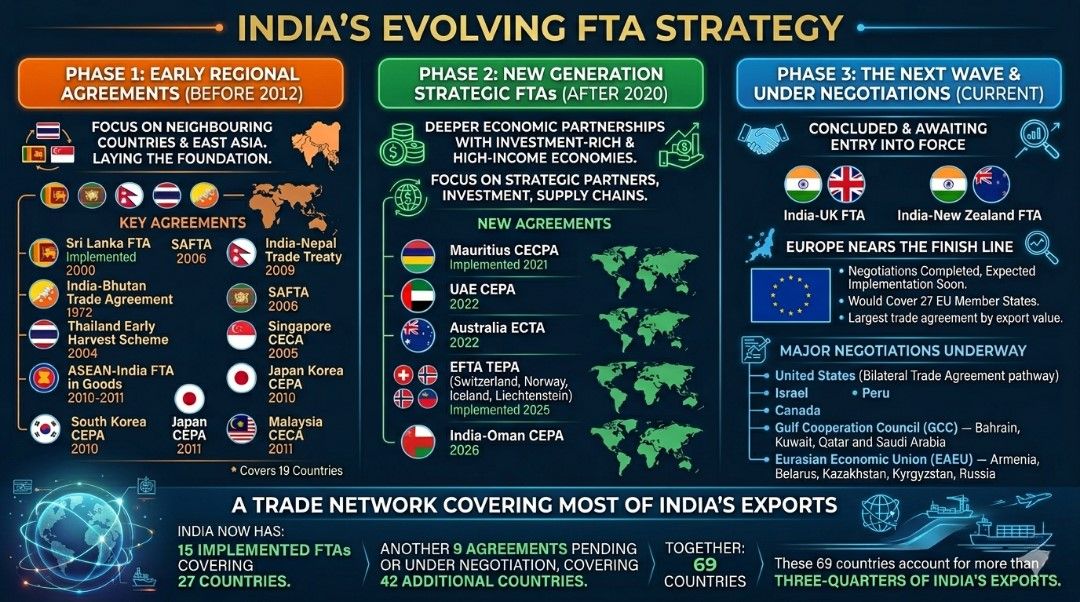
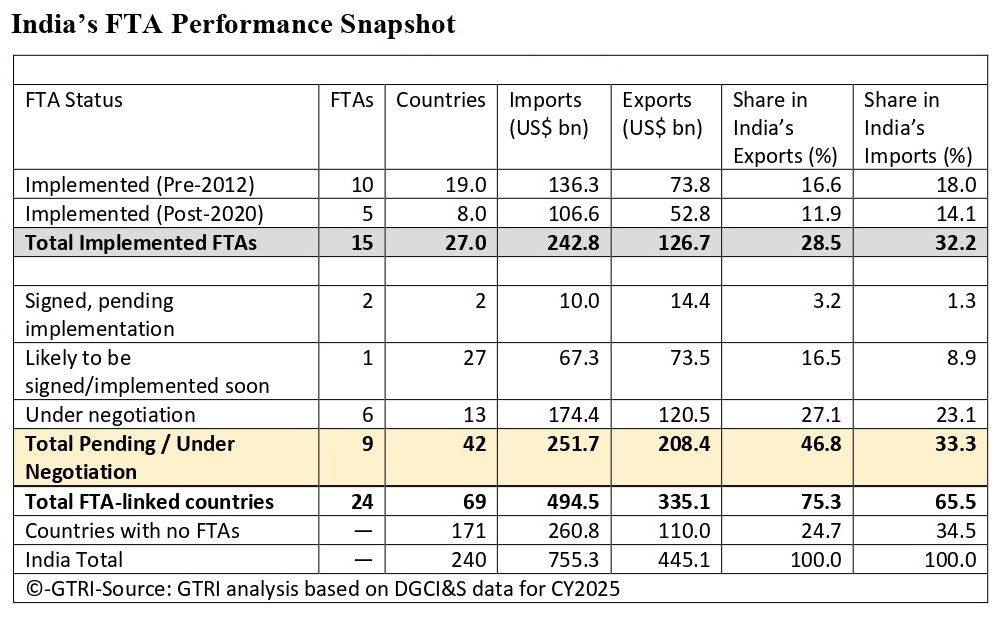
The Global Trade Research Initiative’s report, FTA Report Card 2026: Six Challenges India Can No Longer Ignore, argues that New Delhi’s trade policy is at risk of chasing agreements without adequately fixing structural weaknesses at home. The report arrives at a crucial moment, with 15 FTAs already in force and nine more either awaiting implementation or under negotiation, potentially covering 69 countries accounting for more than 75% of India’s exports.
The numbers underline the scale of the challenge. Existing FTAs account for 28.5% of India’s exports and 32.2% of imports, but India’s trade deficits with some of its biggest FTA partners have surged. Between the pre-FTA period of 2007-09 and 2023-25, the deficit with ASEAN jumped 381%, with Japan 318% and with South Korea 268%.
“Most of India’s FTA partners are already open economies with low tariffs. Average MFN tariffs are close to zero in Singapore and below 4% in Japan, Australia, Malaysia and the UAE. In contrast, India’s trade-weighted MFN tariff is about 12.6%, with rates ranging from zero to 150%,” says the report.
That imbalance, according to the study, creates a structural advantage for exporters into India while limiting gains for Indian companies abroad. Ajay Srivastava, Founder, Global Trade Research Initiative (GTRI), says, “As India negotiates new trade agreements, understanding these challenges is essential to ensuring that FTAs support national economic and development objectives.”
Manufacturing Under Pressure
The report’s sharpest criticism is reserved for the unintended consequences of India’s tariff structure. Rather than simply boosting trade, some FTAs may be undermining the country’s industrial ambitions.
A major concern is the low use of FTA preferences by Indian exporters. The report estimates that only 20-30% of eligible Indian exports use FTA benefits, compared with import-side utilisation rates of 60-70%. The explanation is straightforward: foreign tariffs are often already low, making the paperwork and compliance costs of claiming preferences uneconomical for Indian firms.
The report observes, “Where tariffs are already negligible, exporters often choose not to use FTAs at all. Complying with rules of origin, obtaining certificates and meeting documentation requirements can cost more than the tariff savings generated by the agreement.”
The bigger industrial problem is the worsening inverted duty structure. Indian manufacturers often pay duties on imported raw materials while competing against finished products entering duty-free under FTAs. The distortion, the report argues, is encouraging investment to move overseas.
Its warning is unusually blunt. “When it becomes cheaper to manufacture in an ASEAN country and export duty-free to India than to produce in India, investment and jobs tend to move abroad. As a result, FTAs can encourage firms to ‘Make in ASEAN, Sell in India' rather than ‘Make in India’.”
The implication is that India’s manufacturing strategy and its trade strategy are not always moving in the same direction. Instead of integrating domestic supply chains, some agreements may be incentivising companies to relocate production to partner countries and ship finished products back into the Indian market.
Policy Space Shrinks
The GTRI report argues that tariffs are no longer the biggest issue in trade negotiations. The more significant shift lies in the expanding scope of modern FTAs, which increasingly touch domestic policymaking.
New-generation agreements now cover labour standards, environmental rules, digital trade, government procurement, intellectual property and data governance. The concern is that these provisions could gradually narrow India’s policy flexibility.
“Traditional FTAs focused mainly on reducing tariffs and expanding trade. New-generation FTAs increasingly regulate how governments design policies in areas such as procurement, healthcare, environment, digital governance, and intellectual property,” says the report.
The European Union presents what the study describes as a particularly difficult challenge. Even if an India-EU FTA lowers tariffs, measures such as the Carbon Border Adjustment Mechanism could impose fresh costs on Indian exports. According to the report, “CBAM-related costs would eliminate the tariff benefits secured through the FTA.”
The GTRI study stops short of arguing against FTAs. Instead, it suggests India should rethink the conditions under which they are negotiated and implemented. “Competitiveness — not tariff preferences alone — is ultimately what determines whether FTAs benefit India’s economy,” it says.
That may also be the biggest lesson for policymakers. India’s next trade agreements could open larger markets, but unless domestic tariffs, manufacturing competitiveness and regulatory preparedness improve, the country risks signing more deals that look strategically significant while delivering increasingly uneven economic returns.