

New Delhi: India’s economic diplomacy enters a decisive new phase on July 15, when the India-UK Comprehensive Economic and Trade Agreement (CETA) and the companion Double Contribution Convention (DCC) simultaneously come into force, creating one of New Delhi’s most ambitious bilateral economic frameworks. The twin agreements promise to lower trade barriers, deepen services integration and reduce the cost of overseas talent deployment, while advancing India’s ‘Viksit Bharat 2047’ agenda of becoming a globally integrated economic powerhouse.
The implementation marks the culmination of a five-year strategic effort that began with the Enhanced Trade Partnership and the India-UK Roadmap 2030 in May 2021. Those initiatives sought to elevate bilateral ties into a Comprehensive Strategic Partnership and double annual trade to $100 billion by 2030.
After 14 rounds of negotiations, CETA was concluded on May 6, 2025, before being signed in London on July 24, 2025, by Commerce and Industry Minister Piyush Goyal and UK Secretary of State for Business and Trade Jonathan Reynolds in the presence of Prime Minister Narendra Modi and British Prime Minister Keir Starmer. The social security pact followed on February 10, 2026, completing the architecture of what policymakers view as a next-generation economic partnership.
Goyal described the simultaneous implementation as a structural breakthrough, arguing that the agreement dismantles long-standing tariff barriers while safeguarding India’s sensitive agricultural sectors and protecting the financial interests of Indian professionals working temporarily in Britain.
Exports Gain Ground
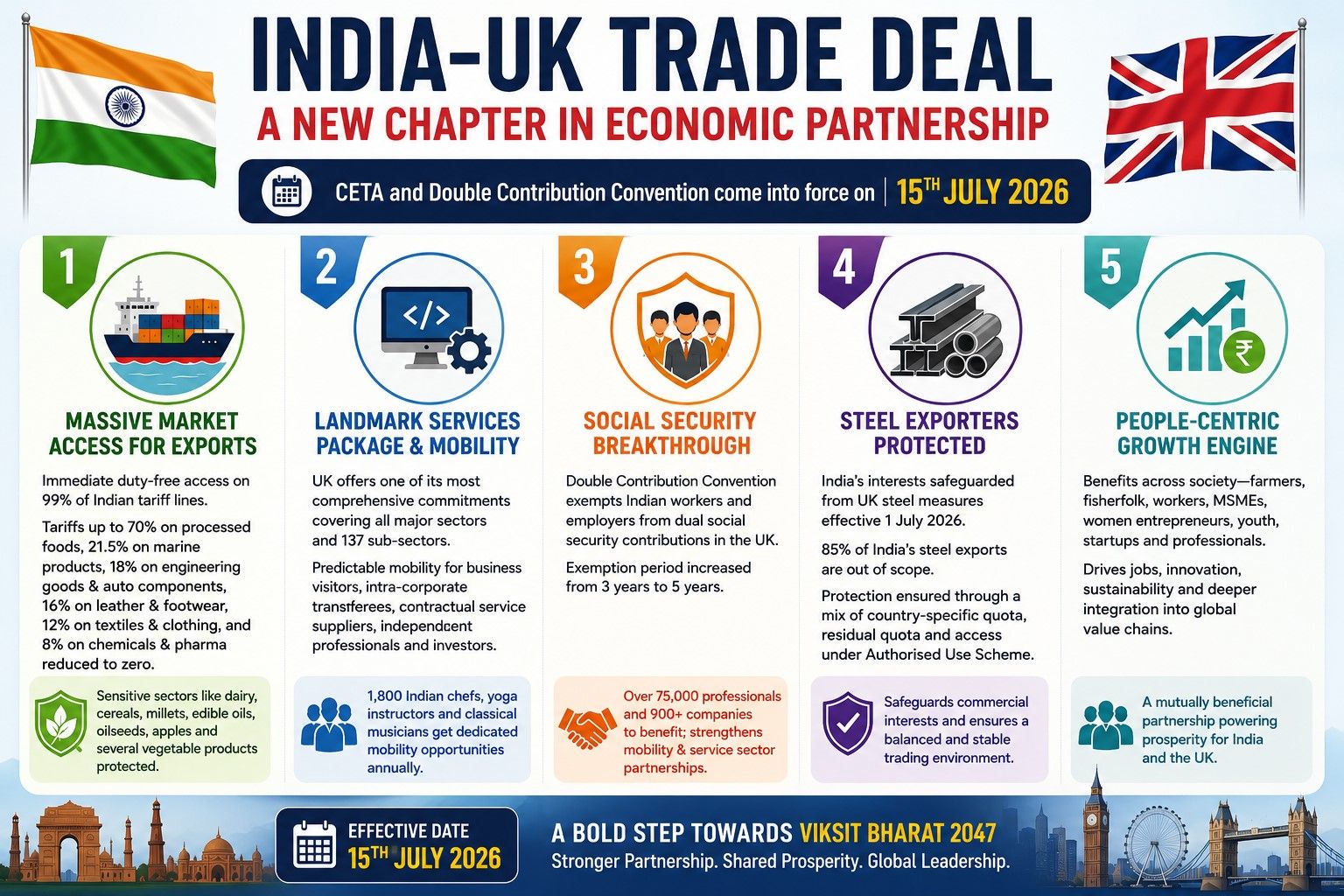
The most immediate impact of the India-UK CETA will be felt by exporters. India has secured immediate duty-free access for 99% of its tariff lines entering the UK, effectively removing a significant pricing disadvantage that Indian businesses have faced in one of the world’s most lucrative consumer markets.
Tariffs of up to 70% on processed food products, up to 21.5% on marine products, up to 18% on engineering goods and auto components, up to 16% on leather and footwear, up to 12% on textiles and clothing and up to 8% on chemicals and pharmaceutical products will fall to zero. The sweeping tariff elimination is expected to strengthen India’s position across labour-intensive and manufacturing sectors while creating fresh opportunities for farmers, fishermen, workers, MSMEs and large industrial producers.
The agreement could prove particularly significant for regional manufacturing clusters and traditional export industries, giving them direct access to the UK market without tariff distortions. By improving price competitiveness, the pact also strengthens India’s integration into global value chains at a time when multinational companies are diversifying supply chains.
At the same time, New Delhi has drawn firm red lines around politically and economically sensitive sectors. Dairy products, cereals, millets, edible oils, oilseeds, apples and several vegetable products remain protected from import competition, reflecting the government’s effort to balance trade liberalisation with rural economic stability.
Steel exporters have also secured protection following bilateral consultations over Britain’s new steel measures taking effect from July 1, 2026. Around 85% of India’s steel exports remain outside the UK’s steel measures, while products falling under the framework will benefit from a combination of country-specific quotas, residual quotas and access through the Authorised Use Scheme.
Services Drive Growth
While tariff cuts dominate the headlines, the services package could generate an even deeper structural impact on bilateral economic ties.
The UK has extended one of its most comprehensive services commitments to India, covering all major services sectors and 137 sub-sectors of export interest. Indian companies operating in IT and IT-enabled services, financial services, healthcare, education, engineering, telecommunications, consultancy and professional services will gain improved market access and greater regulatory certainty.
The agreement also creates more predictable mobility pathways for business visitors, intra-corporate transferees, contractual service suppliers, independent professionals and investors, reducing uncertainty for businesses expanding operations across borders.
In an unprecedented bilateral arrangement, 1,800 Indian chefs, yoga instructors and classical musicians will receive dedicated annual mobility opportunities under the agreement, opening formal pathways for specialised cultural and professional talent.
Running alongside CETA, the Double Contribution Convention could significantly improve the economics of overseas assignments for Indian businesses. The agreement exempts Indian employees and employers from making dual social security contributions during temporary UK postings, while extending the exemption period from three years to five years.
More than 75,000 Indian professionals and over 900 companies are expected to benefit from the arrangement. By lowering employment costs and preserving social security coverage during overseas assignments, the agreement strengthens India's competitiveness in global services exports and supports deeper collaboration between Indian and British businesses.
Economic Stakes Rise
Beyond tariffs and market access, the India-UK CETA represents a shift in the architecture of India’s trade policy. Spread across 30 chapters, the agreement goes well beyond conventional free trade arrangements by incorporating digital trade, telecommunications, financial services, intellectual property rights and, for the first time in a bilateral agreement, government procurement.
It also introduces dedicated frameworks for innovation, SMEs, sustainability and regulatory transparency, reflecting the changing nature of global commerce where technology, services and supply chain resilience increasingly drive economic competitiveness.
The agreement has been deliberately designed to distribute gains across the economy. Farmers gain access to premium export markets, fisherfolk benefit from higher seafood exports, manufacturers receive stronger market access, labour-intensive industries stand to create jobs and MSMEs, startups, women entrepreneurs and young businesses are expected to integrate more deeply into global supply chains. Professionals, meanwhile, gain greater mobility and regulatory recognition.
The simultaneous implementation of CETA and the Double Contribution Convention on July 15 therefore represents more than another trade agreement. It is a calculated economic strategy aimed at expanding India’s global commercial footprint while shielding sensitive domestic sectors, lowering the cost of exporting goods and talent, and embedding the country more firmly within international trade and investment networks.
For both India and the UK, the pact arrives at a moment of shifting global supply chains and rising economic fragmentation. For India, it may also become a template for future trade negotiations as New Delhi seeks to convert economic diplomacy into sustained export growth and accelerate its march towards ‘Viksit Bharat@2047’.
(Cover photo by Ali Mkumbwa on Unsplash)