
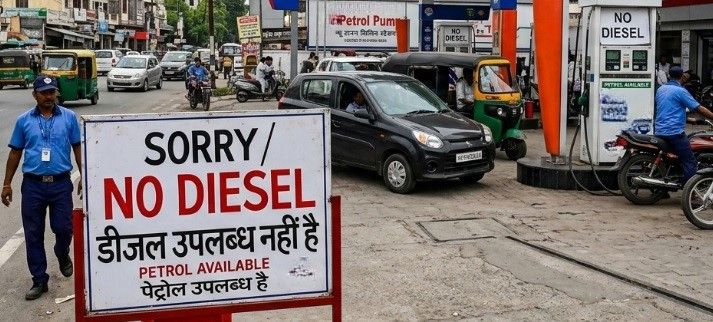

New Delhi: The widening conflict in West Asia has triggered a fresh energy shock that is now beginning to hit India’s transport and logistics backbone. As fears of supply disruption through key global oil routes pushed international crude prices sharply higher, diesel availability tightened across several parts of India, leaving truck and large vehicle drivers stranded in long roadside queues and forcing transport operators to scramble for fuel. The crisis reflects the speed with which geopolitical conflict abroad can destabilize everyday economic activity inside one of the world’s largest energy-importing nations.
India imports more than 90% of its crude oil requirements, making the economy highly vulnerable to wars or disruptions in major oil-producing regions. With tensions escalating around the Gulf — through which a substantial share of global crude shipments pass — fuel retailers and refiners have come under severe pressure from rising procurement costs. While state-run oil companies have continued selling diesel at controlled prices, several private retailers reportedly reduced supplies or revised rates upward to contain losses, pushing thousands of truckers toward overcrowded public-sector fuel stations.
The impact has spread quickly because diesel remains central to India’s logistics machinery. Nearly 70% of the country’s freight movement depends on road transport, while diesel powers everything from long-haul trucking and agricultural machinery to mining equipment, industrial transportation, and backup electricity systems. As queues lengthen at fuel pumps and transport delays increase, economists are warning that the fallout from the overseas conflict may soon begin feeding into inflation, supply-chain disruption, and broader economic stress across India.
Fuel Demand Pressure
Recent consumption trends underline the vulnerability. Market data released in recent weeks showed diesel usage touching record levels in March, increasing by roughly 8% compared with the same period a year earlier. Elevated baseline demand has reduced the margin for error in the supply system. Once private outlets began cutting sales or adjusting prices upward, state-run pumps immediately faced surging traffic from commercial transporters.
Prime Minister Narendra Modi has publicly framed the situation as both an economic and national responsibility issue. He appealed for restrained use of petrol and diesel, encouraged work-from-home, and asked citizens to avoid unnecessary fuel-intensive activities. Government departments have also reportedly started taking fuel-saving steps, including reducing official vehicle usage and expanding the use of electric mobility. The tone of the messaging suggests that the Centre is preparing the public for the possibility of prolonged energy stress.
Petroleum Minister Hardeep Singh Puri has acknowledged that fuel retailers are facing mounting financial pressure. According to figures discussed by ministry officials and market observers, oil marketing companies are reportedly absorbing substantial losses on diesel sales because retail prices have not risen in proportion to international crude benchmarks. State-owned refiners such as Indian Oil Corporation, Bharat Petroleum and Hindustan Petroleum have continued selling at controlled rates, while several private retailers have reportedly chosen to reduce supply volumes or revise prices to avoid deeper losses. The consequence has been an uneven retail market in which transport operators increasingly crowd public-sector stations, creating long queues and localized shortages.
Trucking, Agriculture Strain
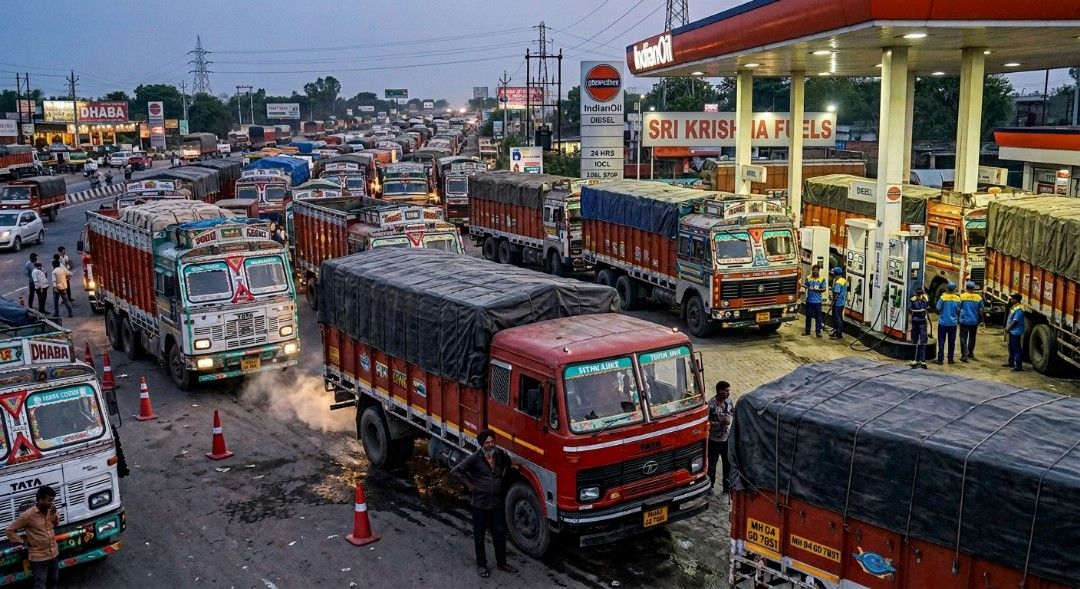
For the trucking industry, the financial impact is becoming severe. Freight operators in multiple regions have described vehicles remaining idle for extended periods while waiting for refuelling opportunities. Every additional hour lost on highways translates into higher logistics costs through delayed deliveries, driver overtime, increased spoilage risk for perishables, and disrupted turnaround schedules. With India operating millions of heavy commercial vehicles, even modest daily losses per truck can accumulate into substantial nationwide economic costs within a short period.
Agriculture is also beginning to feel the strain. Reports from several parts of the country indicate that diesel scarcity has slowed pre-monsoon farm activity. Tractor operators and farm contractors have reportedly struggled to secure adequate fuel supplies, while some pumps have imposed caps on diesel purchases. Since pre-sowing land preparation follows a narrow seasonal window, prolonged disruption could eventually affect planting schedules and kharif crop productivity if supply conditions fail to improve before the monsoon cycle intensifies.
Economists and financial institutions are now evaluating the broader macroeconomic fallout. Several analysts estimate that every sustained increase of $10 per barrel in crude prices can reduce India’s annual GDP growth by roughly 0.3 to 0.5 percentage points. Higher oil prices also tend to increase inflation because transportation costs feed directly into food prices, manufacturing expenses, aviation fuel, retail logistics, and consumer goods distribution. Imported inflation is therefore emerging as one of the central concerns for policymakers.
Economic Fallout Expands
Foreign exchange management has become another major focus. Rising crude prices significantly expand India’s import bill, increasing demand for US dollars and placing downward pressure on the rupee. To preserve external stability, the government has already signalled efforts to reduce non-essential imports and conserve dollar reserves. Measures involving higher duties on certain imported commodities and public appeals for economic restraint are being interpreted by economists as early defensive steps against a potentially wider balance-of-payments challenge.
Another layer of uncertainty surrounds India’s dependence on discounted Russian crude. Since global sanctions reshaped oil trade flows after the Ukraine conflict, India substantially increased purchases of Russian oil at lower prices, helping moderate domestic fuel costs. However, concerns are growing that tighter sanctions enforcement or the expiration of waivers could complicate those supply arrangements. If refiners are forced to reduce Russian imports while Middle Eastern tensions remain elevated, diesel availability could tighten further and procurement costs could rise sharply.
The aviation sector has already begun reacting to higher fuel expenses. Aviation turbine fuel prices have risen steeply in recent months, prompting airlines to reduce frequencies on some international routes and reassess operational costs. Industry groups warn that persistently high fuel prices may eventually reduce passenger demand through more expensive airfares, particularly during peak travel periods.
Financial markets are also adjusting expectations. Investors are increasingly differentiating between sectors that may benefit from elevated energy prices and those vulnerable to higher operating costs. Energy producers and some refining-linked businesses have remained relatively resilient, while logistics-intensive industries, airlines, consumer goods companies, and discretionary retail sectors face growing concerns about shrinking profit margins and weaker consumption demand.
Policy Choices Ahead
The current crisis has also reopened debate over the pace and structure of India’s energy transition. While electric mobility has expanded in urban transport and passenger vehicles, heavy freight transportation remains overwhelmingly dependent on diesel. Alternatives such as LNG trucking, expanded rail freight systems, biofuels, and electric heavy-duty logistics fleets are still developing at a relatively slow pace. As a result, fluctuations in diesel availability continue to have an outsized impact on the wider economy.
Despite the mounting pressure, some economists argue that India’s economic position is stronger than during earlier oil crises because the country now possesses larger foreign exchange reserves, broader energy sourcing networks, and more mature domestic financial markets. Even so, most analysts agree that prolonged shortages would eventually force policymakers into difficult choices between allowing fuel prices to rise, increasing subsidies for oil retailers, or implementing more direct supply-management measures.
The political challenge for the government lies in balancing inflation control with uninterrupted fuel availability. Holding retail prices artificially low can temporarily shield consumers but may deepen retailer losses and worsen shortages. Passing higher global costs directly to consumers could stabilize supply but would almost certainly increase freight charges, food inflation, and household expenses.
For now, the long queues of trucks outside fuel stations have become one of the clearest visual indicators of the strain. In an economy where diesel powers transportation, agriculture, logistics, construction, and industrial movement simultaneously, fuel scarcity quickly becomes more than an energy issue — it becomes a measure of broader economic stress moving through every layer of national activity.