


New Delhi: The escalation of the Iran-Israel war has triggered one of the most far-reaching disruptions in global aviation in recent memory, forcing airlines, regulators and passengers to rapidly adjust to a new and uncertain geography of air travel. What began as a regional security crisis has evolved into a systemic shock for the aviation industry, severing critical air corridors, inflating costs and reshaping competitive dynamics that had long favoured the Gulf’s dominant carriers.
At the height of the disruption, vast stretches of airspace across Iran, Iraq, Israel and parts of the Gulf were either closed or severely restricted. These zones collectively form a key artery for international aviation, linking Europe with South Asia, Southeast Asia and Australasia. Industry estimates indicate that roughly 15% of global air traffic normally traverses this corridor.
With its sudden closure, airlines were forced to cancel more than 4,000 flights per day during the peak of the crisis, a scale of disruption not seen since the pandemic era. Even weeks later, global schedules continue to reflect the aftershocks, with significant reductions in frequencies and persistent delays.
Despite these disruptions, the redistribution of traffic has created opportunities for competitors that had previously struggled to match the Gulf carriers’ connectivity. European airlines, including Lufthansa and British Airways, are among the primary beneficiaries. By expanding direct services between Europe and Asia, they are capturing passengers who would otherwise have connected through Gulf hubs. The relative disadvantage of longer routings without a central hub has diminished in a world where Middle Eastern airspace is constrained.
American carriers are also seeing incremental gains. They have reported stronger demand on long-haul routes, particularly those linking North America directly with Europe and parts of Asia. The shift reflects a broader rebalancing toward point-to-point travel, as passengers prioritise simplicity and perceived safety over the convenience of one-stop connections.
In Asia, airlines based in Japan, South Korea and Singapore are emerging as alternative connectors. Singapore Airlines, in particular, is well positioned to absorb traffic between Europe and Southeast Asia or Australia. Its hub lies outside the conflict zone, and its network allows for relatively efficient rerouting of passengers. This redistribution is contributing to a more decentralised global aviation map, in which traffic flows are spread across multiple hubs rather than concentrated in a few dominant ones.
The impact has been especially severe for the Gulf carriers that built their business models around seamless east-west connectivity. Emirates, Qatar Airways and Etihad Airways have, for years, dominated long-haul transit traffic by funnelling passengers through strategically located hubs in Dubai, Doha and Abu Dhabi. Their geographic advantage allowed them to offer one-stop connections between dozens of city pairs that would otherwise require longer or less convenient journeys.
That advantage has now been sharply eroded. With airspace closures forcing aircraft to detour over Central Asia or the Indian Ocean, flight times have lengthened by one to three hours on many routes. These deviations are not merely inconvenient; they materially alter the economics of long-haul flying. Additional flying time increases fuel burn, crew costs and aircraft utilisation constraints, all of which weigh heavily on profitability.
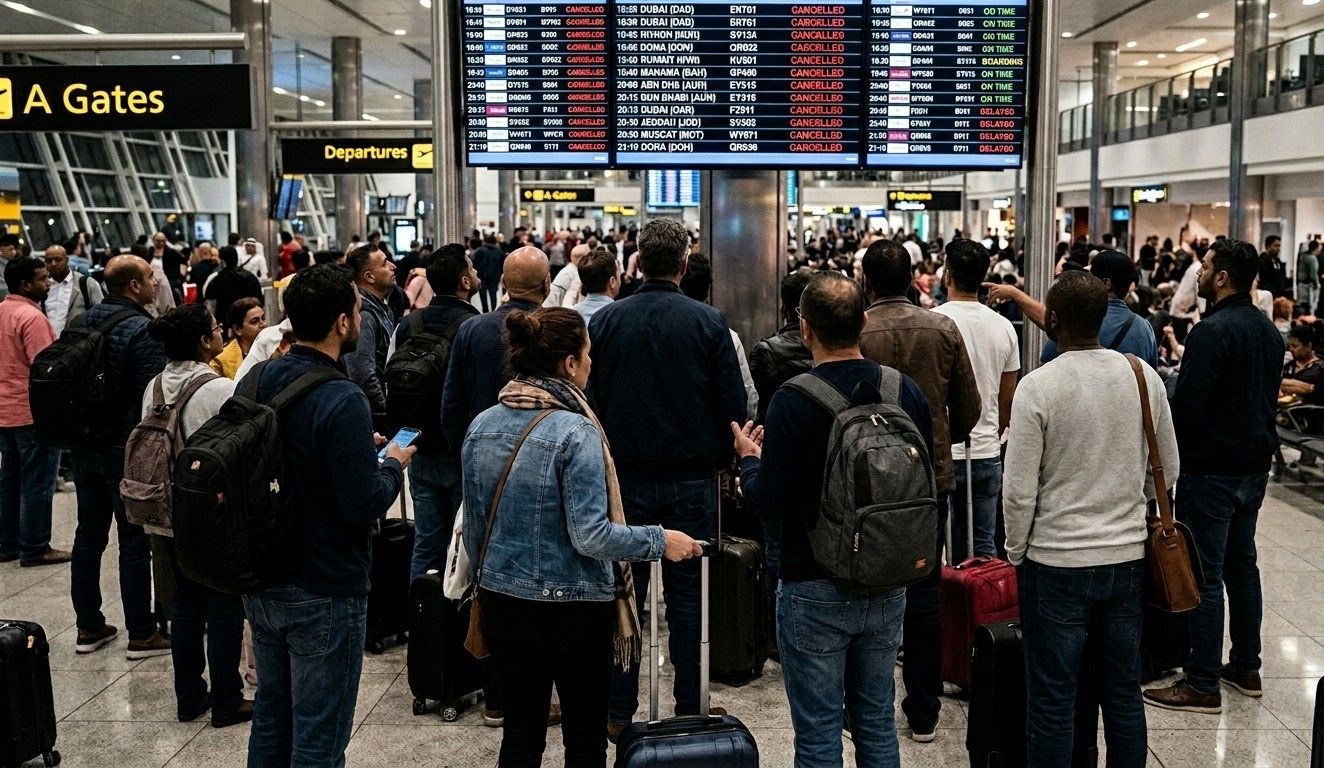
Operational data illustrates the severity of the contraction. Qatar Airways, reportedly, has been operating at roughly 20% of its normal capacity during the most constrained periods. According to media reports, Etihad Airways has managed closer to 50%, while Emirates, benefiting from a larger fleet and more diversified network, has stabilised at around 70-75% of pre-conflict operations. Even at those levels, the scale of lost capacity represents tens of millions of seats annually.
The disruption has been compounded by a sharp rise in jet fuel (ATF) prices. The conflict has heightened risks around the Strait of Hormuz, a chokepoint through which approximately 20% of the world’s oil supply passes. As crude prices climbed above $100 per barrel, jet fuel costs surged accordingly, in some cases doubling compared to pre-conflict levels. For airlines already dealing with longer flight paths, this has created a dual cost pressure: more fuel is required per flight, and each unit of fuel is significantly more expensive.
Passenger behaviour has shifted in parallel. Travellers have shown a growing reluctance to transit through the Middle East, even when flights remain operational. Corporate travel managers, in particular, have steered bookings toward direct services or alternative hubs perceived as lower risk. This shift in sentiment has forced Gulf carriers into aggressive pricing strategies. Discounting of up to 50% on certain long-haul routes has been observed, a clear indication of weakened demand and an attempt to preserve load factors.
Low-cost carriers are experiencing a different, but equally notable, shift. Within Europe, airlines are benefiting from a pivot toward short-haul travel. As long-haul journeys become more expensive and logistically complex, many travellers are opting for regional trips instead. This has led to increased demand for leisure destinations within Europe, reinforcing the resilience of the short-haul market even as long-haul networks struggle.
Airspace congestion in alternative corridors has increased, creating bottlenecks and raising operational risks. Airlines must navigate narrower flight paths with greater precision, often under heightened regulatory scrutiny. Meanwhile, higher costs are driving difficult decisions on capacity and pricing. On some routes, ticket prices have risen by 15-20%, reflecting both supply constraints and the need to offset higher operating expenses.
The longer-term implications are complex. The Gulf carriers’ dominance was not solely a function of geography; it also rested on scale, service quality and strong financial backing. However, the current crisis has exposed the fragility of a model that depends heavily on uninterrupted access to a specific region of airspace. If disruptions persist, even intermittently, airlines and passengers may permanently adjust their preferences, eroding the Gulf hubs’ centrality in global aviation.
At the same time, competitors have a rare window to strengthen their positions. By capturing displaced traffic and expanding their networks, European, American and Asian carriers can rebuild market share that had been steadily ceded over the past two decades. The key question is whether these gains will endure once the conflict subsides and normal air routes are restored.
For now, the aviation industry is navigating a period of profound uncertainty. Thousands of daily cancellations, capacity reductions of up to 80% for some airlines, and fuel cost increases exceeding 100% collectively underscore the magnitude of the shock. The Iran conflict has not only disrupted flight operations; it has challenged the structural assumptions that have shaped global aviation for a generation.
Even if airspace restrictions are eventually lifted, the episode is likely to leave a lasting imprint. Airlines may place greater emphasis on network resilience, diversify their routing strategies and reduce reliance on geopolitically sensitive corridors. Passengers, too, may continue to favour direct flights and alternative hubs, reinforcing a more fragmented and regionally balanced system.
In that sense, the current crisis marks more than a temporary disruption. It represents a turning point in how global aviation is organised, highlighting the interplay between geopolitics and connectivity in an industry where efficiency has long depended on stability. The map of global air travel is being redrawn in real time, and its new contours may endure long after the conflict itself has faded.
(Cover photo by Suganth on Unsplash)