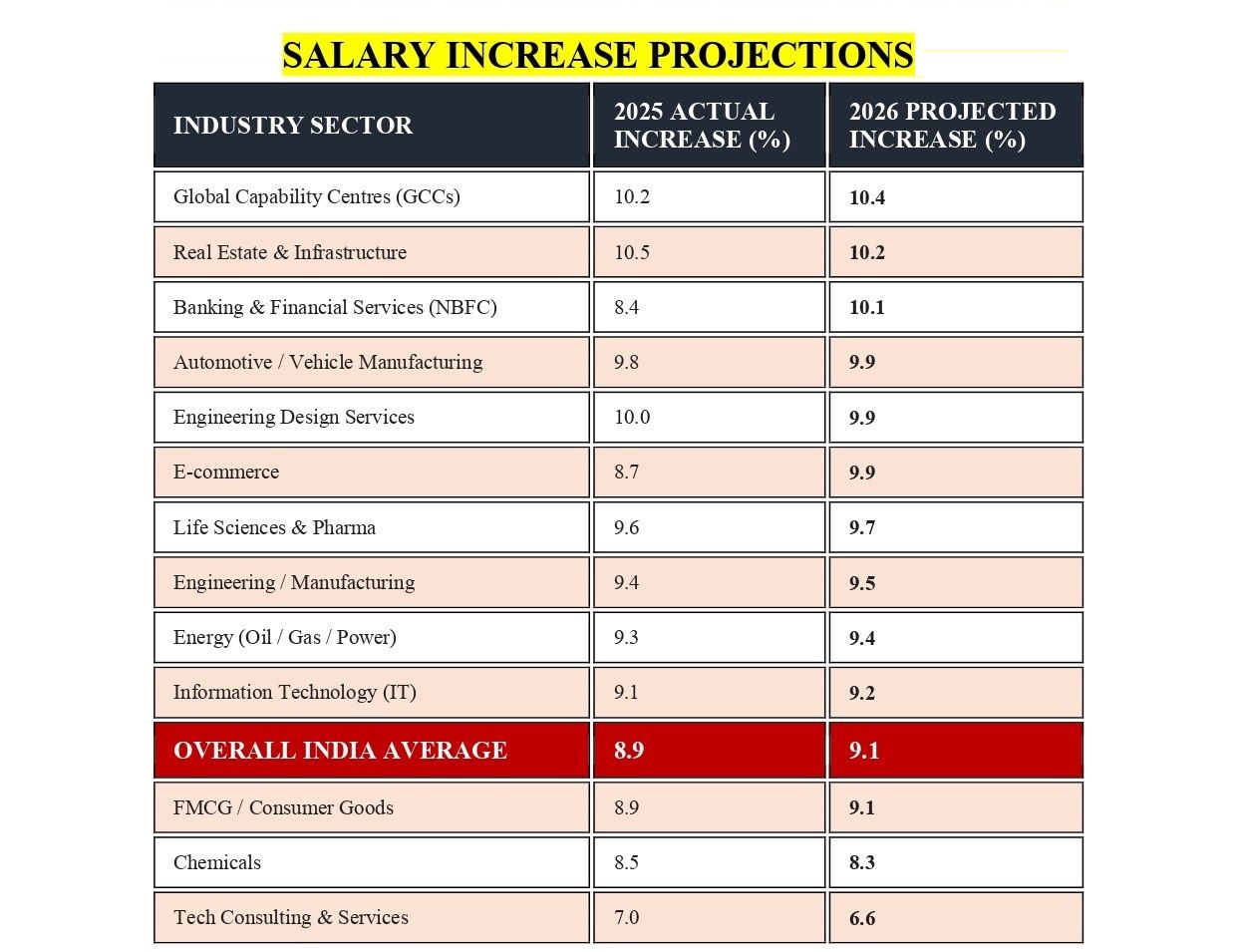

New Delhi: India Inc is poised to see another year of steady pay growth, with salaries projected to rise by an average of 9.1% in 2026, marginally higher than the 8.9% increment recorded in 2025.
The latest findings come from Aon’s Annual Salary Increase and Turnover Survey for 2025-26, which evaluated compensation data from more than 1,400 organizations spanning 45 industries. Now in its 32nd edition, the survey signals sustained wage momentum even as hiring activity moderates.
According to Aon, improving macroeconomic conditions are underpinning the positive outlook. Resilient domestic consumption, easing inflationary pressures and fresh trade agreements are supporting business confidence in the medium term, despite ongoing geopolitical uncertainties. The data suggests that companies are adopting a calibrated approach to compensation, balancing growth ambitions with cost discipline.
Sectoral trends indicate that real estate and infrastructure firms are likely to lead salary growth in 2026 with projected increments of 10.2%, closely followed by non-banking financial companies at 10.1%. Automotive and vehicle manufacturing as well as engineering design services are expected to offer average hikes of 9.9%, while engineering and manufacturing companies may grant around 9.5%. Retail is also anticipated to deliver increases slightly above the national average.
In contrast, some sectors are forecast to see more moderate revisions. Technology consulting and services firms are projected to offer average increases of 6.6%, down from 7% in 2025. Funds and asset management companies may see increments ease to 8.5% from 9.7% last year. Banking, life insurance, e-commerce and chemicals are also expected to remain below the overall market average.
Roopank Chaudhary, partner and rewards consulting leader for talent solutions at Aon India, noted that the stronger projections in areas such as real estate, NBFCs and manufacturing reflect targeted investments in critical talent segments. Organizations are particularly focused on strengthening capabilities in technology, engineering and customer-facing roles as competition for specialized skills intensifies in an evolving business landscape.
The survey also points to a stabilizing labour market. Overall attrition fell to 16.2% in 2025, down from 17.7% in 2024 and 18.7% in 2023, bringing turnover rates close to pre-pandemic levels. The steady decline indicates improved employee retention across industries and marks a departure from the high-churn period seen during and immediately after the pandemic, when aggressive hiring and job-switching drove elevated attrition.
Aon attributes this normalisation to more deliberate recruitment strategies, enhanced workforce planning and a stronger emphasis on employee engagement and career mobility. With hiring becoming more measured, organizations are prioritizing long-term capability building over rapid expansion. Companies are also investing in targeted upskilling initiatives and strengthening talent pipelines to support sustainable growth.
The survey’s release coincides with the implementation of India’s newly notified labour codes, which are prompting businesses to review compensation frameworks. Amit Kumar Otwani, associate partner at Aon India, observed that the standardized wage definitions and broader social security provisions under the new codes are encouraging employers to reassess salary structures. He emphasized that transparent communication will be essential to maintaining employee trust during the transition.
Taken together, the findings portray a labour market that is stabilizing rather than overheating. While salary growth in India remains strong by global standards, the projected increases reflect prudent and strategic investment in talent. With attrition under control and regulatory adjustments underway, companies appear focused on building resilient compensation models aligned with long-term business objectives.