

New Delhi: India’s aggressive renewable energy expansion is set to unleash $10-15 billion worth of land investments by 2030, as solar and wind developers race to secure large contiguous parcels for upcoming clean energy projects, according to a new report by Colliers India.
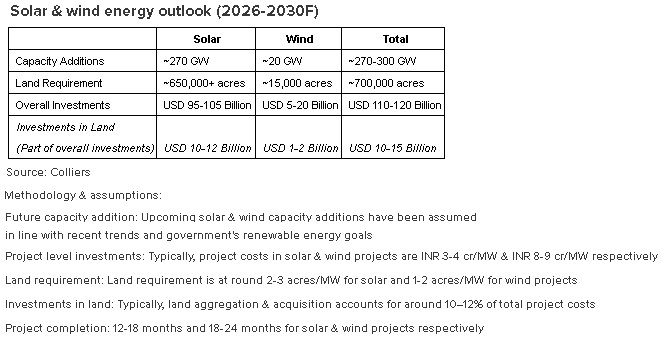
The Colliers India report, titled The Green Shift: Renewable Prioritization Reshaping Indian Real Estate, said the country may require nearly seven lakh acres of land over the next five years to support the next phase of solar and wind capacity creation. According to the report, the land requirement alone could emerge as one of the biggest real estate opportunities linked to India’s green transition.
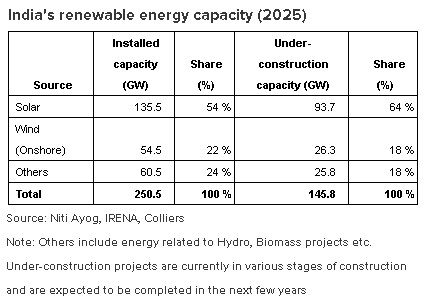
India’s renewable energy installed capacity has already crossed 250 GW in 2025, more than tripling from 2015 levels, aided by sustained policy support, infrastructure creation and rising private sector participation. According to the report, India achieved a major milestone in 2025 when non-fossil fuel sources accounted for more than 50% of the country’s total installed power capacity, reaching its 2030 target ahead of schedule.
“India’s transition toward renewable energy has accelerated significantly over the past decade. Momentum in the sector increased substantially following India’s commitment at the 2021 United Nations Climate Change Conference, where the country announced its target to achieve net-zero emissions by 2070 and significantly expand its renewable power capacity portfolio,” according to the report. “Subsequent years saw the introduction of additional targets focused on solar and wind capacity augmentation, further solidifying the pathway towards clean energy.”
The report noted that the country’s installed renewable energy capacity rose to more than 250 GW in 2025 from around 80 GW in 2015, driven largely by policy interventions and rapid development of utility-scale solar and wind projects.
“Strong and consistent policy support will not only speed up the commissioning of new renewable projects but also indirectly boost Indian real estate by increasing demand for suitable land parcels and drive economic development around project locations,” according to the report.
“As renewable energy deployment continues to scale, policy stability and faster implementation will play a critical role in opening new opportunities for land development, industrial corridors & manufacturing hubs, logistics assets, and energy-linked real estate growth.”
Land Demand Surges
The report projected overall investments of $110-120 billion in India’s renewable energy sector over the next four to five years, with solar projects expected to account for the bulk of future capacity additions.
"India’s renewable energy capacity stands at 251 GW, and with another 270-300 GW of expected solar and wind energy additions by 2030, the sector is set to enter its next phase of accelerated growth. This scale-up will create significant opportunities for the real estate sector, particularly in land and industrial & warehousing segment. By 2030, solar and wind projects alone could require nearly 7 lakh acres of land, unlocking $10-15 billion of opportunity in land aggregation & acquisition,” said Badal Yagnik, CEO & Managing Director at Colliers India.
“Most importantly, over the next few years, renewable energy will not only accelerate India's decarbonisation journey but also drive development of growth corridors and investment destinations, catalysing long-term sustainable growth across the country,” he added.
The report estimated solar capacity additions of nearly 270 GW between 2026 and 2030, while wind additions could touch 20 GW during the same period. Solar projects alone may achieve installed capacity of 400-450 GW by 2030.
Rajasthan and Gujarat are likely to remain at the centre of the next wave of renewable-linked land transactions due to their high solar irradiation, strong wind corridors and availability of large land parcels. Together, the two states already account for more than 40% of India’s installed solar and wind capacity.
The clean energy push is also expected to create significant opportunities for land aggregation firms, transmission infrastructure developers and industrial real estate operators. The report said private participation is expected to rise sharply in pre-development activities such as land aggregation, title verification, conversion and establishment of land banks.
“The rapid expansion of renewable energy capacity is expected to unlock multiple growth opportunities for India’s real estate sector, with investments largely concentrated in wind and solar energy ecosystems,” according to the report. “As government, renewable energy players and transmission companies seek to expand capacity and transmission capabilities, the demand for suitable contiguous land parcels will continue to rise in regions with high renewable energy potential.”
The report added that renewable energy projects are likely to stimulate growth across industrial townships, affordable housing, logistics parks and commercial assets in Tier-II and Tier-III cities emerging as clean energy hubs.
Warehousing Boom Ahead
Beyond land acquisition, India’s renewable energy expansion is expected to substantially reshape the industrial and warehousing sector.
According to the report, renewable energy equipment manufacturers (OEMs) are likely to contribute 10-15% of overall warehousing demand by 2030, compared with around 8% in 2025.
"Over the last five years, annual leasing by renewable energy OEMs has surged nearly 4X times to around 3 million sq ft of industrial and warehousing space uptake in 2025. Chennai (accounting for nearly 44% of total leasing between 2021 and 2025) and Pune have emerged as the preferred cities, cumulatively accounting for almost two-thirds of the space uptake since 2021,” said Vimal Nadar, National Director & Head-Research, Colliers India.
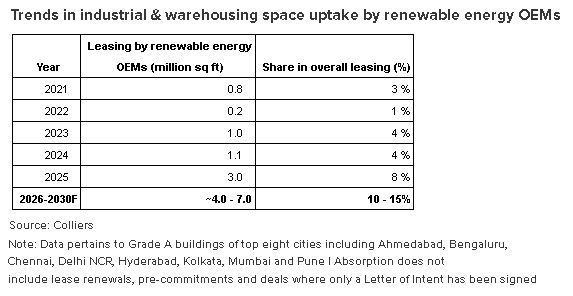
“By 2030, annual Grade A space uptake by these OEMs is likely to reach 4-7 million sq ft, accounting for 10-15% of the overall industrial & warehousing demand. This growth will be driven by rapid scaling up of domestic component manufacturing of solar PV modules, wind turbines, geothermal heating & cooling systems, battery storage solutions, semiconductors and other renewable energy components,” he added.
The report further highlighted that renewable energy OEMs acquired more than 2,200 acres of land in the last two to three years for manufacturing facilities, with Madhya Pradesh accounting for over 40% of those acquisitions. Total investments by renewable energy OEMs during the period stood at nearly Rs 75,000 crore.
It cautioned that fragmented land ownership, regulatory hurdles, incomplete digitisation of land records and inadequate infrastructure connectivity continue to remain major bottlenecks for renewable-linked real estate development. Still, the long-term trajectory remains firmly positive as India pushes towards its 500 GW non-fossil fuel target by 2030.
(Cover photo by KULJEET PUNIA on Unsplash)