

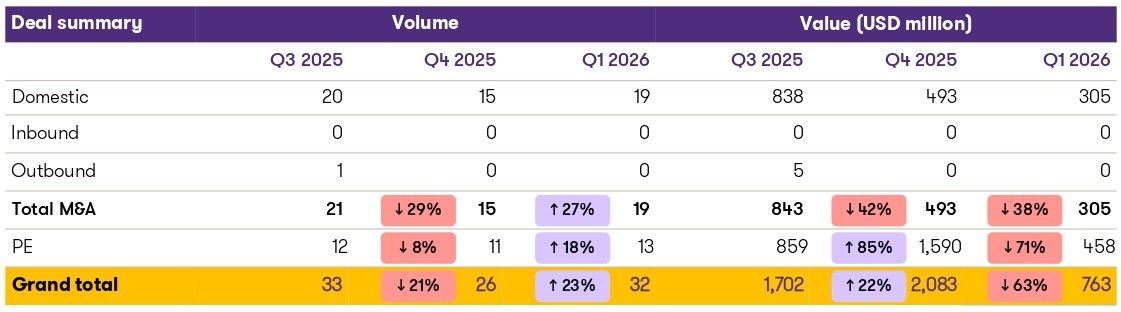
New Delhi: India’s real estate sector opened 2026 with rising deal activity but sharply lower investment values, signalling a decisive shift in investor behaviour. According to Grant Thornton Bharat’s Real Estate/REITs Dealtracker, the sector recorded 32 deals worth $763 million in the first quarter, marking one of the lowest quarterly values since Q4 2023, even as volumes climbed 23% sequentially and 14% year-on-year.
The divergence between deal momentum and capital deployment underscores a clear recalibration: investors are moving away from large-ticket transactions toward smaller, more measured bets amid macroeconomic and geopolitical uncertainties. The quarter also stood out for the complete absence of IPO and QIP activity, compared with $916 million raised via public markets in the previous quarter.
“Q1 2026 reflects a stable yet measured start for India’s real estate sector, with deal volumes improving even as overall values corrected sharply due to the absence of large-ticket transactions. The quarter saw a clear shift towards mid-sized and income-generating assets, with domestic activity continuing to dominate and private equity remaining a key source of capital. Investment trends indicate a strong preference for commercial assets, particularly office and retail platforms, supported by yield visibility and stable cash flows, while REIT-led transactions continue to reinforce institutional confidence in high-quality, income generating assets,” said Shabala Shinde, Partner and Real Estate Industry Leader, GTB.
“Overall, the deal environment remains resilient, though investors are adopting a more selective approach, prioritising asset-level performance and execution certainty amid ongoing macro and geopolitical uncertainties,” she added.
M&A rebounds on domestic consolidation
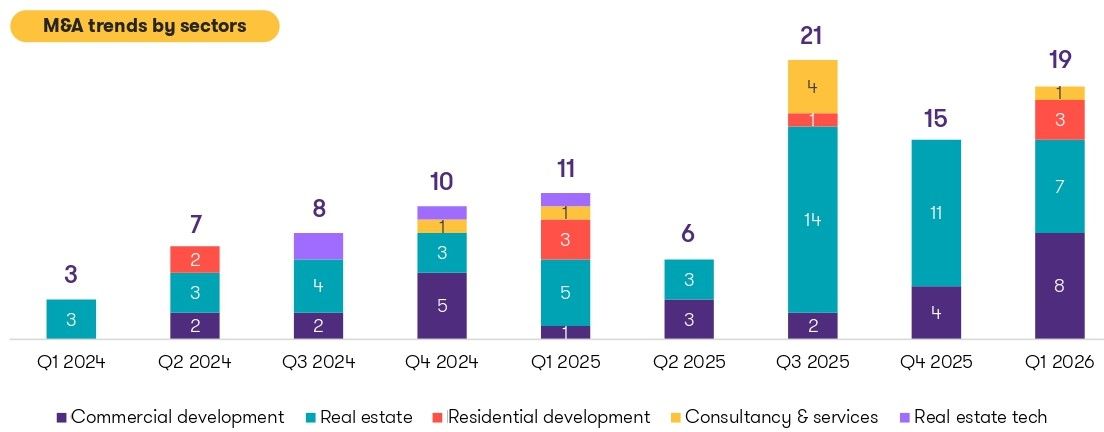
Mergers and acquisitions emerged as the backbone of deal activity, accounting for 19 transactions — up 27% quarter-on-quarter and significantly higher than 11 deals a year ago ij the same period. However, total M&A value dropped to $305 million, reflecting the absence of large-scale acquisitions and a clear tilt toward mid-market consolidation.
Domestic players dominated the landscape for the second consecutive quarter, with no inbound or outbound deals recorded. This underscores a structurally inward-looking market where Indian strategic and financial investors are driving transactions.
The largest M&A deal of the quarter — RSVM Hospitality Pvt Ltd’s $55 million acquisition of an 18.6-acre land parcel in Thane — highlighted continued appetite for operator-led opportunities, albeit at moderated ticket sizes. Meanwhile, active consolidators such as Prozone Realty added momentum through multiple smaller acquisitions.
Private equity shifts to smaller, diversified bets
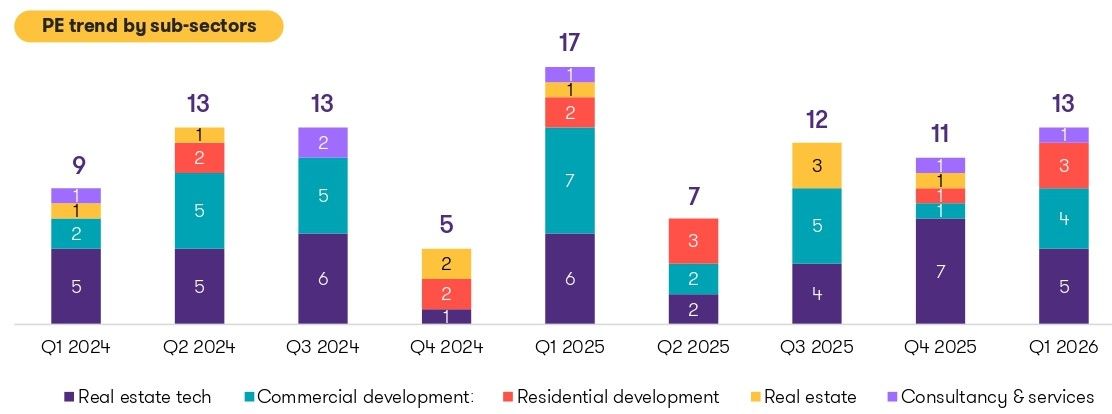
Private equity activity remained a critical capital source, contributing 13 deals worth $458 million and accounting for 60% of total deal value. While volumes reached their highest level in a year, values plunged 71% from the previous quarter, largely due to the absence of a single mega transaction.
This shift has sharply reduced average deal sizes from $80 million to $23.8 million, pointing to a diversification strategy where investors prefer multiple smaller exposures over concentrated bets.
The quarter’s standout transaction was Alpha Alternatives’ $139 million investment in ASF Infrastructure Pvt Ltd, reaffirming sustained institutional interest in commercial development assets. At the same time, funds such as ASK Property Fund remained active across residential platforms, signalling balanced deployment across asset classes.
REIT-led transactions added another layer of stability, with acquisitions such as a mall asset by Nexus Select Trust reinforcing confidence in income-generating retail properties and the maturing REIT ecosystem.
Commercial assets dominate, residential regains traction
Commercial development continued to anchor the sector, accounting for 42% of M&A volumes and as much as 78% of private equity value. Office and retail platforms remained the preferred destinations for capital, driven by predictable yields and stable cash flows.
At the same time, residential development staged a notable comeback, with deal volumes rising from one in the previous quarter to six, and values touching approximately $178 million. This reflects renewed but selective investor interest in development-led opportunities tied to end-user demand and urban expansion.
Other segments showed mixed trends. Real estate operators recorded seven deals worth $133 million, indicating moderation amid the absence of large-ticket transactions. Real estate technology continued to attract steady but cautious investment through smaller deals, while consultancy and services remained subdued with just two transactions totalling $8 million.
(Cover photo by Parth Savani on Unsplash)