

New Delhi: Gold appears to have reached a critical crossroads, with the precious metal defending a key technical threshold even as investors weigh competing signals from geopolitics, inflation and monetary policy. While the metal has managed to remain above the psychologically important $4,500/ounce level, the latest market data suggest that confidence in a sustained rally remains tentative.
The latest Weekly Markets Monitor – Point of Inflection from the World Gold Council argues that gold’s ability to hold its long-term support level could determine whether the market resumes its upward trajectory or slips into a deeper correction. The assessment comes at a time when easing concerns over energy-driven inflation, improving risk appetite in equities and resilient economic data are reshaping investment flows across asset classes.
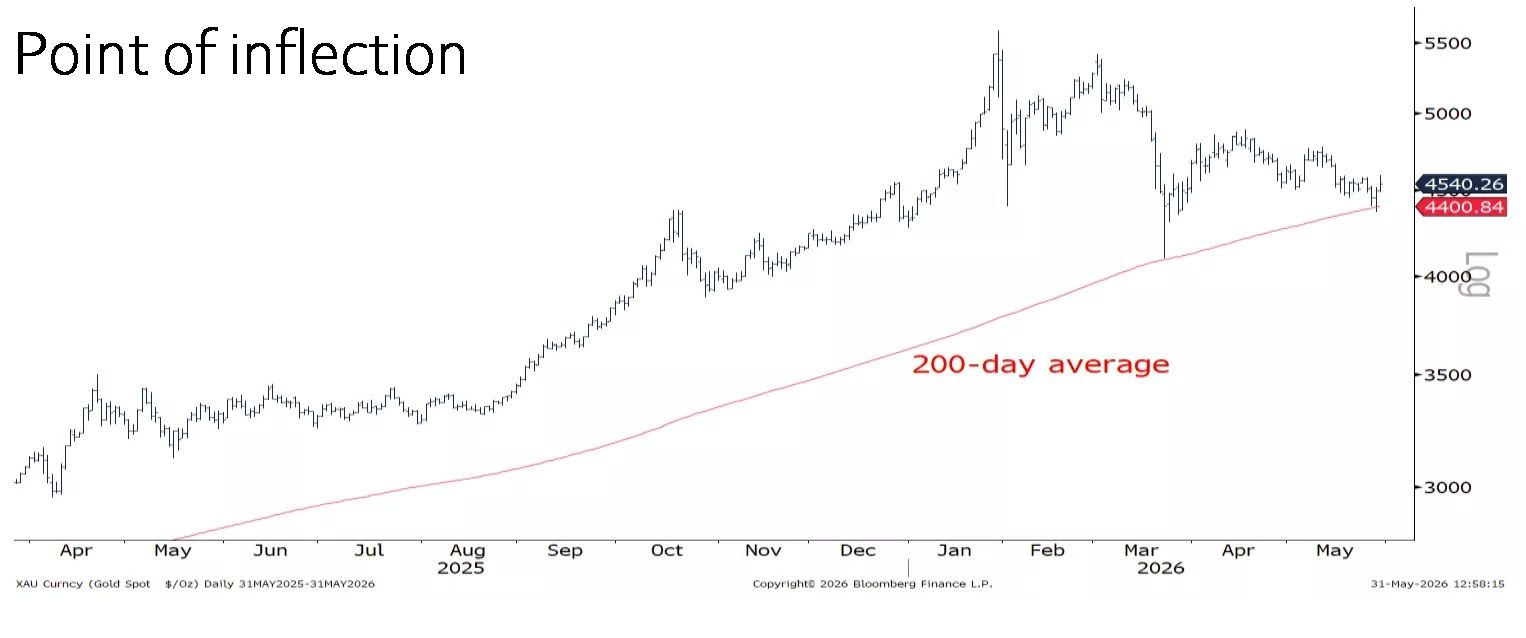
According to the report, gold has repeatedly defended its 200-day moving average, a level that market participants increasingly view as the dividing line between recovery and weakness. It notes that while short-term momentum has improved, investors are still waiting for stronger confirmation that a durable base has been established.
Critical Market Turning
The report says recent developments surrounding US-Iran negotiations have played a central role in shaping gold’s direction. Optimism that a diplomatic breakthrough could reopen the Strait of Hormuz helped cool inflation concerns, pushing Treasury yields and the US dollar lower and offering support to bullion prices.
“Gold tested and held its 200-day moving average once again last week, a technical floor set in March. We continue to see this as a key inflection/risk point for the market. With short-term momentum improving and net long positioning neutral, we look for confirmation that a more durable base is forming,” says the report.
Despite the modest recovery in prices, investor behaviour remains mixed. Global gold exchange-traded funds continued to witness outflows, particularly from the US and China. At the same time, options traders increased bullish positions and COMEX futures data showed a rise in net long holdings, suggesting that speculative investors remain willing to bet on a rebound.
The WGC report points out that gold rose 0.9% during the week to $4,546 an ounce, lifting its year-to-date return to 4.1%. However, that gain appears modest compared with the scale of uncertainty still facing global markets.
Inflation Risks Persist
A slightly uncomfortable reality for policymakers is that inflation remains elevated across major economies despite signs of slowing growth. The report highlights persistent price pressures in the US, Japan, the UK and Australia, even as government support measures have softened the impact in some regions.
“Last week was dominated by developments around US-Iran negotiations and strong US corporate earnings. Inflation pressures remain elevated across major economies, including Japan, the UK, Australia, and the US, though government subsidies helped soften the impact in some regions. In the US, durable goods orders and exports were strong in April despite softer Q1 GDP growth, while China’s industrial profits rose sharply, driven by high-tech manufacturing,” says the report.
The broader macroeconomic backdrop remains complex. US durable goods orders surged 7.9% in April, while exports strengthened and China’s industrial profits jumped 24.7%, driven largely by high-tech manufacturing. Yet softer US GDP growth and uneven consumer demand continue to raise questions about the durability of global economic expansion.
The report expects upcoming US employment and manufacturing data to remain relatively strong, a development that could reinforce expectations of further Federal Reserve tightening. That prospect poses a challenge for gold because higher interest rates typically reduce the appeal of non-yielding assets.
Technical Battle Ahead
The most striking aspect of the WGC report is its cautious tone. While it acknowledges signs of stabilisation, it stops short of declaring that gold has entered a fresh bull phase.
“Gold has fallen to test and again hold key support from its rising long-term 200-day average, now seen higher at $4,401/oz and we continue to view this as a key inflection/risk point for the market. With short-term momentum turning higher and with net long positioning still seen low our bias is to look for evidence we may be set to establish a more important floor here,” it says.
According to the report, a sustained move above resistance levels around $4,607 and $4,653 an ounce would strengthen the case for a broader recovery. Conversely, a decisive break below the 200-day average at $4,401 could trigger a sharper correction, potentially opening the door to a decline towards the $4,099-$4,075 range.
Adding another layer of intrigue is renewed political scrutiny of US gold reserves. The report notes that US President Donald Trump has again called for a physical audit of Fort Knox, citing concerns following the arrest of a former senior CIA official accused of stealing government gold. Any controversy surrounding the audit process could bolster gold’s safe-haven appeal at a time when investor conviction remains fragile.
For now, gold’s resilience has bought it time. Whether that resilience develops into a fresh rally or merely delays a deeper pullback may depend on how inflation, interest rates and geopolitics evolve over the coming weeks. The market, as the report suggests, is approaching a genuine point of inflection.
(Cover photo by Scottsdale Mint on Unsplash)