


New Delhi: India’s affluent economy is entering a structural expansion phase, with rising wealth rapidly changing how premium consumers spend, travel and define status. The shift is creating a powerful lifestyle economy where experiences, convenience and exclusivity are overtaking conventional luxury consumption.
The transformation has been captured in India’s Affluent Economy 2025-2026, a whitepaper by Visa Consulting & Analytics (VCA), which says affluence in India is no longer confined to legacy metro elites or measured purely through income and net worth. Instead, the report tracks behavioural indicators such as discretionary spending, travel intensity, digital transactions and credit card usage to define the country’s emerging affluent class. “Affluence is a behavioural pattern, not a static number,” said the VISA report.
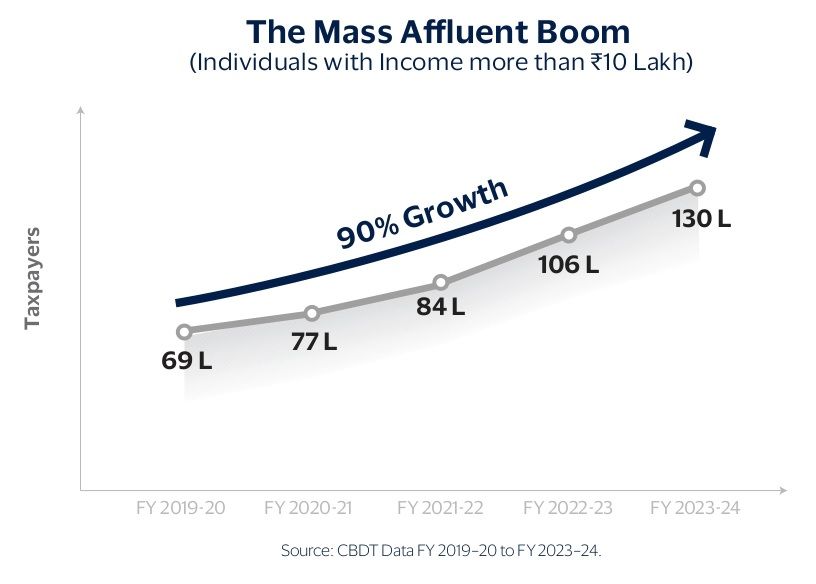
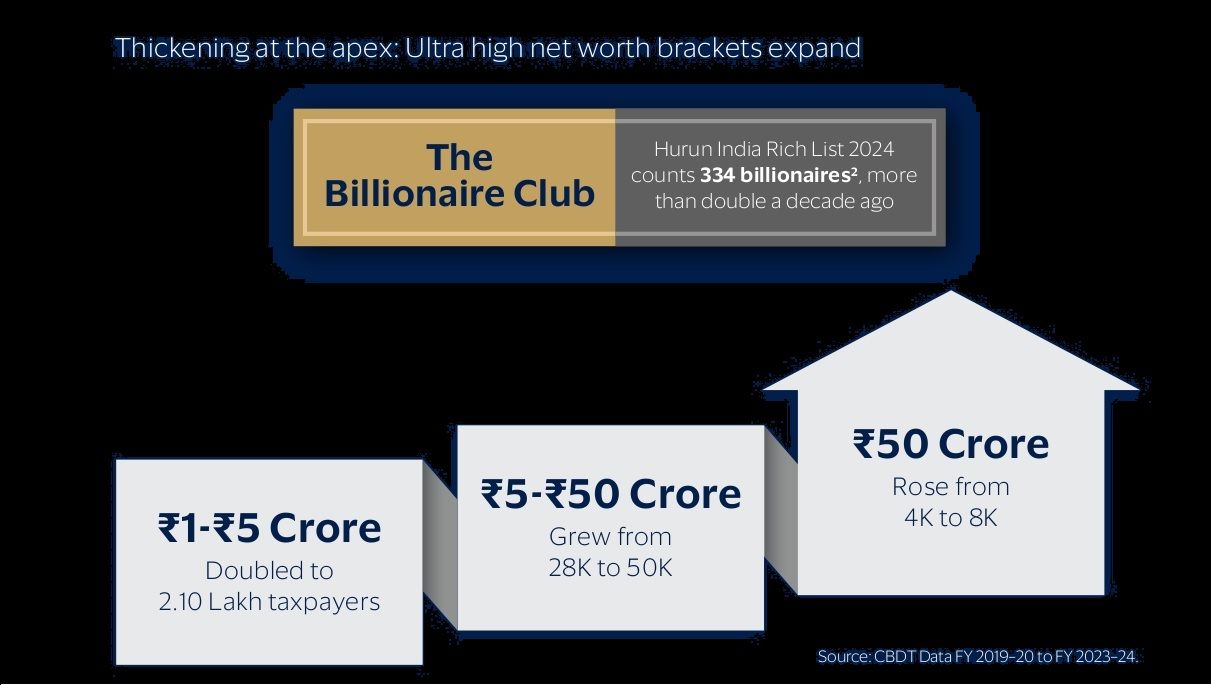
The numbers reflect the scale of the wealth explosion. According to CBDT data cited in the report, taxpayers earning more than ₹10 lakh annually surged 90% between FY20 and FY24, rising from 69 lakh to 1.30 crore individuals. Taxpayers in the ₹1 crore-₹5 crore bracket doubled to 2.10 lakh, while those earning between ₹5 crore and ₹50 crore increased from 28,000 to 50,000.
The report also pointed to the rise of a “mass affluent boom”, supported by India’s IPO surge, startup wealth creation, expanding equity participation and premium real estate demand.
The whitepaper cited estimates from Goldman Sachs suggesting India could have 100 million affluent consumers by 2027, each earning over $10,000 annually.
Wealth Spreading Beyond Big Metros
One of the most significant trends identified in the report is the decentralisation of wealth away from traditional economic centres. “Wealth is flowing from power centres (Mumbai, Delhi, Bengaluru) into emerging hubs like Ahmedabad, Surat, Jaipur, and Lucknow.”
The report attributed this spread to industrial clusters, SME exports, IT services expansion and regional entrepreneurship. Consumption patterns in smaller cities are now beginning to mirror metropolitan behaviour, especially in premium travel, luxury retail and digital payments.
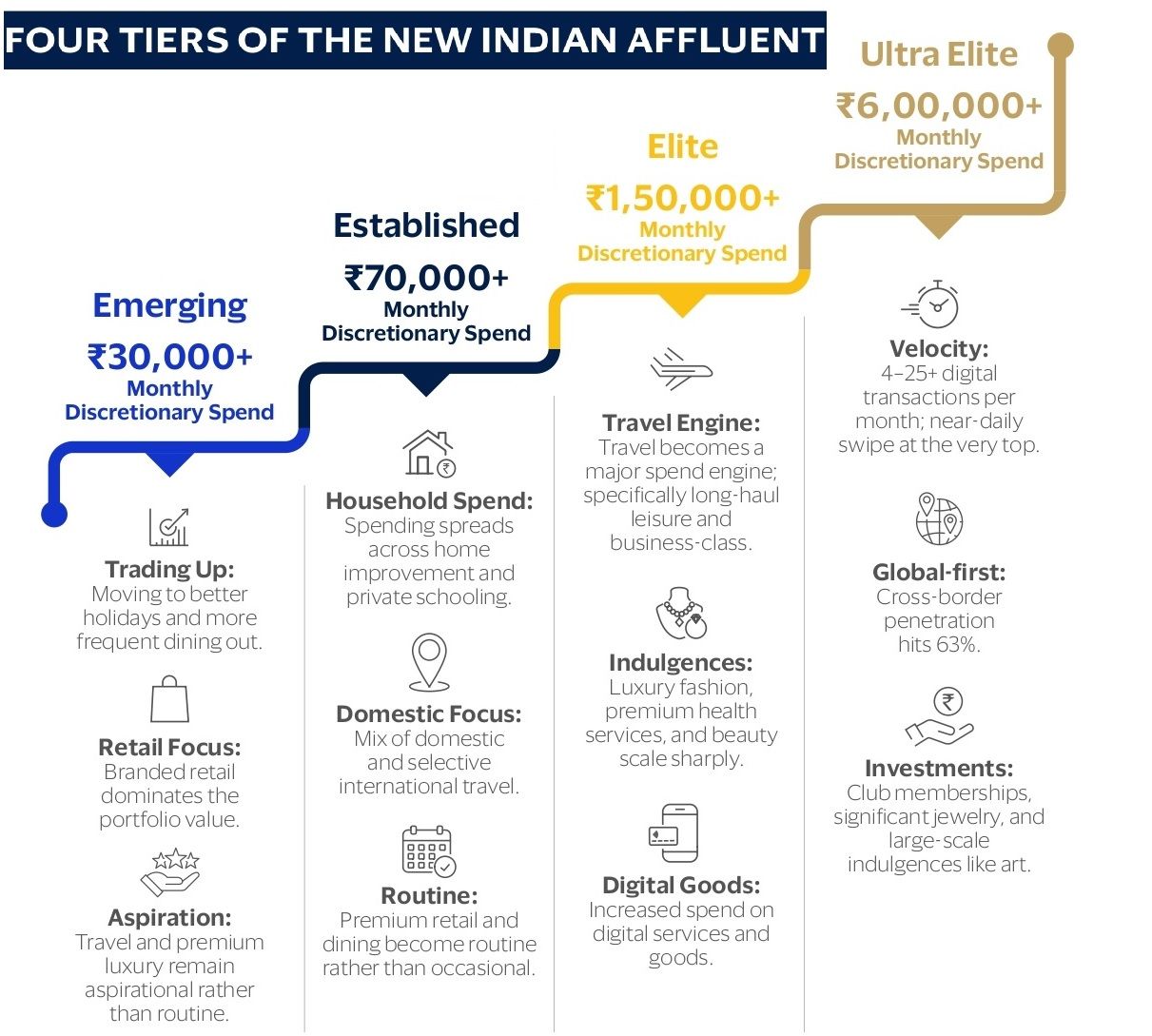
At the same time, affluent consumers are increasingly becoming digitally intensive users. The report said transaction frequency among affluent cardholders rises almost 10 times compared to non-affluent users, while cross-border spending penetration jumps from 30% among emerging affluent consumers to nearly 65% among ultra-elite households.
The affluent consumer is also increasingly “multi-card”, using different cards strategically for airline rewards, lounge access, premium dining and lifestyle benefits.
“The top tiers do not just spend more; they transact differently — faster, globally, and frequently,” the report said.
Travel’s Biggest Luxury Category
The VISA whitepaper identified travel as the single biggest engine of premium spending among affluent Indians, replacing traditional retail categories as the dominant symbol of status. Data in the report showed retail’s share of wallet declining from 49% among emerging affluent consumers to 28% among ultra-elite households. In contrast, travel spending rose sharply across the affluence ladder, peaking at 58% among elite consumers.
“As wealth increases, data shows that retail’s share of wallet declines... while travel’s share expands, signalling a shift from accumulation of goods toward curated experiences,” said the report.
“Affluent consumers are redefining travel, moving beyond passive consumption toward an active expression of identity, wellness, and cultural immersion through curated, high-intensity experiences.”
Nearly four in five affluent consumers now demand top-tier suites and bespoke accommodation experiences, while three in five prioritise meals curated by celebrity chefs and seek private shopping privileges during travel.
The report also highlighted the rise of “future-forward travel”, where affluent consumers are increasingly exploring wellness retreats, detox holidays, luxury wildlife safaris and even experimental experiences such as underwater hotels and zero-gravity wellness concepts. “Nearly 3 in 4 plan at least one wellness-centered trip annually,” according to the report.
Travel frequency is also accelerating rapidly. While seven in 10 emerging affluent travellers still visit only one foreign destination annually, half of elite and ultra-elite consumers travel to as many as three countries every year. One in 25 affluent travellers now undertake itineraries spanning more than 10 countries.
Europe remains the dominant luxury destination for affluent Indians because of heritage stays, fine dining and cultural experiences. Southeast Asia is emerging as the preferred gateway for newly affluent consumers seeking affordable luxury and wellness tourism, while African safaris, Maldives resorts and Nordic wilderness tours are increasingly attracting ultra-elite travellers.
Fine Dining, Fashion & Wellness Are Daily Rituals
The VISA report argued that luxury consumption in India is steadily moving away from milestone-based purchases towards everyday indulgence and recurring lifestyle behaviour. “Among elite and ultra-elite consumers, luxury spending is increasingly moving from milestone-driven occasions toward more routine behaviour,” it said.
Dining has emerged as one of the clearest examples of this transition. Nearly four in five affluent Indians dine at premium restaurants at least three times annually, while one in four visits luxury dining venues more than five times every year.
The report estimated annual dining expenditure among affluent consumers at nearly ₹2 lakh, while almost half spend upwards of ₹50,000 during a single premium dining experience.
“Dining has evolved from sustenance to status. It is now a high-frequency, high-value ecosystem that serves as the primary stage for social signalling.”
Affluent consumers are also increasingly demanding immersive dining experiences, including chef-led tasting menus, VR-enhanced gastronomy and destination dining concepts such as floating or cliff-side tables.
The report said fine dining is now functioning simultaneously as a social, professional and experiential platform.
“Gastronomy serves as the primary stage for social and professional life: Dining is the connective tissue between personal celebration, global travel and professional advancement,” according to the report.
Luxury retail, meanwhile, is becoming more selective and investment-oriented. The report found that two in five affluent consumers spend more than ₹5 lakh annually on premium purchases, while one in four spends over ₹10 lakh every year.
Fashion remains the most visible expression of status and professional identity. Ultra-elite consumers spend more than ₹34,000 per visit on designer apparel, bags and footwear, while one in five purchases luxury luggage worth more than ₹1 lakh per visit.
Jewellery and watches are increasingly viewed as collectible assets tied to heritage and exclusivity rather than one-time purchases. “They represent ‘permanence’ in the portfolio, driven by brand heritage rather than resale value,” the report said.
Technology and wellness are also emerging as major luxury categories. The report said affluent consumers are increasingly integrating smart-home systems, premium gadgets, beauty treatments and wellness services into everyday lifestyles. “Technology has moved beyond utility to become a marker of a thoughtfully curated lifestyle,” according to the report.
Ultra-elite consumers are now eight times more likely to visit spas than non-affluent consumers, while spending on beauty and cosmetic products has risen five-fold across affluence tiers.
Brands Must Shift To Lifestyle Ecosystems
The VISA report concluded that India’s affluent economy is increasingly being driven by “access over ownership”, where consumers value belonging, exclusivity and seamless experiences more than visible accumulation. “Status is moving away from visible possession toward meaningful participation,” the report said.
The report argued that affluent consumers are now seeking integrated ecosystems that combine travel, payments, dining, memberships, wellness and digital identity into one frictionless lifestyle experience. “Luxury is no longer defined by ownership alone. It is defined by belonging, ease, and flow,” the report said. “As wealth increases, so does the desire for simplicity. The true premium is not choice, but clarity.”
(Cover photo by Courtney Cook on Unsplash)