

New Delhi: India, according to a Reuters report, recorded its fifth-driest June since nationwide rainfall records began in 1901, capping an unusually weak start to the 2026 southwest monsoon and raising fresh concerns over agriculture, reservoir levels and inflationary pressures in the months ahead.
India recorded 99.5 mm of rainfall in June, well below the long-term average of 165.3 mm, according to data from the weather department, said the report. The rainfall deficit was driven by a delayed onset of the southwest monsoon, which arrived in Kerala three days behind schedule, followed by a nearly two-week pause in its advance across key agricultural regions in western India.
The disappointing June monsoon performance comes at a critical point in the Kharif sowing season, when millions of farmers depend on timely and widespread rainfall. Although the monsoon has advanced across the country, rainfall distribution has remained uneven, leaving several key agricultural regions facing moisture stress.
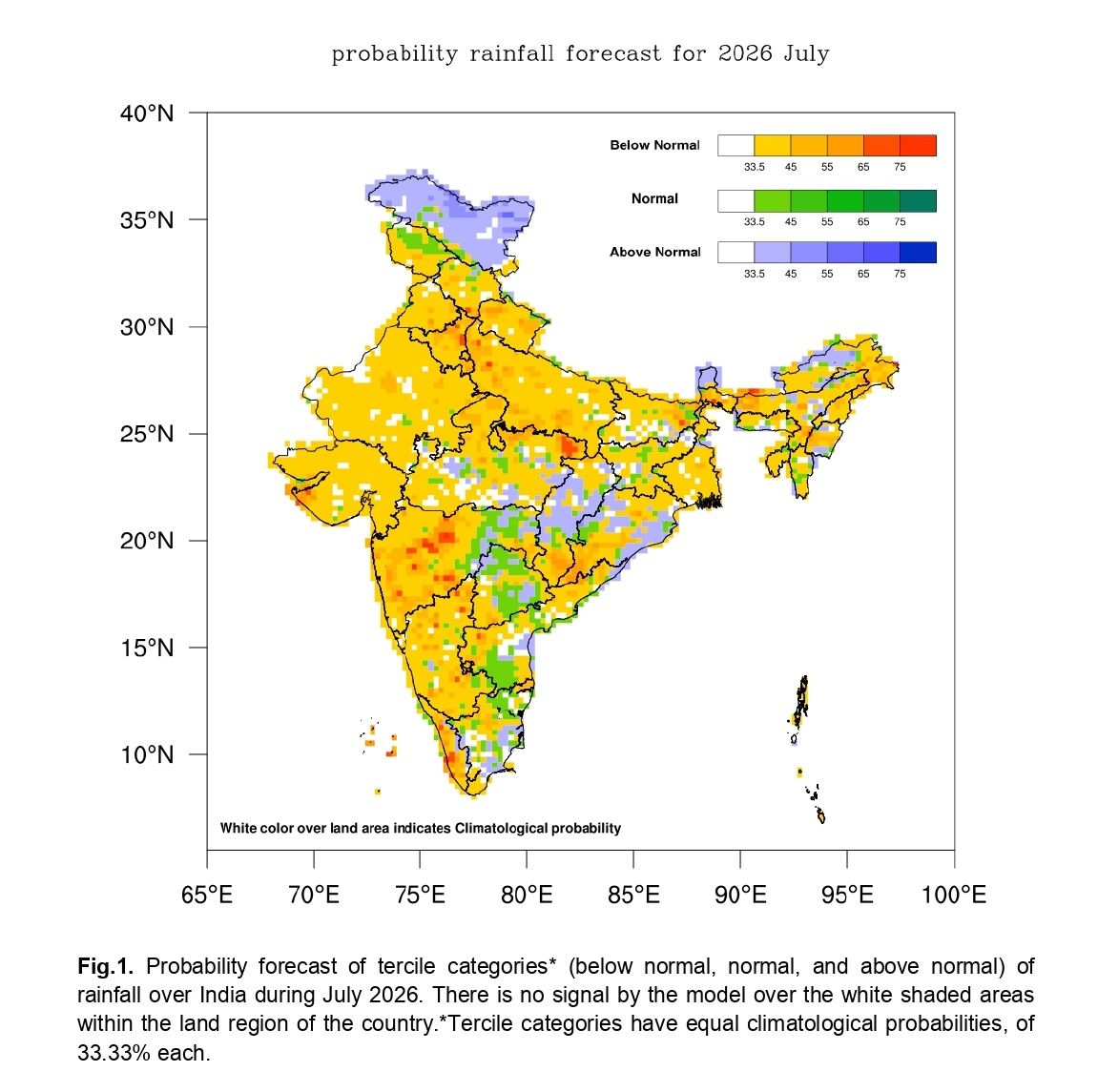
The India Meteorological Department (IMD) now expects July — the most rain-intensive month of the monsoon — to deliver below-normal rainfall for the country as a whole. Monthly rainfall is forecast to remain below 94% of the Long Period Average (LPA) of 280.4 mm, suggesting that the rainfall deficit could persist through the peak monsoon month rather than narrowing.
“Monthly average rainfall over the country during July 2026 is most likely to remain below normal. Most regions are expected to receive lower-than-normal rainfall, although parts of northwest, northeast, east-central and eastern peninsular India could see normal to above-normal precipitation,” the IMD said.
The forecast marks a notable shift from expectations of a stronger recovery during July. A second consecutive month of subdued rainfall would test agricultural resilience, particularly for water-intensive crops such as paddy, cotton and sugarcane, while increasing dependence on irrigation in several states.
The rainfall outlook also assumes greater significance because June rainfall establishes soil moisture conditions that determine crop establishment across much of rural India. A weak opening month often leaves farmers vulnerable to prolonged dry spells during the rest of the season.
July Weather Outlook
Alongside weaker rainfall, the IMD expects July to remain warmer than usual across much of the country.
Maximum temperatures are forecast to stay above normal over most regions, with only isolated pockets of west-central India likely to experience normal or below-normal daytime temperatures. Minimum temperatures are also expected to remain above seasonal averages across large parts of the country, reducing night-time cooling and potentially increasing heat stress.
The warmer conditions could accelerate evaporation from reservoirs and soil, intensifying pressure on already constrained water resources where rainfall remains deficient.
The weather outlook is also being shaped by evolving global ocean conditions. Weak El Niño conditions have developed over the equatorial Pacific and are expected to strengthen further during the southwest monsoon season. At the same time, neutral Indian Ocean Dipole (IOD) conditions are likely to persist.
“Below-normal rainfall can create significant challenges for agriculture, drinking water availability, hydropower generation, ecosystems and water-resource management. Timely conservation measures, efficient water management and agricultural contingency planning can substantially reduce the impact of rainfall deficits,” the weather office said.
Although El Niño has historically been associated with weaker Indian monsoons, its influence varies depending on atmospheric circulation and Indian Ocean conditions. Neutral IOD conditions may provide only limited support to rainfall if Pacific warming intensifies during the season.
Economic Impact Ahead
The weak start to the monsoon comes at a time when policymakers are closely monitoring food prices after inflation eased in recent months.
A prolonged rainfall deficit could slow Kharif sowing, reduce crop yields and eventually push up prices of cereals, pulses and vegetables if rainfall does not improve later in the season. Reservoir replenishment, hydroelectric power generation and groundwater recharge may also come under pressure in rain-deficit regions.
Despite the subdued July forecast, rainfall is not expected to be uniformly weak across the country. Parts of northwest India, northeast India, east-central India and the eastern peninsular region are likely to receive normal or above-normal rainfall, offering some relief to agricultural activity in those pockets.
The IMD continues to provide extended-range forecasts, district-level weather predictions and agro-meteorological advisories to help farmers and state agencies respond to evolving weather conditions. The department will issue its outlook for rainfall during August and the second half of the southwest monsoon — covering August and September — towards the end of July.
“The IMD's forecasting system provides seasonal forecasts, extended-range outlooks, district-level weather forecasts and impact-based advisories. Effective use of these services can help farmers, water managers and disaster-response agencies minimise risks arising from below-normal rainfall,” the department said.
For now, attention will remain firmly fixed on July. After one of the weakest June performances in more than a century, the coming weeks will determine whether the 2026 southwest monsoon can regain momentum or whether India faces a more prolonged season of rainfall stress with broader implications for growth, rural incomes and inflation.
(Cover photo by Priyash Vasava on Unsplash)