


New Delhi: Europe’s second major heatwave of 2026 is doing more than pushing thermometers into record territory. It is reinforcing a structural shift in the continent’s climate — one that scientists say has been unfolding for decades but is now becoming impossible to ignore.
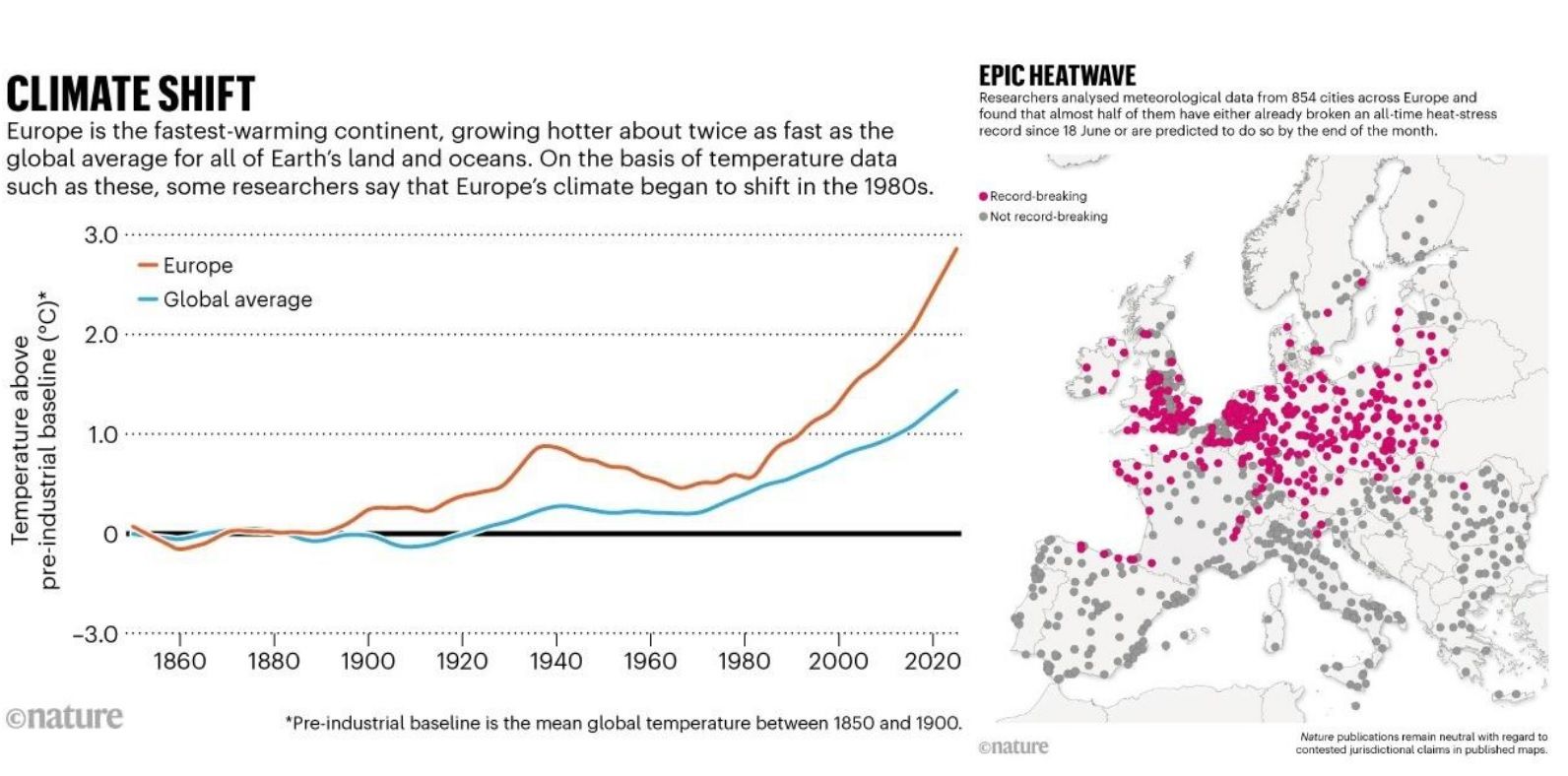
The latest numbers illustrate the scale of the transformation. Germany registered a record 41.3°C near Saarbrücken. France climbed to 43.8°C in Pulluau after recording its hottest national day on record, with an average daily temperature of 30°C. Czechia touched 40.6°C, Switzerland reached 38.8°C in Basel, while Denmark posted an unprecedented 37°C, a remarkable figure for a country historically associated with mild summers.
These records span regions with vastly different climates, indicating that this is not a Mediterranean phenomenon spreading northward but a continent-wide warming trend. The geographical breadth of the heat is arguably more significant than the individual temperature records themselves.
Scientists increasingly distinguish between weather and climate by examining probability rather than individual events. In that framework, Europe’s recent heatwaves are no longer statistical outliers. They are becoming increasingly probable outcomes of a warmer atmosphere.
The continent has already warmed by around 2.4°C since pre-industrial times — roughly twice the global average. That differential matters because every fraction of a degree dramatically increases the likelihood of prolonged extreme heat. Climate attribution studies repeatedly conclude that heatwaves of this magnitude would have been exceptionally unlikely without anthropogenic greenhouse gas emissions.
Perhaps the clearest indication that Europe’s climate is changing is not the existence of new records but the speed with which old ones are being surpassed. Many national temperature records established only a decade ago have either been matched or exceeded within a remarkably short period. What was once classified as an extreme event is increasingly becoming part of the seasonal climate baseline.
Scientists caution that records are, by definition, meant to be broken occasionally. Yet when records fall simultaneously across multiple countries and in consecutive years, they point to a systematic shift rather than random weather variability.
Compounding Economic Risks
The consequences extend well beyond headline temperatures. Heat is emerging as one of Europe’s fastest-growing macroeconomic risks because it simultaneously affects labour, agriculture, infrastructure, healthcare and energy systems.
In France, hospitals treated more than 3,000 heat-related patients within 24 hours as temperatures remained dangerously high overnight, limiting the body’s ability to recover from daytime exposure. Italy expanded red alerts to 18 cities, while authorities across southern Europe imposed restrictions on outdoor work during peak afternoon hours.
Infrastructure designed for 20th-century climate conditions is increasingly operating beyond its engineering thresholds. Railway tracks expand, road surfaces soften and electricity grids experience surging demand as air-conditioning use accelerates. At the same time, drought reduces hydropower generation and constrains cooling water supplies for thermal and nuclear power stations, exposing a growing mismatch between energy demand and energy resilience.
Agriculture presents another layer of vulnerability. Water stress is intensifying across the Po Valley, one of Europe’s most productive farming regions, while Swiss glaciers are approaching one of their earliest annual mass-loss milestones on record following an unusually warm winter and an exceptionally hot June. Lower snowpack, shrinking glaciers and drier soils also create feedback mechanisms that amplify future heat, allowing temperatures to rise even faster during subsequent heatwaves.
These interconnected impacts demonstrate why economists increasingly view extreme heat as a systemic risk rather than an isolated weather event.
An equally important question is why Europe is warming faster than every other inhabited continent. The answer lies in a combination of geography and climate feedbacks that amplify global warming at the regional level. Unlike oceans, land heats up more rapidly because it absorbs and retains heat differently. Europe also sits adjacent to the rapidly warming Arctic, where declining sea ice reduces the Earth’s ability to reflect incoming solar radiation. As darker ocean surfaces replace reflective ice, more heat is absorbed, accelerating regional warming through Arctic amplification.
Southern Europe is experiencing another reinforcing mechanism. Years of below-average rainfall have left soils significantly drier than historical norms. Moist soils naturally cool the surrounding air through evaporation, but when that moisture disappears, a greater share of incoming solar energy directly heats the land surface. The result is a self-reinforcing cycle in which drought intensifies heat, and heat further worsens drought. This feedback has become increasingly evident across Spain, Italy and parts of France over successive summers.
The Mediterranean Sea has also become a critical climate driver. Sea surface temperatures have repeatedly reached record highs, weakening the cooling influence that surrounding waters traditionally exerted on nearby land. Warmer seas inject additional heat and moisture into the atmosphere, fuelling weather extremes while keeping night-time temperatures unusually high. These warmer nights are especially dangerous because the human body depends on cooler overnight conditions to recover from daytime heat stress. When temperatures remain elevated after sunset, heat-related illnesses and mortality increase sharply.
The broader implication is that Europe is entering an era of compound climate extremes. Heatwaves are increasingly coinciding with drought, water scarcity, wildfire outbreaks and energy shortages rather than occurring independently. These overlapping crises multiply economic losses because multiple sectors come under stress simultaneously. A drought depresses agricultural output at the same time that extreme heat boosts electricity demand, while shrinking rivers disrupt inland shipping and industrial supply chains. The cumulative effect extends well beyond weather statistics, influencing food prices, inflation and overall economic growth.
Financial markets have begun incorporating these risks into long-term valuations. Investors are paying closer attention to climate exposure across utilities, insurers, transport operators, construction companies and agricultural businesses as recurring heatwaves alter earnings expectations. Central banks and financial regulators have likewise intensified climate stress testing, reflecting growing concern that repeated climate shocks could evolve into broader financial stability risks. What was once treated primarily as an environmental issue is increasingly being recognised as a material economic variable.
Perhaps the most profound shift is psychological. For decades, extreme heat in Europe was viewed as an occasional anomaly requiring emergency measures. Today, governments, businesses and households are increasingly planning for severe heat as an annual operational challenge. That change in perception may ultimately prove as consequential as the rising temperatures themselves because it signals that climate adaptation has moved from long-term policy ambition to immediate economic necessity.
Beyond New Normal
The phrase “new normal” suggests stability after change. Europe’s climate offers no such reassurance.
Climate models indicate that, unless greenhouse gas emissions fall rapidly, each successive decade is likely to be warmer than the previous one. That means today’s records are establishing a moving baseline rather than defining an upper limit.
The scientific evidence points to an important distinction. Europe is not simply experiencing more frequent heatwaves. The physical characteristics of those events are changing simultaneously. Heatwaves are arriving earlier in the year, lasting longer, covering larger geographical areas, producing warmer nights and reaching higher daytime peaks. Each of those variables independently increases health and economic risks; together they multiply them.
This year’s second major heatwave before the midpoint of summer illustrates that transition. What once qualified as an exceptionally rare event is becoming increasingly embedded within Europe’s seasonal climate.
The debate, therefore, is no longer whether Europe’s climate has fundamentally changed. Record temperatures of 43.8°C in France, 41.3°C in Germany, 40.6°C in Czechia, 38.8°C in Switzerland and 37°C in Denmark point to a continent operating under a different climatic regime than it did a generation ago. The remaining uncertainty is not whether more records will fall, but how rapidly governments, businesses and societies can adapt before the next unprecedented heatwave arrives.