

New Delhi: The AI race is no longer just about technological innovation. It is becoming the defining economic and industrial battleground of the next quarter century, with implications that stretch far beyond Silicon Valley. According to BMI, a Fitch Solutions company, AI has emerged as the single most disruptive force for global industries through 2050, eclipsing climate change, geopolitical uncertainty and supply chain upheavals.
The finding marks a significant shift in long-term business thinking. After a decade of tracking structural changes across the global economy, BMI argues that no previous megatrend has matched AI’s reach across sectors or its ability to reshape competitive dynamics. Yet the report also suggests that the growing corporate enthusiasm for AI risks overlooking the costs and vulnerabilities that accompany rapid technological adoption.
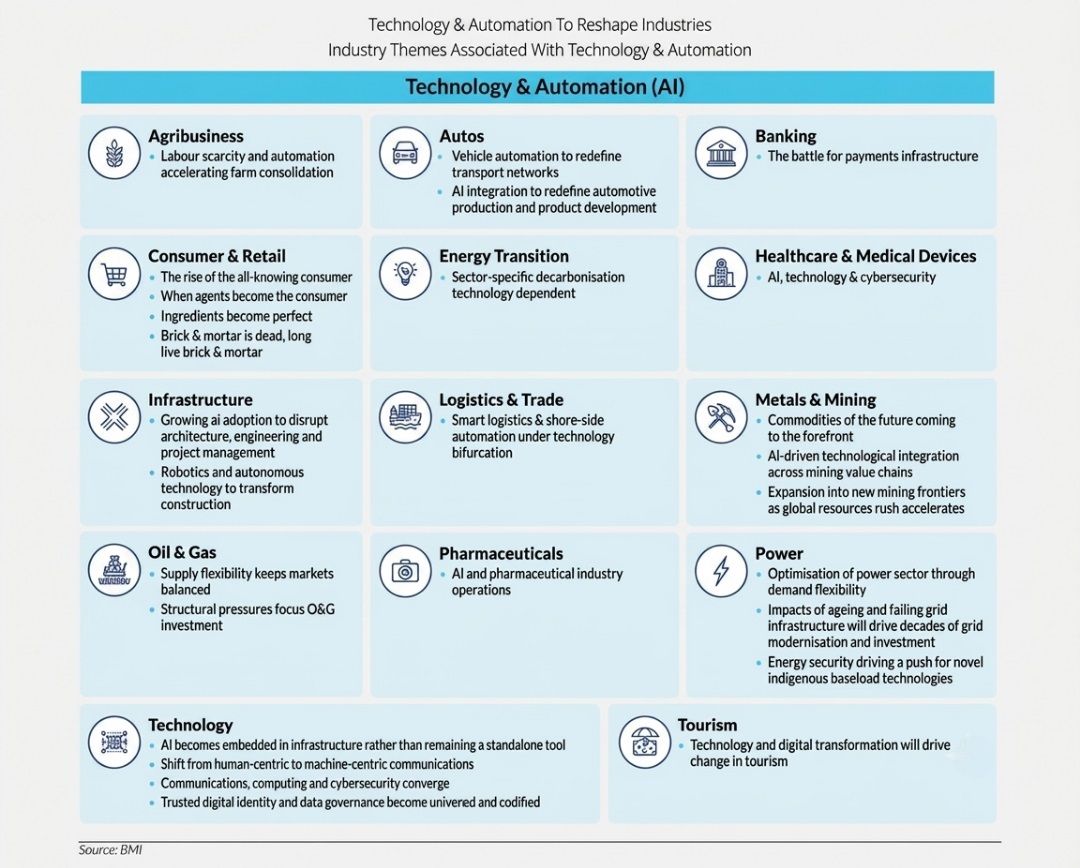
The fifth edition of Towards 2050: Megatrends In Industry, Politics And The Global Economy argues that technology and automation, led by AI, have become the clear long-term winner among the structural forces reshaping business. According to the report, AI-related disruption now spans 27 industry themes across 14 sectors, making it the broadest industrial transformation BMI has identified in 10 years of research.
AI Changes Everything
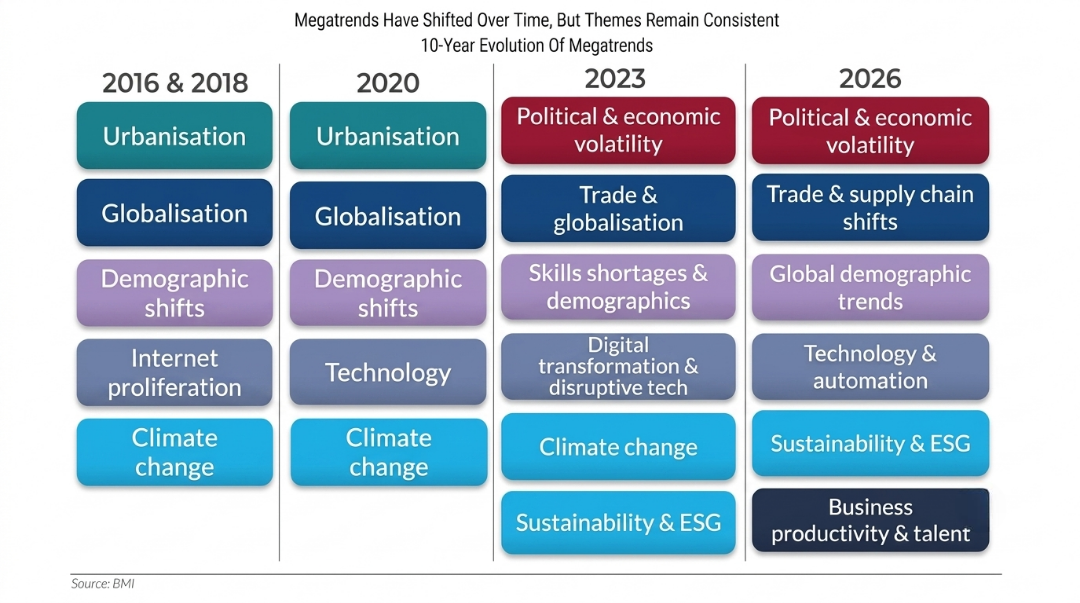
“For the first time in 10 years of megatrends research and survey, there is a clear stand-out in terms of overarching megatrend. The rise of AI is permeating all industries as well as the global economy and political landscape in a way that no other trend is, or has in this research series so far,” says the report.
That assessment is backed by a survey of 741 senior executives across 15 industries and five geographies. More than 90% of respondents believe the structural megatrends identified by BMI will disrupt their businesses through 2050, while AI increasingly features both as a source of disruption and as a solution to other long-term challenges, says the report.
The implications extend well beyond technology companies. According to the report, AI is expected to improve transparency and product customisation in consumer sectors, speed up project execution in heavy industries, accelerate drug development in pharmaceuticals and healthcare, and help offset labour shortages created by ageing populations. The breadth of those applications explains why AI has moved from being another technological innovation to a core business strategy.
Yet BMI offers a more nuanced assessment than the prevailing market optimism. According to the report, “Technology & automation (including AI) is the most universal theme seen to date in our megatrends research, touching every industry and having the potential to both disrupt industries but also act as a salve for disruption caused by other structural megatrends.”
The qualification matters. AI may improve productivity, but it is unlikely to eliminate the underlying structural pressures facing businesses. Instead, it could amplify new forms of competition, increase investment costs and deepen the divide between companies that adapt quickly and those that lag behind.
Risks Grow Too
The report argues that the AI revolution cannot be viewed in isolation. Climate change and the green transition remain the second most disruptive structural force, while changing trade patterns, geopolitical tensions and demographic shifts continue to reshape business models.
One of the less discussed consequences of AI is its growing infrastructure demand. According to the report, improved energy efficiency and smarter grid management could reduce waste, but the rising electricity needs of the technology sector could place significant pressure on power supplies, particularly renewable energy systems.
Cybersecurity is another area where the AI boom could expose weaknesses rather than solve them. “Across all sectors, growing technological integration leaves them more exposed to cybersecurity breaches. This is especially urgent to address in sectors with highly sensitive data, such as life sciences, or critical infrastructure,” says the report.
The survey suggests businesses recognise the threat. About 93% of respondents believe they are somewhat or well prepared for cybersecurity risks, up from 75% in the previous survey. However, BMI hints that this confidence could underestimate the pace at which cyber threats are evolving, particularly as AI systems become deeply integrated into industrial operations.
The report also challenges the assumption that AI will inevitably lead to large-scale job losses. Companies currently view the technology more as a productivity tool than a replacement for workers, with only 14% expecting AI to reduce headcount. Instead, businesses anticipate that AI will expand capabilities and support workforce transformation.
That expectation could prove optimistic. History suggests that technological revolutions rarely eliminate labour challenges; they simply redefine them, creating new demands for skills while rendering others obsolete.
Beyond The Hype
BMI’s analysis suggests that AI’s greatest impact may lie in its interaction with other megatrends rather than in technological progress alone. Businesses facing shrinking workforces, fragmented supply chains and climate risks increasingly see AI as an enabler that can help manage structural pressures.
Michelle Karavias, Head of Industry Research at BMI, captures that shift in perspective. “In the three years since the fourth edition of our Megatrends report, a fresh round of geopolitical and macroeconomic upheaval has impacted all regions; but these traditional challenges are no match for AI's disruptive potential in both scale and reach, with the technology touching more sectors than any other megatrend we track.”
She adds, “At the same time, climate change and energy transition is a clear and irreversible disruptive force that has the potential to shift the structure of industries and redefine the calculation of risk. Businesses that focus only on today’s volatility may risk overlooking the deeper structural trends that will define competitive advantage through 2050.”
The report ultimately offers a cautionary message for boardrooms. AI may have emerged as the defining industrial megatrend, but it will not operate in a vacuum. Success will depend not simply on deploying the latest technology but on integrating AI with broader strategies for resilience, workforce development, energy security and risk management.