


New Delhi: Artificial intelligence has gone mainstream in the workplace, but corporate management has not. Companies across the world have poured billions into AI adoption, employees are using the technology at unprecedented rates, and productivity gains are becoming measurable. Yet much of that value risks evaporating because executives have failed to answer a simple question: what should workers do with the time AI creates?
That disconnect is the central finding of Boston Consulting Group’s latest global workplace survey. AI is no longer a technology story. It is increasingly a management story, and corporate leadership appears to be lagging the technology curve.
BCG’s AI at Work: Strategy Matters More Than Tools report, based on a survey of 11,749 employees across 14 markets and multiple industries, argues that the biggest barriers to AI-driven growth are no longer software availability or employee adoption. They are strategic clarity, organisational redesign and management capability. The report suggests that many companies are treating AI as a productivity application when the larger opportunity lies in reinventing how work itself is organised.
The headline numbers are difficult to ignore. About 74% of frontline employees now use AI regularly, up 23 percentage points from 2025. Among managers, the figure is 88%, while 93% of leaders use AI frequently. India is among the world’s leaders, with 86% of frontline employees using AI several times a week, well above the global average of 74%.
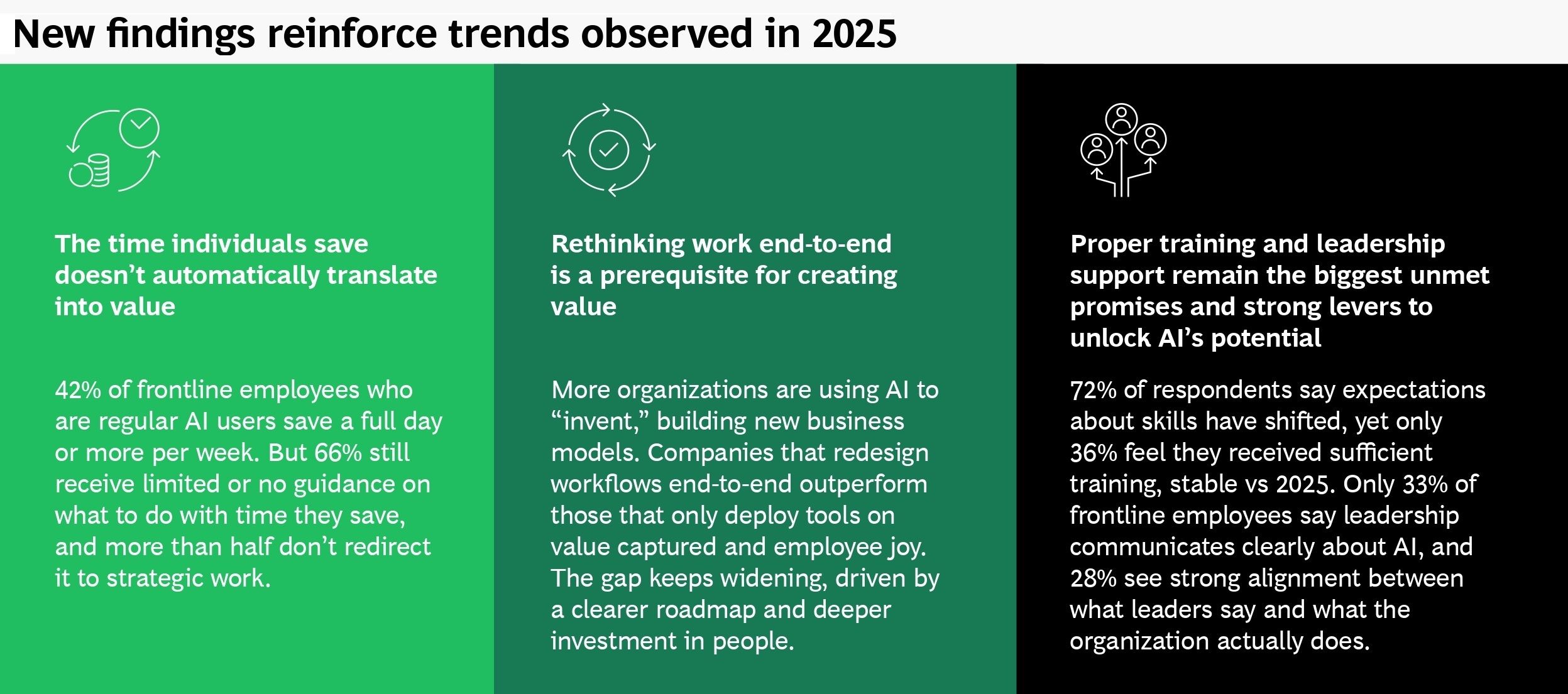
Yet the productivity dividend is leaking away. Among regular AI users, 52% save at least a full workday every week. For leaders, the figure rises to 60%. Frontline workers save less but still post impressive gains, with 42% reporting savings of at least eight hours a week.
The report captures the dilemma succinctly. “Everyone talks about time saved, but the real shift is deeper and structural. 72% of the respondents report skill expectations have changed, and nearly half say their roles have shifted toward managing and directing AI instead of doing the work itself,” it says.
The problem is that companies have not caught up with that structural change. About 66% of frontline employees say they receive limited or no guidance on what to do with the time AI saves, while more than half do not redirect those gains into strategic work. The result is that productivity improvements remain largely individual achievements rather than enterprise-wide value creation.
Strategy Beats Software
Corporate AI spending has largely been driven by the race to deploy tools. BCG’s research suggests that strategy, not technology access, increasingly separates winners from laggards.
The report divides companies into three categories: those merely deploying AI tools; those reshaping workflows around AI; and those inventing entirely new products and business models. The gap between the groups is widening rapidly.
About 78% of organisations are deploying AI to improve productivity, 72% are redesigning workflows and 42% are using AI to create new business models, nearly double last year’s level. Employees working in companies pursuing ‘Reshape’ or ‘Invent’ strategies consistently outperform those at businesses focused only on deployment.
The numbers are striking. Workers in transformation-focused companies are 22 percentage points more likely to save at least a day each week through AI. They are 24 percentage points more likely to see measurable business improvements and 23 percentage points more likely to demonstrate their own unique value. Job satisfaction also rises sharply, with 68% reporting greater enjoyment at work against 48% in companies pursuing simple deployment strategies.
Perhaps the report’s most uncomfortable finding for technology vendors is that expensive software cannot compensate for weak leadership. Employees with strong strategic clarity but limited access to AI tools report measurable business impact 80% of the time. Those with strong tool access but weak strategic direction report impact only 60% of the time.
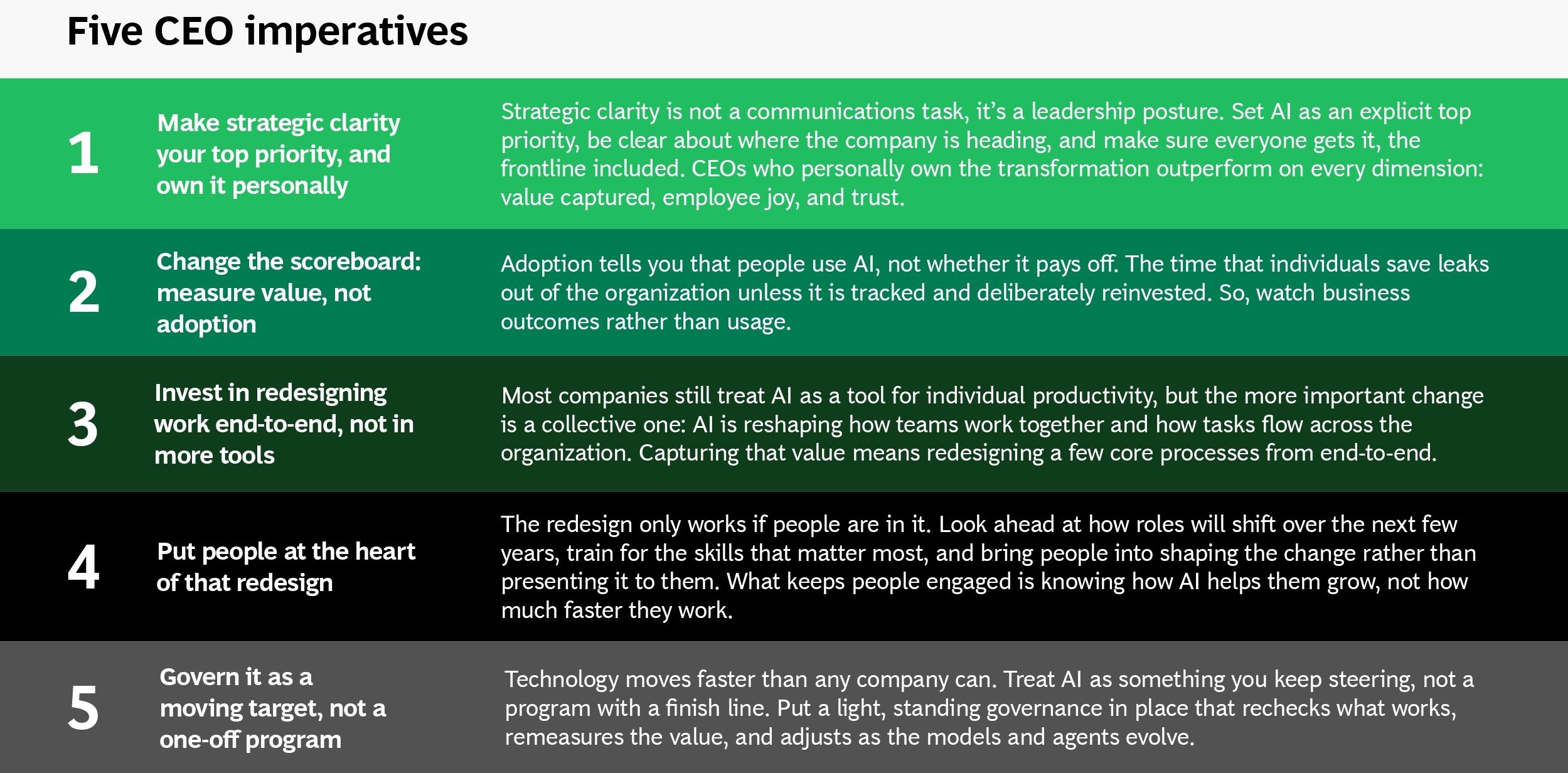
The report says, “Strategic clarity is not a communications task, it’s a leadership posture. Set AI as an explicit top priority, be clear about where the company is heading, and make sure everyone gets it, the frontline included.”
That message exposes a persistent weakness in corporate AI programmes. While 72% of employees believe skill expectations have fundamentally changed, only 36% feel adequately trained for the transition. An overwhelming 88% expect major upskilling requirements over the next five years.
The disconnect extends to leadership communication. Only one-third of frontline employees believe management communicates clearly about AI, while fewer than three in 10 see alignment between executive messaging and organisational action.
Governance Gap Widens
If generative AI unsettled corporate structures, AI agents could force an even larger overhaul. Here too, businesses appear enthusiastic about technology but underprepared for the operational consequences.
Awareness of AI agents has surged, with 84% of respondents familiar with the concept. More importantly, deployment has accelerated. The share of organisations integrating AI agents directly into workflows has jumped from 13% in 2025 to 30% in 2026.
The workforce expects profound disruption. About 61% of respondents believe AI agents could perform at least half their job within three years. Among managers and senior leaders, that figure climbs to 65%.
But governance frameworks remain conspicuously absent. Half of employees say their companies have no clear guidance for managing human-AI teams, while 47% rank AI-driven accountability among their top concerns over the next two to three years.
The report warns against treating governance as a one-off compliance exercise. “Technology moves faster than any company can. Treat AI as something you keep steering, not a programme with a finish line. Put a light, standing governance in place that rechecks what works, re-measures the value, and adjusts as the models and agents evolve.”
There is another cautionary note. AI appears to make work simultaneously more satisfying and more demanding. Around 67% of regular users say job satisfaction has improved, but 41% also report higher mental strain. The initial excitement of AI adoption fades over time unless employees receive clear strategic direction and understand how technology enhances their long-term role.
For corporate leaders, the findings carry an uncomfortable message. The first phase of the AI race was about buying technology. The second phase is about redesigning organisations. Many companies appear to believe the hard part is over because the software is installed.
BCG’s data suggests the opposite. AI adoption is becoming commonplace and the technology advantage is narrowing. The next competitive edge will come from management quality, organisational redesign and workforce strategy. Companies that mistake AI for another productivity tool risk discovering that the biggest returns never came from the technology itself, but from changing the way people work. Many have bought the tools. Far fewer have built the strategy.