

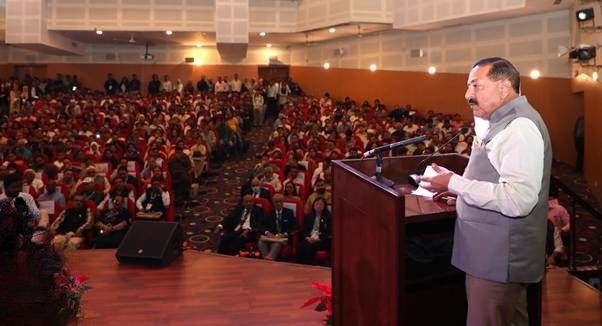
New Delhi: Stressing the critical need to address climate change, urbanization, and sustainable resource management, Union minister of science & technology Jitendra Singh called them “deeply interconnected issues that collectively determine the sustainability of our shared future”.
In his inaugural address at the Asian Conference on Geography at Jamia Millia Islamia, he highlighted India’s leadership in linking economic growth with environmental sustainability, aiming for a net-zero target by 2070 and promoting the LiFE (Lifestyle for Environment) movement.
Commending Jamia Millia Islamia for hosting the first-ever edition of this prestigious conference in India, the minister praised the institution for bringing together international experts, academics and students to deliberate on global environmental challenges.
“Asia is at the centre of global transformation, marked by impressive industrial and economic dynamism, yet contributing to more than half of the world’s greenhouse gas emissions,” Singh noted, citing the IPCC Sixth Assessment Report. He warned of increasing vulnerability in the region to extreme weather events, including heatwaves, floods, and water stress. South Asia alone is home to over 750 million people exposed to severe climate hazards, with cities like Delhi, Dhaka, Bangkok and Manila ranked among the most climate-vulnerable megacities by 2050.
Singh pointed out that rapid urbanization, while a sign of progress, poses challenges due to unplanned expansion, encroachment on floodplains, groundwater depletion, and rising pollution levels. Referring to the 2014 Srinagar floods, he stressed that human negligence and poor planning often exacerbate natural disasters.
Highlighting waste management as a critical concern, the minister shared that nearly 80% of wastewater in developing Asian countries is discharged untreated and urban India generates over 55 million tonnes of solid waste annually, growing at 5% per year. He emphasized the importance of waste-to-wealth technologies and circular economy initiatives, citing successful community-driven recycling projects in Dehradun as examples.
The minister stressed that public participation is essential for success, noting that “unless there is a social movement, no amount of policy or seminar will yield optimal results.” He cited the Swachh Bharat Mission as a case study in mobilizing citizen action for sustainable change.
The minister also underscored India’s robust policy framework for sustainability, including the National Action Plan on Climate Change (NAPCC), state action plans, Smart Cities Mission, AMRUT, and Swachh Bharat Mission. He highlighted the LiFE initiative as inspiring a global movement towards responsible consumption and environmental stewardship.
Scientific research and innovation remain central to India’s sustainability agenda, he noted, pointing to Isro’s earth observation missions, the National Geospatial Policy (2022), and the Survey of India’s drone-based mapping under the SVAMITVA programme as transformative tools for climate resilience planning.
Education and youth engagement were also emphasised, with Singh highlighting the role of the National Education Policy (NEP) 2020 in promoting interdisciplinary learning and environmental awareness. “Empowering youngsters with the knowledge and tools for sustainability is the most powerful investment in our collective future,” he said.
Urging stronger regional and international cooperation, Singh pointed to India’s leadership in initiatives such as the International Solar Alliance (ISA) and the Coalition for Disaster Resilient Infrastructure (CDRI), stressing that Asia must collaborate closely to ensure a resilient, low-carbon, and equitable future.
Concluding his address, he reminded attendees that climate action is “a personal concern for every citizen, for our own health, our own well-being, and our children’s future.”