

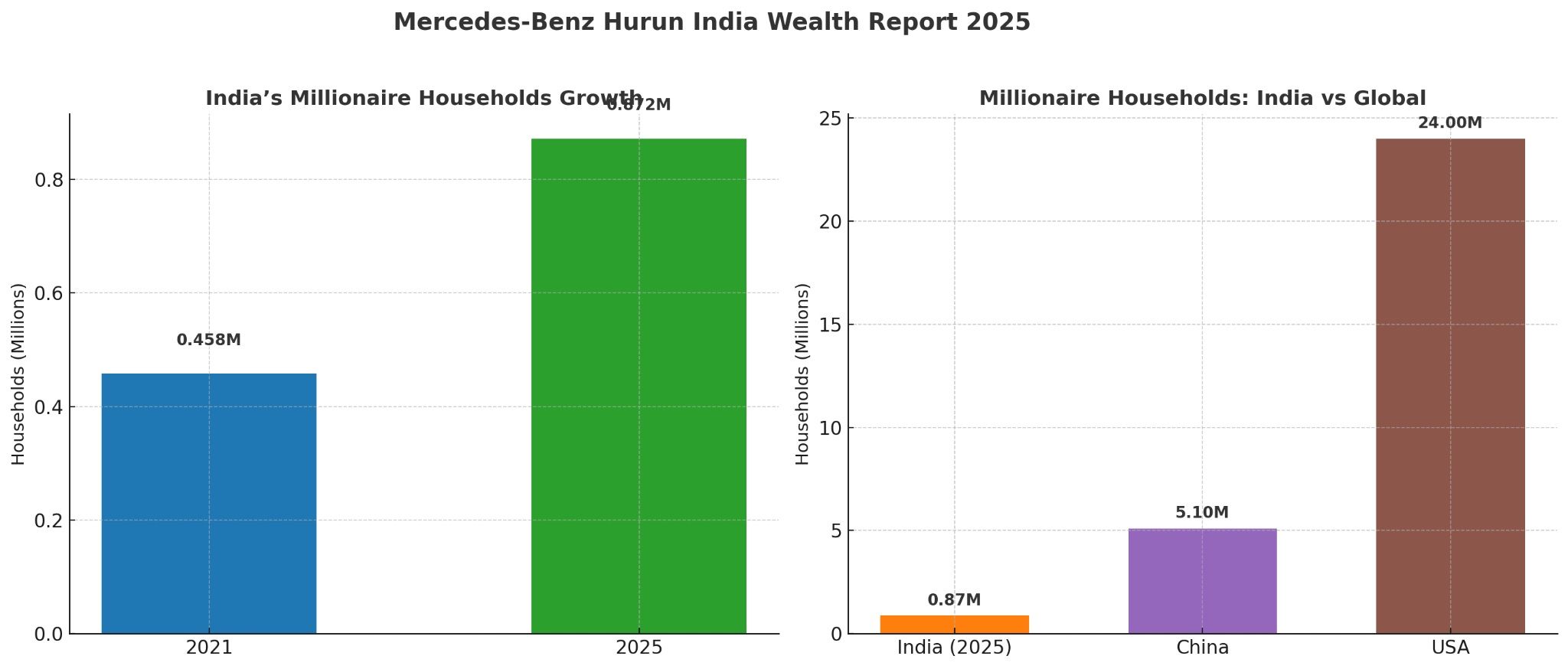
New Delhi: India’s wealth landscape is transforming at record pace. The country is now home to 8,71,700 dollar-millionaire households, each with a net worth of Rs 8.5 crore or more. This represents a staggering 90% growth in just four years, up from 4,58,000 millionaire households in 2021. These affluent families now account for 0.31% of India’s total households, compared with 0.17% four years ago.
The findings, part of the inaugural Mercedes-Benz Hurun India Index (MBHX), were unveiled recently alongside the Mercedes-Benz Hurun India Luxury Consumer Survey 2025, which offers a window into the aspirations, investments and lifestyle choices of India’s millionaires. With an average age of just 32 years, these young wealth creators are shaping India’s luxury consumption patterns, from adopting digital payments to defining preferred global brands.
In parallel, the MBHX index highlights the surge of India’s wealth creation story, blending indicators such as luxury car sales, billionaire growth, stock market performance and GDP. According to Hurun India, the index has surged nearly 200% in recent years — an evidence of the country’s strong and resilient economic momentum.
Historic Scale
Describing the scale of wealth creation as “extraordinary upward mobility”,Anas Rahman Junaid, founder & chief researcher of Hurun India, noted that in less than a decade, the number of millionaire households in India has grown by 445%, underlining the expanding base of prosperity.
However, he also pointed out that only 5% of 2017’s millionaires have gone on to become ultra-high-net-worth individuals (UHNWIs), and a mere 0.01% reached billionaire status. “This shows that while affluence is spreading, the climb to the very top remains steep,” he said.
Comparing the country’s wealth base globally, Junaid said India’s 8.7 lakh millionaire households are modest compared to China’s 51 lakh and the even larger figure in the United States. But he emphasized this as India’s “runway for growth”. With the economy projected to double in the next decade, Hurun estimates India could see 1.7 to 2 million millionaire households by 2035, making it one of the world’s fastest-growing wealth hubs.
Luxury Market
Alongside wealth creation, India’s luxury market is also undergoing a remarkable shift. The Mercedes-Benz Hurun India Luxury Consumer Survey 2025 highlights how young millionaires are embracing premium experiences and global brands. Luxury in India, Junaid said, is no longer just indulgence but represents aspiration, innovation, and confidence.
This shift, he noted, offers global luxury brands a unique opportunity to deepen their presence in the Indian market. “As wealth grows, so does demand for premium experiences, and the next decade presents a meaningful opportunity for luxury brands,” he added.
Santosh Iyer, MD & CEO of Mercedes-Benz India, echoed this sentiment, calling India’s growth story a testament to the resilience of its economy and aspirations of its young generation. “Mercedes-Benz, with strong roots in India, remains a symbol of social prestige, financial affluence and unmatched desirability,” he said, while emphasizing that the MBHX index reflects “the pulse of India’s wealth creation and luxury consumption patterns”.
Benchmark for India’s Future
With a young demographic eager to spend, a wave of technological innovation reshaping consumer behavior, and an entrepreneurial ecosystem driving new opportunities, India’s trajectory toward becoming one of the world’s largest wealth and luxury markets is unmistakable. The momentum we see today is not a passing phase but the foundation of a long-term transformation.
Global brands are already taking notice, while homegrown players are redefining what luxury means in an Indian context, making it more personalized, accessible, and aspirational than ever before.
This convergence of demographic advantage, digital disruption, and entrepreneurial spirit signals that India is only at the beginning of its wealth creation journey. The scale and depth of change ahead promise to reshape not only domestic markets but also global perceptions of Indian consumer power.