

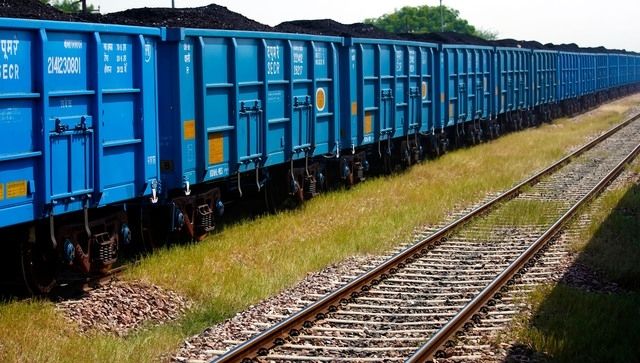
New Delhi: Indian Railways has reached a landmark achievement in the current financial year (2025-26), crossing the 1-billion-tonne freight loading threshold well ahead of schedule. By November 19, its cumulative freight movement touched 1,020 million tonnes, underscoring the railway network’s strengthening role in driving India’s economic and industrial growth. This is not only a numerical milestone but also an indication of India’s growing reliance on rail-based logistics for large-scale supply chain demands.
A closer interpretation of the freight composition shows that the performance is broad-based rather than dependent on a single commodity. Coal continues to be the backbone of railway freight and contributes 505 million tonnes, reflecting the ongoing demand from power generation and industrial users. Iron ore, at 115 million tonnes, reflects momentum in steel manufacturing and export-linked mining. Cement movement stands at 92 million tonnes and signals the pace of infrastructure development across the country.
Container traffic at 59 million tonnes represents the increasing shift of long-haul, value-added cargo from roads to rail. Other major contributors include pig iron and finished steel at 47 million tonnes, fertilisers at 42 million tonnes to support the agricultural cycle, mineral oil at 32 million tonnes to meet industrial and consumer energy needs, food grains at 30 million tonnes for public distribution and inter-state consumption, raw materials for steel at about 20 million tonnes, and the balance 74 million tonnes from other diversified commodities. Taken together, these figures reflect a freight basket large enough to insulate railways from fluctuations in any one sector and highlight the continuing industrial recovery across India.
Daily loading levels offer further insight into the system’s operational efficiency. Railways now handle around 4.4 million tonnes of freight every day, compared to 4.2 million tonnes during the same period last year. An improvement at this scale indicates not a temporary surge but a systematic enhancement in turnaround time, rolling stock deployment, capacity utilisation, and logistics planning.
The April-October performance supports this as well: 935.1 million tonnes have already been transported in the first seven months of the financial year, compared to 906.9 million tonnes during the same period last year. The upward trend is therefore consistent and sustained rather than episodic.
A significant portion of the recent momentum comes from the cement sector, whose demand is tightly linked to nationwide infrastructure development. Recognising this, Indian Railways has deliberately expanded its support mechanisms for cement logistics. The introduction of the Policy for Bulk Cement Terminals and the rationalisation of rates for cement movement in containers are not routine tariff adjustments but structural reforms.
They are designed to reduce bottlenecks in loading and unloading, encourage multimodal connectivity, support bulk handling infrastructure, decrease transport time, and ultimately improve cost efficiency for producers and end users. Modernizing cement distribution through rail directly strengthens the wider construction ecosystem, which includes highways, metro networks, housing, industrial plants, and public infrastructure.
Beyond industrial gains, the transition of bulk cargo from road to rail carries important environmental and social implications. Moving heavy goods by trains reduces diesel consumption on highways, lowers greenhouse gas emissions, and decreases congestion on national and state road networks. It also improves road safety by reducing the volume of heavy commercial vehicles.
Advantages
For industries, including MSMEs, the availability of greener, cost-efficient logistics options enhances competitiveness and supports sustainable business operations. Every incremental shift to rail therefore becomes a step toward India’s Net Zero Carbon Emission commitments while simultaneously reinforcing the economic value chain.
Taken together, the freight performance marks not only a statistical success for Indian Railways but a demonstration of how modern logistics reforms, operational efficiency, and sustainability goals can converge. Railways is positioning itself not just as a transporter of goods but as a central pillar for India’s long-term industrial and environmental progress.