
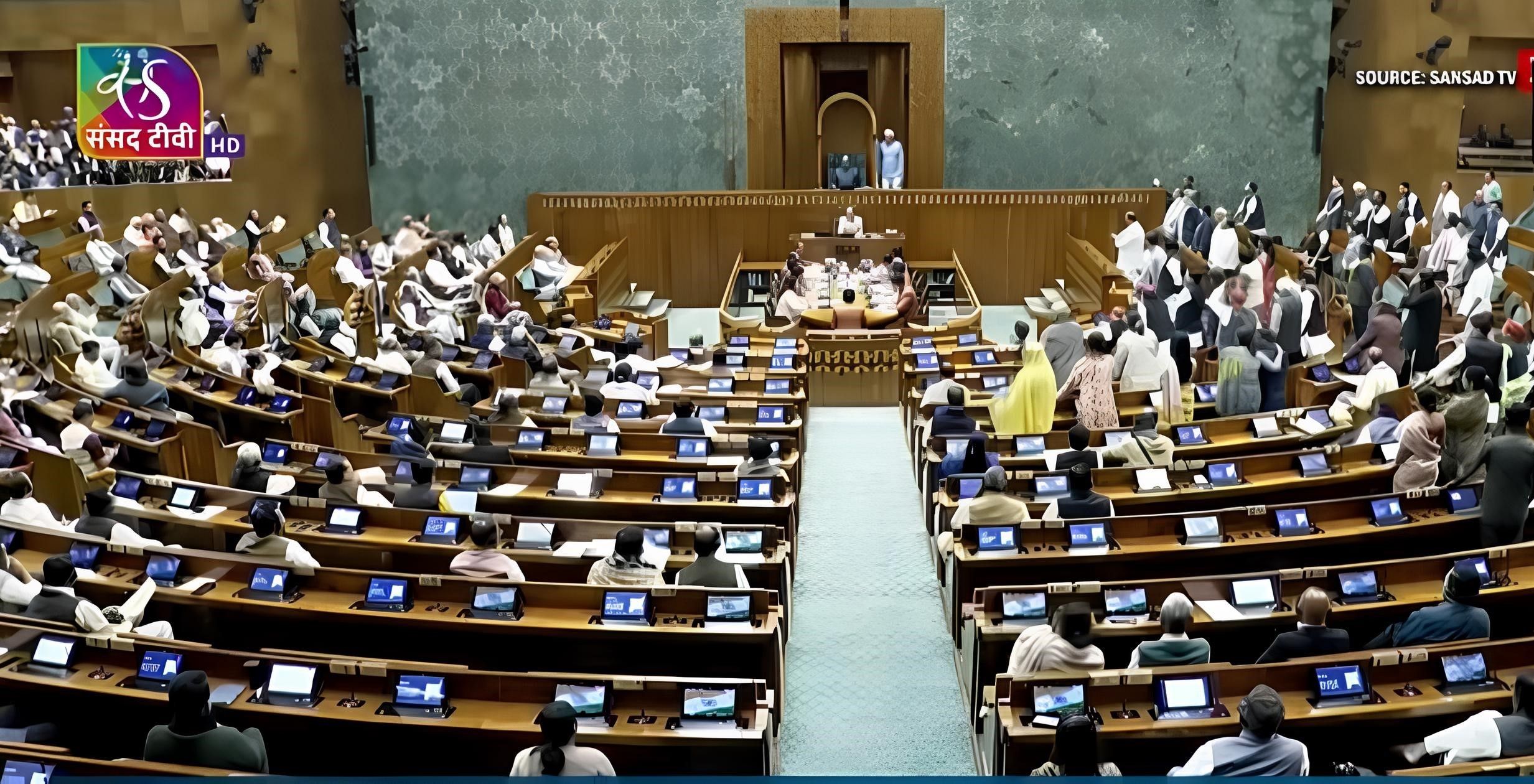

New Delhi: The winter session of Parliament began on Monday with immediate disruptions as the opposition demanded that the first debate be held on the issue of the Special Intensive Revision (SIR) of electoral rolls. This took place despite Prime Minister Narendra Modi’s opening-day remarks in which he said Parliament is “meant for debate, not drama”, and urged the opposition not to use Parliament as a backdrop for political battles linked to recent or upcoming elections.
Both the Lok Sabha and the Rajya Sabha, however, witnessed uproar as the opposition refused to allow proceedings to continue until the SIR issue was listed as the first point of discussion. Both the Lok Sabha and Rajya Sabha resumed proceedings on Monday after being adjourned till 2 PM. However, disruptions persisted in the Lower House as the opposition continued raising slogans over the SIR issue, forcing the Speaker to adjourn the House for the rest of the day. The Rajya Sabha also faced uproar and was also adjourned for the day.
The government, meanwhile, responded that it was fully prepared for a debate on SIR but that the opposition should not block the House over scheduling.
Tensions over SIR were not limited to Parliament. In Kolkata, members of the Booth Level Officer (BLO) union protested outside the Election Commission office, alleging unbearable workload, pressure tactics, and a lack of safety and support. At the same time, a BJP delegation reached the Election Commission headquarters, and reports of clashes between the two sides emerged. The unrest highlights the intensifying nationwide concern over SIR implementation.
Opposition parties insist that their demand is not procedural but urgent. They allege that the SIR process is being carried out in irrational haste and that dozens of BLOs across multiple states have died by suicide or due to work-related stress. They argue that BLOs — who are often school teachers, Anganwadi workers, or junior government staff — have neither the training nor the resources to verify documents linked to citizenship or ancestry.
The opposition claims that if such high-pressure conditions continue, more lives may be lost. They further say that neither the Election Commission nor the government has yet issued a public condolence for the deaths or taken responsibility, which they describe as symptomatic of institutional insensitivity.
Political Flashpoint
Political analysts also observe that SIR has become a larger political flashpoint because it is increasingly being linked to citizenship status, creating fear among voters that mistakes or omissions during the revision could lead to disenfranchisement. The government counters that SIR is only an administrative exercise and that no one has approached the Supreme Court claiming wrongful deletion after the Bihar elections. The opposition argues that this reasoning ignores the far more pressing human cost of the process and accuses the government of using technical language to minimise real suffering on the ground.
Regional political dynamics are adding another layer of conflict. In West Bengal, the BJP has accused the state government of manipulating the voter list by exerting pressure on BLOs, even though in other states — where BJP governs — the opposition makes similar accusations. Critics argue that SIR has opened up a scenario in which whichever party controls state administration can potentially influence the outcome through additions and deletions in the voter list.
In the Supreme Court, senior lawyers have raised constitutional questions on whether the Election Commission can effectively take on the role of a legislative body by determining which documents are valid proof of a voter’s eligibility, and whether voting rights can be indirectly restricted without proper legal procedure.
Observers believe that the opposition views the SIR issue as its most powerful tool to corner the ruling party and to force accountability from both the government and the Election Commission. At the same time, analysts say the government appears reluctant to allow SIR to dominate the session, fearing extensive debate could damage its political standing ahead of upcoming elections, trigger public suspicion toward the Election Commission, or revive earlier calls for inquiries and even impeachment motions.
While the uproar is greatest in states like West Bengal and Uttar Pradesh, Kerala has seen comparably less friction due to stronger administrative checks and higher civic awareness, though experts warn that the structural issues with SIR remain national in scope.
With the Parliament session being the shortest winter session in recent years, concerns are rising that continued deadlock could push out legislative business and lead to yet another washed-out session. The central question now is whether the government will advance the SIR debate immediately, as the opposition demands, or maintain its schedule and take it up later. For now, both sides remain unmoving, and the productivity of the winter session hangs on the outcome of this standoff.