
New Delhi: When Joseph Vijay Chandrasekhar, popularly known as ‘Thalapathy’ (commander) Vijay, walked into the Tamilaga Vettri Kazhagam (TVK) headquarters in Chennai and paid floral tributes to E V Ramasamy after his party’s electoral triumph, the act was neither incidental nor ornamental. It was political signalling of the highest order.
In Tamil Nadu, Periyar is not merely a historical figure; he remains the moral vocabulary through which legitimacy is negotiated. Every major political force in the state, whether explicitly Dravidian or tactically accommodative, eventually returns to him.
Vijay understood the risk of appearing detached from that inheritance. His tribute was therefore less about ideological surrender and more about political calibration. The actor-politician was sending a message that while he may challenge the DMK and the AIADMK, he would not rupture the emotional and social compact built by the Dravidian movement over six decades.
That distinction matters. Tamil Nadu’s electorate has repeatedly demonstrated that it welcomes disruption, but only when disruption speaks in a familiar idiom. Even megastar M G Ramachandran, who broke from the DMK to create the AIADMK in 1972, did not abandon the Dravidian framework; he merely repackaged it through charisma and welfare populism. Vijay appears to be attempting a similar manoeuvre for a younger generation shaped by social media impatience, anti-incumbency fatigue, and post-ideological aspiration.
Political observers see the symbolism as deliberate. In an analysis published in The Indian Express, TVK’s ideological positioning was described as centre-left, drawing inspiration from Periyar, Ambedkar and Kamaraj while rejecting majoritarian politics. The article argued that Vijay’s careful invocation of Dravidian icons was intended to reassure traditional voters while broadening his appeal among urban youth and politically unaffiliated first-time electors.
The balancing act became even clearer when Vijay publicly criticised attempts to “paint a caste colour on Periyar” and urged students to reject caste and religious divisions. “Like narcotic substances, we should keep caste and religion away from us,” he said at a student interaction near Chennai in May last year. That intervention was not random rhetoric. It was an unmistakable declaration that TVK intends to remain within the broad Dravidian consensus on secularism and social justice, even while attacking the DMK’s political conduct.
Vijay’s political approach continues to align with key Dravidian ideals, including Tamil nationalism, secular values, federal autonomy, and social equity, observe political analysts. That assessment captures the core of Vijay’s political method. He is not dismantling the Dravidian grammar; he is rewriting its syntax.
Binary Finally Broken
For the first time since 1967, Tamil Nadu’s political stage no longer appears structurally confined to the DMK-AIADMK axis. TVK’s rise has disrupted a rhythm that survived ideological schisms, leadership transitions and generational churn. The significance of that disruption cannot be overstated.
But the more important question is whether the binary has truly collapsed or merely entered a phase of temporary fracture.
The answer lies in understanding what exactly voters rejected. The verdict does not necessarily amount to a repudiation of Dravidian politics itself. Instead, it reflects exhaustion with institutional stagnation, dynastic concentration and a growing perception that both principal Dravidian parties became insulated from everyday anxieties. Employment insecurity, urban frustration and the aspiration of first-time voters created a political opening that Vijay exploited with precision.
His appeal is emotional before it is organisational. Like MGR before him, Vijay carries the advantage of cinematic intimacy. His fans do not merely admire him; many feel they know him. In a state where cinema and politics have historically overlapped, that emotional infrastructure remains electorally potent.
Yet Tamil Nadu’s history also offers cautionary lessons. Charisma may open the gates of power, but durability requires institutional depth. The DMK survived because it was built as a movement before it became an electoral machine. The AIADMK survived because it developed a welfare ecosystem that outlasted individual leaders. TVK still appears heavily dependent on Vijay’s personal magnetism.
Political scientist and commentator Sumanth C Raman observed during a discussion on Chennai-based television platform Puthiya Thalaimurai that Vijay’s biggest challenge would be “transforming admiration into political endurance”. Raman argued that Tamil Nadu voters eventually demand organisational accountability, not merely emotional connection. The observation reflects a recurring pattern in the state’s politics: celebrity appeal can trigger momentum, but governance expectations quickly replace spectacle.
Even critics acknowledge the scale of the disruption. Another analysis described Vijay’s rise as a “structural disruption” created by voter fatigue with entrenched political networks.
But disruption alone cannot guarantee permanence. Tamil Nadu voters are historically unforgiving toward political formations that fail to evolve beyond symbolism. Vijay’s transition from fan-club politics to cadre politics will determine whether TVK becomes a governing force or merely a spectacular electoral moment.
Future Beyond Stardom
The larger debate now revolves around sustainability. Can Vijay institutionalise his movement before anti-incumbency catches up with him? Can TVK produce second-rung leadership capable of independent political articulation? Can it convert cinematic loyalty into administrative credibility?
These questions have already surfaced within political discourse. Critics frequently argue that TVK’s ideological framework remains deliberately elastic. Supporters view that ambiguity as strategic inclusiveness. Opponents interpret it as political evasiveness.
What is undeniable, however, is that Vijay has succeeded where many outsiders failed: he entered Tamil Nadu politics without appearing culturally alien to it. He did not attack Periyar. He did not reject social justice politics. He did not embrace overt Hindutva nationalism. Instead, he carefully positioned himself as both continuation and correction.
That explains why his homage to Periyar carried such weight. In Tamil Nadu, leaders may challenge governments, families, parties and alliances, but challenging the foundational emotional architecture of Dravidian politics remains perilous territory. Vijay recognised that reality early.
There is also a generational shift working in his favour. Younger Tamil voters are less emotionally invested in the historic rivalries between the DMK and AIADMK than their parents were. Their politics is increasingly shaped by unemployment, digital culture, corruption fatigue and aspirational anxieties. Vijay’s carefully cultivated public image — accessible, restrained and non-confrontational — fits that changing mood.
Yet the paradox remains unavoidable. The more Vijay attempts to project himself as a political alternative, the more he must operate within the ideological ecosystem created by Periyar and sustained by the Dravidian movement. Tamil Nadu may be ready for a new political face, but it has not abandoned the grammar through which leadership is judged.
Tamil Nadu’s political grammar has therefore not disappeared. It has merely encountered a new narrator. And that narrator understands that in Tamil Nadu, no leader truly becomes “supreme” by severing ties with Periyar. They survive by reinterpreting him for another generation.
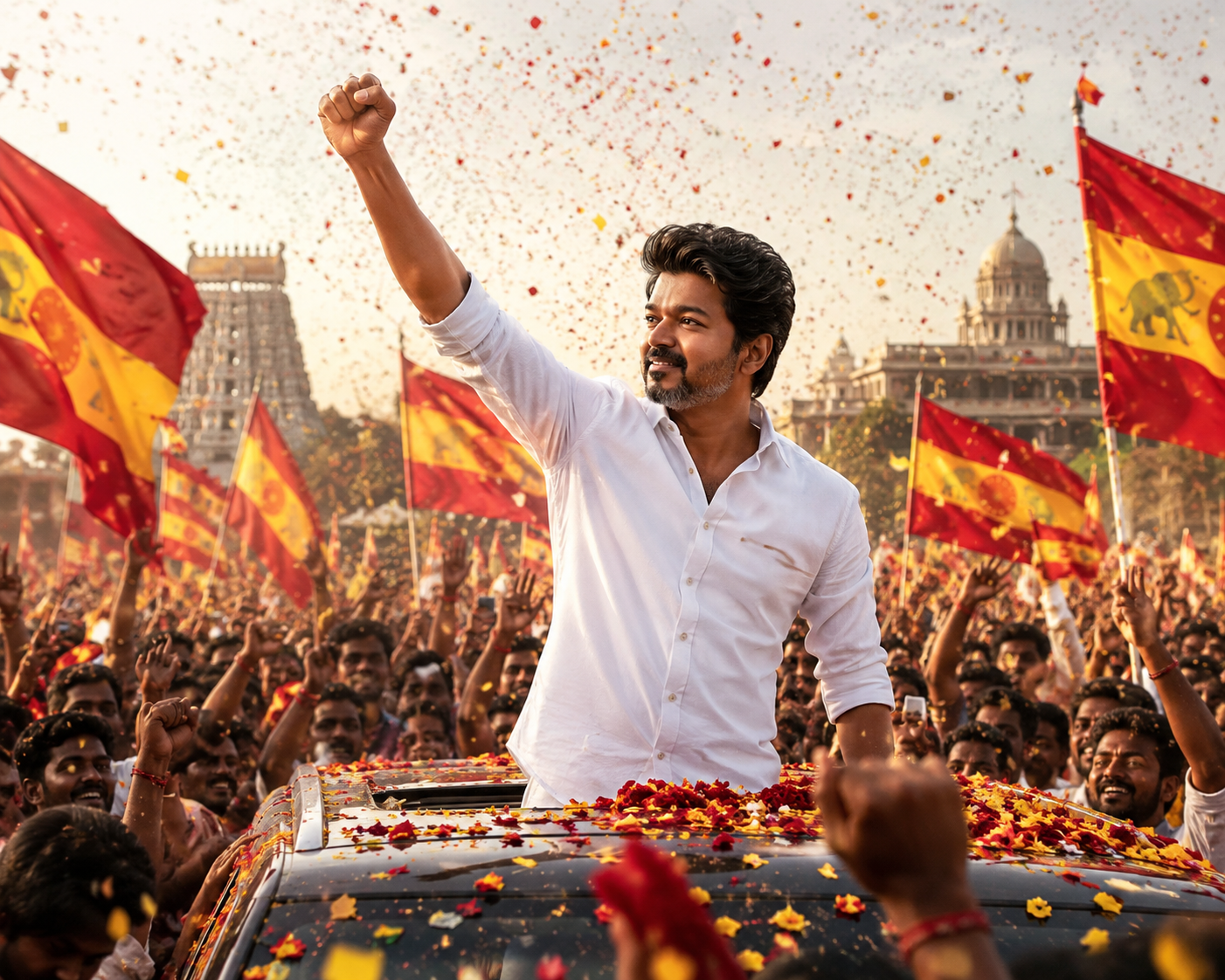
(Cover photo generated by AI)