

New Delhi: India’s inflation landscape has entered another phase of divergence, with wholesale prices surging sharply even as retail inflation remains relatively subdued — a trend economists warn may not last for long. The sharp rise in commodity-linked costs in the wake of the West Asia conflict has pushed wholesale inflation well above consumer inflation, reviving concerns over input costs, corporate profitability and a delayed hit on household budgets.
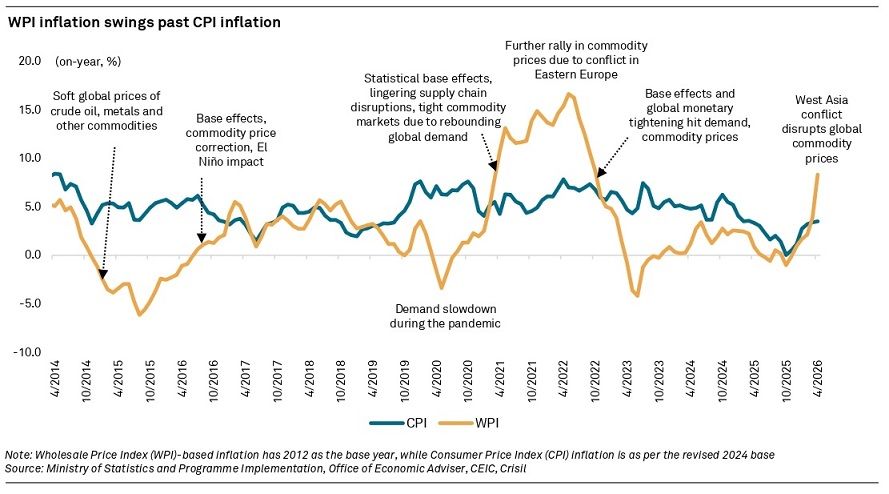
The Crisil report, Quickonomics: Price Parts Path — Again, notes that the Wholesale Price Index (WPI)-based inflation climbed to 8.3% in April 2026 from 3.9% in March, while Consumer Price Index (CPI)-based inflation edged up only marginally to 3.5%. The report says the divergence reflects the immediate impact of higher global commodity and energy prices on producers, while the pass-through to consumers is yet to fully materialise.
“The dichotomy between inflation based on WPI and CPI is not new. CPI inflation has always been in the positive zone unlike WPI, which tends to swing between inflation and deflation, causing divergence between the two. Data for the past 15 fiscals shows divergence in 2015-16 and 2020 on account of the pandemic,” says the report.
The inflation split has emerged as a key macroeconomic concern because wholesale prices often act as a precursor to retail inflation. Economists tracking the trend say the latest surge reflects the vulnerability of India’s production ecosystem to global disruptions, especially in crude oil and commodity supply chains.
Conflict Fuels Costs
The report attributes the spike largely to the ongoing West Asia conflict, which has disrupted commodity markets globally and sharply increased input costs across sectors. Crude petroleum inflation under WPI surged to 88.1% in April from 51.6% in March, while furnace oil inflation accelerated to 74.2%. Inflation in plastics, chemicals and metals also witnessed broad-based increases.
“In April 2026, WPI-based inflation (at 8.3%) decisively surpassed a benign CPI, which printed 3.5%, hit by the West Asia conflict. The upside risk to inflation from the conflict is yet to materially reflect in CPI. Between March and April, CPI inflation moved gradually to 3.48% from 3.40%, while WPI inflation spiked to 8.3% from 3.9%, reflecting higher input and energy costs,” according to the report.
The report says WPI inflation remains structurally more volatile because it mirrors production-side pressures and global commodity fluctuations more directly than retail inflation. Unlike CPI, WPI excludes services, which account for more than half of India’s economy, making it more sensitive to energy and manufacturing shocks.
The inflationary build-up is also becoming increasingly broad-based. Rising costs are now visible across chemicals, fertilisers, paints, plastics and metals, suggesting that industrial sectors are facing sustained pricing pressure rather than a temporary commodity shock.
Retail Risks Ahead
The sharper concern for policymakers is the likelihood of wholesale inflation feeding into consumer prices over the coming quarters. The report says companies facing rising input costs may increasingly pass on the burden to consumers to protect margins, particularly if global crude oil prices remain elevated.
“Higher wholesale inflation is known to transmit to retail inflation. Empirical analysis cited in the minutes of the RBI’s Monetary Policy Committee meeting of February 2021 suggests that while the pass-through from a 1% change in WPI inflation in non-food manufactured products to CPI inflation in core goods is likely to be ~0.20%, it is much lesser for overall CPI core inflation and even lesser for headline CPI inflation,” says the report.
The report expects retail inflation to average 5.1% in the current fiscal against 2% last fiscal, citing higher fuel prices, a weakening rupee, elevated imported input costs and weather-related risks to food production. Heatwaves and the possibility of a below-normal monsoon due to El Niño conditions could further intensify food inflation pressures.
“Persistently high global crude oil prices make pass-through to domestic cooking and transportation fuel prices an imperative. The government has raised the cost of petrol, diesel and compressed natural gas,” according to the report.
For businesses, the latest inflation trend raises concerns over shrinking operating margins and weakening consumer demand if price increases accelerate. For policymakers, it complicates the inflation outlook just as India appeared to be entering a relatively stable price cycle.