


New Delhi: India’s unemployment rate stood at 5.5% in May, underscoring a softening labour market as weaker rural employment offset improving conditions in cities, according to the latest Periodic Labour Force Survey (PLFS) released by the National Statistical Office (NSO) on Monday (June 15).
The overall jobless rate was unchanged from a year earlier, but rural unemployment rose to 5.1% from 4.6% in April, signalling pressure on the farm and informal economy. Urban unemployment eased to 6.4% from 6.6% in April and 6.9% a year ago, marking the lowest urban unemployment rate since May 2025.
The divergence between rural and urban labour markets suggests that the benefits of economic growth are yet to spread evenly across the country. While services and manufacturing hubs appear to be supporting urban hiring, rural India continues to grapple with patchy demand and seasonal fluctuations in employment.
The survey indicated that employment growth failed to keep pace with changes in the labour force during the month, reflecting a seasonal slowdown in economic activity.
Participation Rate Falls
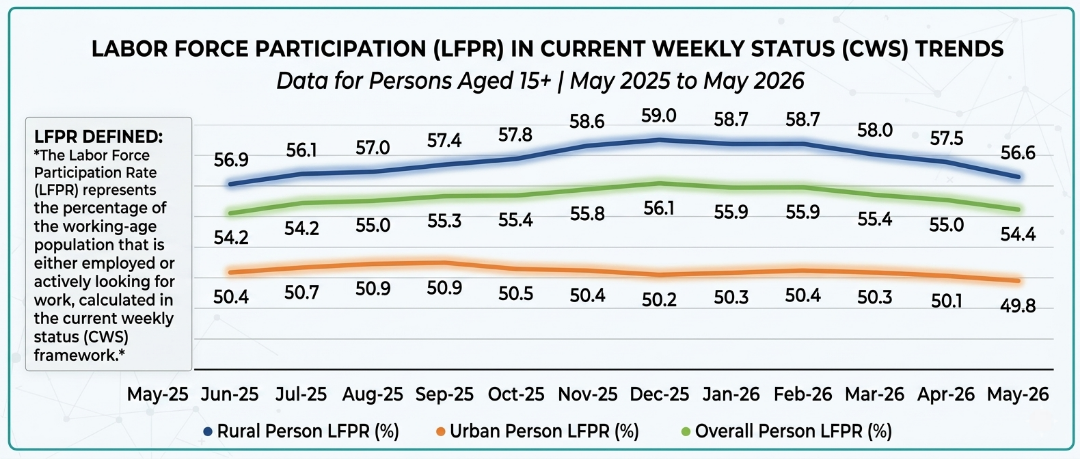
The Labour Force Participation Rate (LFPR) for people aged 15 years and above declined to 54.4% in May from 55% in April and 54.8% in May 2025, suggesting fewer people were either working or actively looking for jobs.
Rural LFPR stood at 56.6%, while the urban rate was 49.8%. Female participation in the workforce remained broadly stable in cities, with the urban female LFPR at 24.8%, almost unchanged from the previous month. Overall female LFPR was 32.8%, marginally lower than 33.2% a year earlier. Rural female LFPR was recorded at 36.7%.
The Worker Population Ratio (WPR), which measures the share of employed people in the population, slipped to 51.4% in May from 52.2% in April and 51.7% a year ago. Rural WPR dropped to 53.8% from 54.9% in April, while the urban ratio remained broadly stable at 46.6% compared with 46.8% in the previous month.
The data also showed a mixed trend across demographic groups. Urban male unemployment remained unchanged at 5.9%, while urban female unemployment declined to 8.2% during May. The stability in urban female labour force participation, despite broader weakness in the labour market, points to a gradual improvement in workforce attachment among women in cities, although participation levels remain well below those of men.
Rural Pressure Builds
The latest PLFS data suggest that the labour market lost momentum during May as employment opportunities contracted faster than labour force participation, pushing up unemployment within the available workforce.
While urban hiring conditions improved, helping lower city unemployment, the increase in rural joblessness and the decline in both LFPR and WPR point to weakening employment generation across large parts of the economy. The trends are significant because rural India accounts for a majority of the country’s workforce and often acts as a barometer of broader economic health.
Economists closely track LFPR and WPR alongside the unemployment rate, as a stable unemployment figure can sometimes mask a shrinking workforce. In May, the simultaneous decline in participation and employment ratios suggests that the labour market slowdown extended beyond job creation to overall economic engagement.
The NSO attributed the moderation in labour market indicators partly to seasonal factors affecting economic activity during May. Agricultural cycles, lower construction activity before the monsoon and temporary slowdowns in rural economic activity are often reflected in monthly labour market readings.
The monthly estimates are based on responses from 3,73,887 individuals, including 2,13,294 in rural areas and 1,60,593 in urban centres.
The PLFS remains India’s primary employment survey and, following a methodology overhaul introduced in January 2025, now provides monthly and quarterly national labour market estimates based on the Current Weekly Status approach. The May 2026 bulletin is the fourteenth release under the revised framework and offers one of the most comprehensive snapshots of employment conditions across the country. The latest data indicate that while urban labour markets continue to show resilience, sustaining employment growth across rural India will remain a key challenge for policymakers in the coming months.