
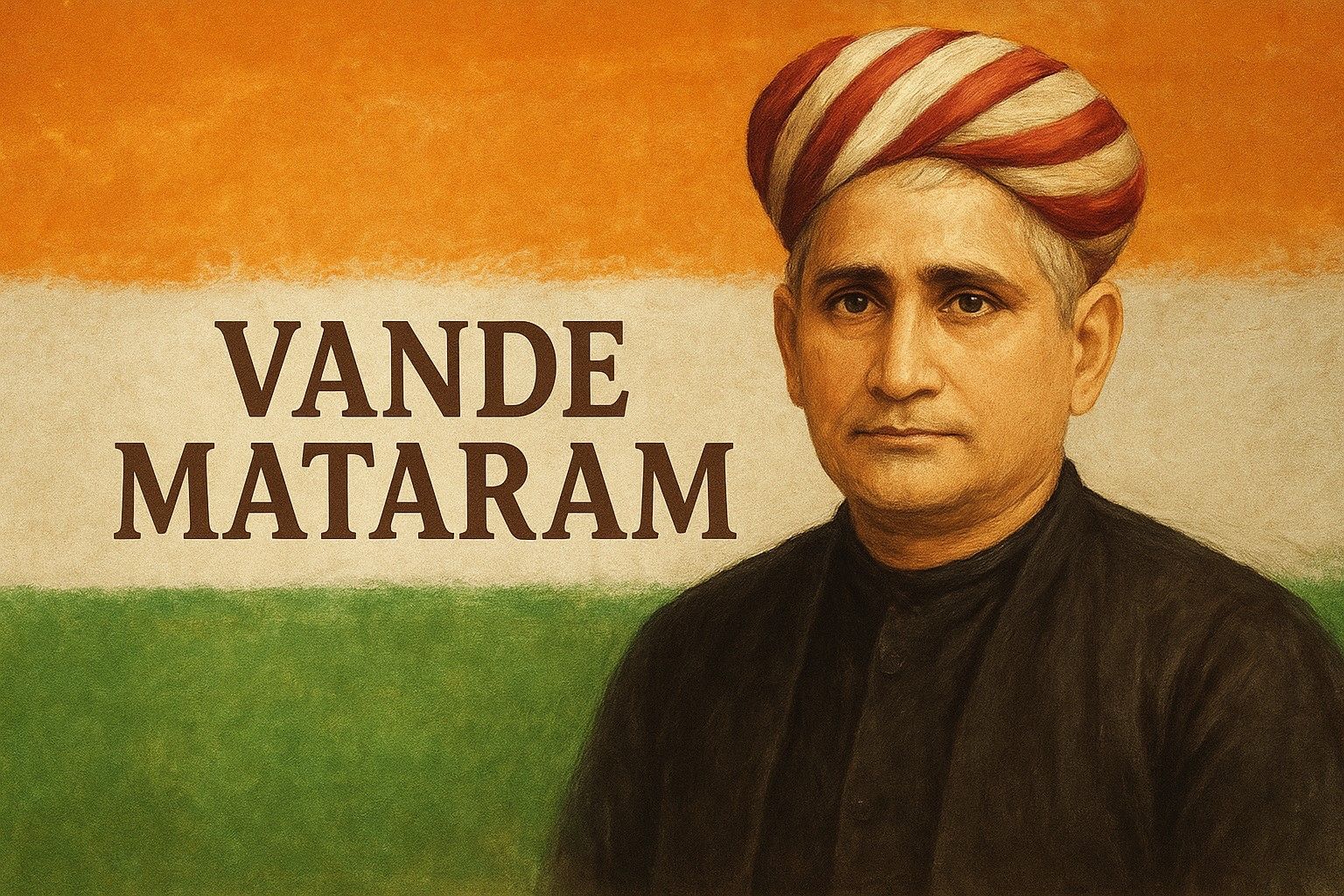

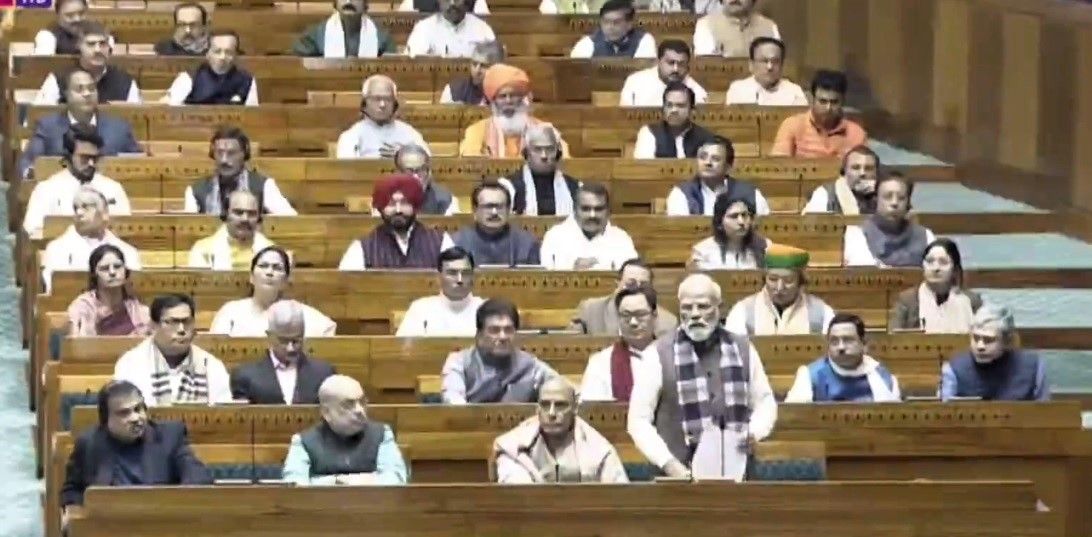
New Delhi: A heated parliamentary debate erupted on Monday as Prime Minister Narendra Modi, marking 150 years of ‘Vande Mataram’, accused the Congress of capitulating to Muslim League pressure in the past, leading to the “partition” of the national song and, by extension, the country. The opposition countered, alleging the debate was a politically-timed manoeuver to polarize voters ahead of the crucial West Bengal assembly elections.
Addressing the Lok Sabha, PM Modi stated, “When Vande Mataram completed 100 years, the country was shackled by the chains of Emergency. At the time of the centenary celebrations of Vande Mataram, the Constitution was throttled. Those who lived and died for patriotism were imprisoned behind bars.”
“150 years of Vande Mataram presents an opportunity to re-establish a great chapter and glory, and neither the House nor the nation should let this occasion pass.”
Sharpening his attack, Modi further said, “Unfortunately, on October 26, 1937, Congress compromised on Vande Mataram, fragmenting it in their decision. He noted that this decision was cloaked under the guise of social harmony, but history bears witness that INC bowed before the Muslim League and acted under its pressure, adopting a politics of appeasement.”
He also recalled that just five days after Mohammed Ali Jinnah’s opposition, on October 20, 1937, Nehru wrote a letter to Subhas Chandra Bose, agreeing with Jinnah’s sentiment and stating that the ‘Anand Math’ background of Vande Mataram could irritate Muslims. Modi quoted Nehru’s words: “I have read the background of the Vande Mataram song. I feel that this background may provoke Muslims.”
Opposition’s Retort
The opposition launched a fierce counterattack, dismissing the PM’s speech as ahistorical and electorally motivated.
Congress leader Priyanka Gandhi Vadra questioned the PM’s narrative, pointing out that Rabindranath Tagore first sang ‘Vande Mataram’ at a Congress session. “Why the hesitation in stating that fact?” she asked.
The government “wanted debate on Vande Mataram because the Bengal polls are coming soon... The government wants us to keep delving in past because it does not want to look at present and future,” she added.
In support of her argument, Priyanka read aloud relevant portions from the correspondence between Nehru, Subhas Chandra Bose, and later between Nehru and Rabindranath Tagore, emphasizing the need to “understand the chronology” behind the adoption of Vande Mataram as the national song.
She said: “Let me share an excerpt from Gurudev Rabindranath Tagore’s letter, in which he explains that the first two stanzas of Vande Mataram — the ones traditionally sung — were so meaningful that ‘I have no hesitation in separating these verses from the rest of the poem’. Tagore noted that during the freedom struggle, ‘it was always these two stanzas that were sung to honour the memory of countless martyrs,’ and therefore, ‘they must be sung in their original form.’ He also cautioned that the later stanzas could be ‘interpreted in a communal spirit’, and that their inclusion would be ‘inappropriate in the delicate atmosphere of the time’.”
Priyanka added that, following these exchanges and deliberations, “the Congress Working Committee, on 28 October 1937, passed a resolution declaring Vande Mataram the national song.”
Kalyan Banerjee of Trinamool Congress objected to the way the prime minister addressed Bankim Chandra Chattopadhyay, saying it was was very “disturbing”.
“The debate was started by the PM. It is really, very sorry to say, it was below standard. The debate was for Vande Mataram, not for attacking Jawaharlal Nehru or Indira Gandhi…”
“The way he addressed the great author (as Bankim da), it was really disturbing,” he added.
“The sole intention of the BJP is to divide the people further. They want to make it about the Bengal election. Do they have faith in India's independence movement and did they take part in it?” asked (CPI) MP P Sandosh.
Political Experts’ Views
A senior journalist and political analyst argued, “This is purely political use. There is an election in Bengal. In Bengal’s election, they (BJP) want to do Hindu-Muslim politics... They know that talking about Hindu issues will get them more votes as Hindus are in a majority.”
Highlighting the context of the freedom struggle, another senior journalist said, “Calling accommodation during the national movement ‘appeasement’ is wrong. Gandhi ji, Nehru ji, Subhas Chandra Bose, all were part of the committee that decided on the song’s usage. It was a consensus for unity.”
Analysts unanimously identified the looming West Bengal polls as the immediate trigger for reviving this settled debate. The BJP, which made significant inroads in the state in 2019 but fell short of power in the 2021 assembly elections, is seen as reigniting cultural nationalism to consolidate Hindu votes.
“BJP is trying to enter Bengali nationalism through Bankim Chandra Chatterjee and Vande Mataram,” noted an expert. “They want to play their polarization politics here.”
“BJP’s rise in Bengal is also due to filling an opposition vacuum left by the Congress and Left. While they use cultural nationalism, it’s not the sole reason for their success,” he added.
Beyond immediate politics, the debate signifies a deeper ideological contest over India’s history and identity. BJP’s narrative seeks to juxtapose what it calls the “appeasement” of Congress-led freedom movement against its own brand of uncompromising cultural nationalism. The opposition frames this as a dangerous revisionism that undermines the foundational compromises of India’s pluralistic democracy.