
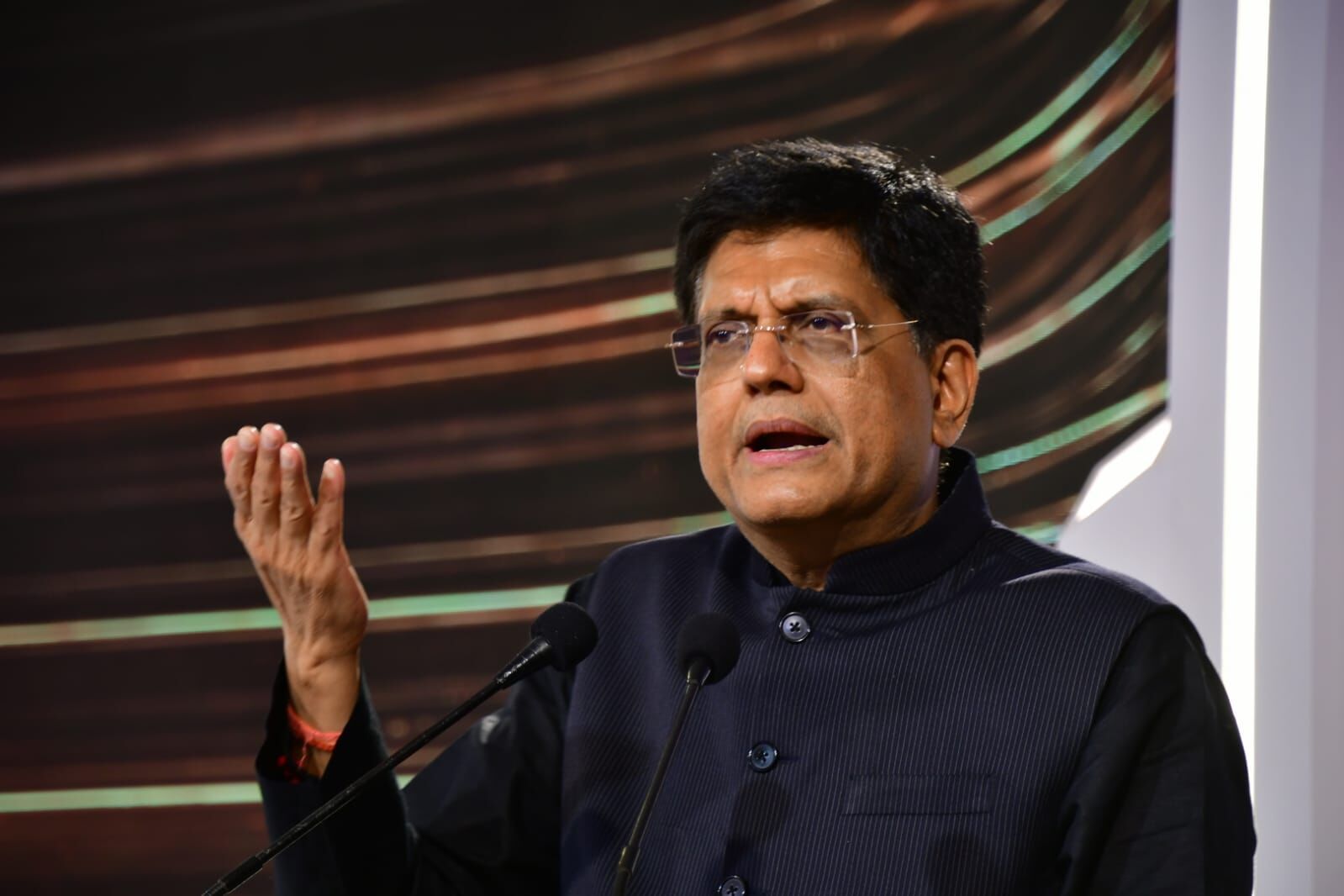

New Delhi: India Inc must treat geopolitical disruptions and global macroeconomic uncertainty as an opportunity to accelerate reforms, deepen local manufacturing and reduce import dependence, while positioning India as a stronger export-driven economy, Union Commerce and Industry Minister Piyush Goyal said on Tuesday (May 19).
Addressing the Assocham India Business Reform Summit 2026 in New Delhi, Goyal said the evolving global environment, including tensions in West Asia and broader supply-chain disruptions, should be viewed as a strategic opening for India to strengthen competitiveness, improve business processes and build long-term economic resilience.
The minister said India had consistently converted crises into opportunities for structural reform and growth, adding that the current global uncertainty could similarly become a catalyst for faster reforms and stronger supply chains.
While cautioning businesses to remain vigilant amid the uncertain global environment, Goyal said there was no reason for panic, pointing out that India had already demonstrated resilience by successfully navigating disruptions such as Covid-19.
He called on industry to adopt more efficient operating models by reducing waste, improving productivity and increasing energy efficiency. Goyal also said the pandemic had established the effectiveness of digital engagement and remote working models, which continue to reshape global business operations.
Focus on Localisation
A central theme of the minister’s address was the need to reduce import dependence through stronger domestic manufacturing and greater value addition. He urged Indian industry to identify sectors where imports can be substituted through local production, innovation and improved competitiveness, while simultaneously expanding exports of higher-value products.
Goyal stressed that Indian goods should increasingly reach global markets as finished and value-added products rather than raw materials. He identified automobiles, auto components, electronics, consumer goods and agro-based processed products as key sectors where India could significantly expand exports while improving value realisation for farmers and fishermen.
The minister also encouraged companies to adopt global best practices, including Japanese manufacturing systems, to strengthen productivity, efficiency and quality standards within domestic industry.
Calling for a broader shift in industrial culture, Goyal said India must focus on quality, localisation, productivity and innovation. He suggested that industry and government jointly create scorecards to track progress in areas such as indigenisation, import substitution, exports, energy efficiency and innovation.
Despite global headwinds, including tariff barriers and conflicts in Ukraine and West Asia, Goyal said India’s exports had reached an all-time high of $863 billion last year, driven by growth in both merchandise and services exports.
The minister reiterated the government’s target of achieving $1 trillion in exports and urged businesses to aggressively leverage India’s free trade agreements (FTAs) covering 38 countries. According to him, these agreements should be used to attract investments and expand exports rather than merely increasing imports.
Goyal also asked exporters to prepare proactively for upcoming trade agreements by exploring new markets, undertaking sampling and trial orders, and strengthening global engagement even before the pacts formally come into force.
Highlighting India’s emergence as a global services and technology hub, the minister said sectors such as artificial intelligence, cybersecurity, cloud computing and digital services would create significant opportunities for growth.
Referring to the rapid expansion of Global Capability Centres (GCCs), he said nearly 1,800 GCCs are currently operating in India, generating around two million direct jobs and nearly 10 million indirect jobs. He added that multinational corporations increasingly viewed India as a trusted global partner because of its young and skilled workforce.
The minister also outlined the government’s push to position India as a major data centre and cloud services hub. He said the government was creating an enabling ecosystem through trusted global partnerships, low-cost data availability, renewable energy expansion and robust power infrastructure.
Goyal noted that cloud services provided from India or Indian data centres to global markets had been granted 100% tax-free status until 2047. He added that investments in data centres would generate demand across sectors such as real estate, logistics, transport, hospitality, healthcare, education and manufacturing, creating a broader economic multiplier effect.
The minister also highlighted ongoing industrial infrastructure initiatives, including stakeholder consultations for 100 new industrial parks, of which 20 are already at various stages of development.
He said the government was examining the possibility of establishing a single authority at industrial parks to function as a one-stop shop for central and state approvals, aimed at improving ease of doing business.
Participate More in Reforms
At the same time, Goyal urged stronger industry participation in reforming government systems. Referring to the national single-window clearance system launched after Covid-19, he said industry engagement and feedback had remained below expectations.
He called on businesses to work more closely with the government to identify specific pain points and improve ease of doing business through collaborative reforms and practical policy suggestions.
The minister said the government continued to function in an integrated manner rather than in silos and invited industry to provide innovative and out-of-the-box recommendations for improving efficiency and transparency.
He also disclosed that the Commerce Ministry, which operates 482 offices across 216 cities under 46 organisations, is undertaking internal restructuring to improve service delivery. The ministry plans to consolidate operations into integrated single-point contact centres in major cities and state capitals, enabling businesses to access services related to organisations such as DGFT, Coffee Board, Spices Board and GeM through digitally connected systems.
Underscoring the role of domestic demand in sustaining economic growth, Goyal also highlighted tourism and consumption as key drivers of the economy and urged citizens to promote Indian destinations.
Referring to India’s energy-efficiency programmes, he recalled the success of the Ujala LED bulb scheme, which significantly reduced power consumption and generated estimated annual savings of nearly Rs 1 lakh crore.
(Cover: PIB file photo)