


New Delhi: When Elon Musk says coding may “die” this year, it does not sound like metaphor. It sounds like a warning shot.
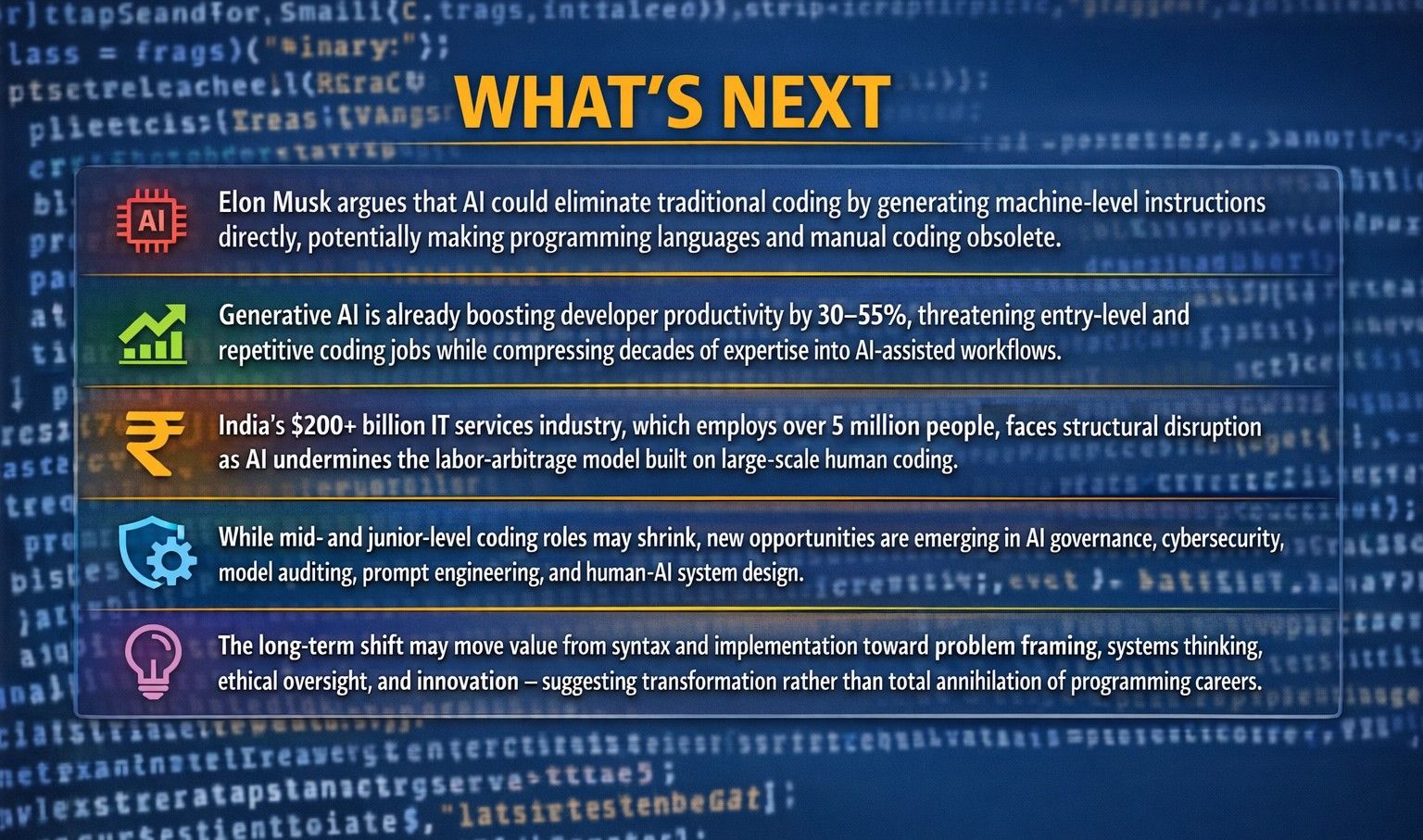
His claim is stark: AI will move beyond human-written programming languages and generate machine-level instructions directly — optimized binary beyond the reach of human logic. No syntax. No compilers. No IDEs. “You don’t even bother doing coding,” he suggests.
Programming, in this framing, was a bridge technology — a translation layer between human intention and machine execution. If AI fully understands natural language — and eventually even neural signals via ventures like Neuralink — that bridge disappears.
The timeline may be exaggerated. But the direction of travel is not speculative. Generative AI systems already write production-ready code, refactor legacy systems, design APIs, generate tests, and detect vulnerabilities. According to GitHub, developers using Copilot complete coding tasks up to 55% faster in controlled studies. McKinsey estimates generative AI could add $2.6-$4.4 trillion annually to the global economy, with software engineering among the most affected functions. Goldman Sachs has projected that AI could automate the equivalent of 300 million full-time jobs globally — many in knowledge work.
This is not merely automation. It is compression. Skills refined over decades are being distilled into prompts.
For a generation raised on “learn to code”, this feels like betrayal.
Economic Shockwaves
The global IT services market exceeds $1.5 trillion annually. Its foundation is human programmers translating business requirements into code. Outsourcing giants built empires on this translation layer. If AI makes code generation near-instantaneous, the billable hour model fractures.
In India, this debate is existential.
India’s IT-BPM industry generated roughly $254 billion in revenue in FY2024, with exports contributing over $224 billion. The sector employs more than 5.4 million people directly and supports millions more indirectly. A substantial share of revenue comes from coding-intensive services: maintenance, testing, migration, enterprise customization — precisely the areas where generative AI excels.
Productivity gains of 30-50% are already reported internally by firms integrating AI coding assistants. That gain translates into fewer hires. Major Indian IT firms have slowed campus recruitment over the past two years. Entry-level hiring — historically the backbone of the industry — is tightening as AI handles routine tasks.
The arithmetic is stark. If one engineer equipped with AI can do the work of two, headcount growth slows. If AI handles the repetitive 40% of tasks in a development cycle, demand for junior roles contracts first. Wage pressure follows.
Young graduates face a brutal paradox: they trained for a world that may be shrinking. Mid-level engineers confront quieter dread: decades of debugging expertise may now be embedded inside models trained on public repositories.
This shift targets cognitive labour, not manual labour. Previous industrial revolutions mechanized muscle. This one augments — and sometimes replaces — structured thought.
Identity & Disruption
Coding was more than employment; it was identity. It signified logic, merit, discipline. Debugging through the night was a rite of passage. Mastering systems conferred status.
If AI erases the struggle, what becomes of the status?
The anxiety intensifies when Musk links this trajectory to brain-machine interfaces. “Imagination-to-software” suggests bypassing even natural language prompts. If intention can be neurologically captured and translated into executable systems, the gap between idea and instantiation approaches zero.
This is disintermediation of skill.
For centuries, human creation required mastery of tools — chisels, lathes, compilers. AI threatens to dissolve the instrument layer. If a small team can generate what once required thousands of engineers, labour markets face structural compression.
Speed compounds the shock. Technological transitions once unfolded over decades. Today, model capabilities improve quarterly. The half-life of technical skills is shrinking. A framework learned in first year of college may be outdated by graduation.
And yet, technological history tempers apocalyptic certainty.
Assembly programmers did not vanish when high-level languages emerged. System administrators did not disappear with cloud computing; they evolved into cloud architects and DevOps specialists. Work shifted upward in abstraction.
The same pattern may recur. If AI writes code, humans may define problems, validate outputs, enforce cybersecurity, ensure regulatory compliance, and design architectures at meta levels. The locus of value moves from syntax to systems thinking.
India’s Strategic Crossroads
India’s advantage has historically been labour arbitrage — skilled engineers at competitive costs. AI erodes that advantage because machine productivity is geographically neutral. Code generation costs roughly the same everywhere.
To remain competitive, India must pivot from services to innovation, product design, AI governance, and domain expertise. That demands structural shifts in education and corporate strategy.
Indian engineers are not inherently disadvantaged. India produces over a million engineering graduates annually. The workforce is young and adaptable. But curricula must pivot from rote language mastery toward computational thinking, distributed systems design, AI-human collaboration, cybersecurity, and data governance.
Reskilling at scale is essential. NASSCOM estimates that over 60-65% of India’s tech workforce will require significant upskilling in AI and related technologies over the next three to five years. That is millions of professionals.
Policymakers must also prepare for displacement. Urban economies such as Bengaluru and Hyderabad are deeply intertwined with tech salaries. Remittances from Indian IT professionals abroad contribute billions annually. A contraction in global tech hiring would ripple across housing markets, consumer spending, and higher education.
Interrogating the Premise
Musk’s vision of AI generating raw optimized binaries is theoretically plausible. But real-world systems operate within constraints: auditability, security, maintainability, regulatory compliance. Enterprises cannot deploy opaque systems they do not understand.
Software in banking, healthcare, aviation, and defense must meet explainability and traceability standards. Governance is not optional. Human oversight remains a regulatory requirement, not sentimental attachment.
Moreover, imagination is unevenly distributed. If the limiting factor becomes clarity of intent rather than syntax mastery, education becomes more — not less — critical. The world may reward conceptual precision, interdisciplinary insight, and ethical reasoning.
There is real risk. Mid-level developers performing repetitive tasks may see shrinking demand. Entry-level roles may contract. Wage growth could stagnate.
But annihilation is not inevitable.
New Skill Frontiers
AI threatens coding jobs — and simultaneously creates new ones.
Emerging roles include AI trainers, model evaluators, prompt engineers, AI safety specialists, cybersecurity analysts, data curators, algorithm auditors, and human-in-the-loop supervisors. The global AI market is projected to exceed $1.8 trillion by 2030. Entire ecosystems around AI alignment, governance, and digital trust are forming.
Lower friction to build software may expand entrepreneurship. When cloud computing reduced infrastructure barriers, startup formation accelerated. If AI reduces development time by 50–70%, experimentation increases. The number of creators may rise even if traditional coding roles shrink.
The printing press did not eliminate writing; it multiplied authorship.
Transitions, however, are messy. Workers bear costs before systems adapt. India, given its scale, sits at the epicentre of turbulence. The stakes are not abstract.
Yet adaptability is India’s historical strength. The workforce survived transitions from mainframes to web, web to mobile, on-premise to cloud. Continuous learning was the survival trait.
Coding as manual syntax entry may diminish. But system thinking, ethical oversight, creative problem framing, and interdisciplinary integration remain durable human advantages — at least for the foreseeable future.
Perhaps coding does not die. It dissolves into infrastructure — invisible but omnipresent — while humans operate at higher conceptual layers.
Musk’s provocation forces a reckoning. What if syntax was never the true competitive edge? What if adaptability always was?
If the gap between idea and execution narrows dramatically, then value shifts to the ideas themselves — economically viable, ethically grounded, socially beneficial ideas.
Machines may generate software. They do not yet decide which futures are worth building.
In that distinction lies both disruption — and hope.