

New Delhi: In a landmark ruling aimed at safeguarding the independence of the judiciary, the Supreme Court on Wednesday struck down several contentious provisions of the Tribunals Reforms Act, 2021.
A bench comprising Chief Justice of India B R Gavai and Justice K Vinod Chandran held that the provisions governing the appointment, tenure and service conditions of tribunal members were “unconstitutional” for violating the principles of separation of powers and judicial independence.
The court observed that the very clauses previously invalidated through earlier judgments had been reintroduced by the Union government with minimal alterations. According to the bench, such a legislative pattern amounted to an impermissible attempt to override binding judicial directives without addressing the foundational constitutional defects identified earlier.
“Therefore, the provisions of the impugned Act cannot be sustained. They violate the constitutional principles of separation of powers and judicial independence, which are firmly embedded in the text, structure, and spirit of the Constitution. The Impugned Act directly contradicts binding judicial pronouncements that have repeatedly clarified the standards governing the appointment, tenure, and functioning of tribunal members.
“Instead of curing the defects identified by this Court, the Impugned Act merely reproduces, in slightly altered form, the very provisions earlier struck down. This amounts to a legislative override in the strictest sense: an attempt to nullify binding judicial directions without addressing the underlying constitutional infirmities. Such an approach is impermissible under our constitutional scheme,” the court ruled.
“Accordingly, the impugned provisions are struck down as unconstitutional,” it ruled.
The court cautioned that while Parliament has the power to legislate, it cannot nullify judicial pronouncements by reproducing the same provisions under a different label. In its strongly worded decision, the bench remarked that the repeated re-enactment of struck-down clauses reflected disregard for constitutional discipline and judicial authority.
The court observed that excessive executive control over tribunals undermines their autonomy and compromises their role as impartial adjudicatory bodies.
Referring to the Constituent Assembly debates, the judgment recalled Dr B R Ambedkar’s warning that the form of administration should remain consistent with the spirit of the Constitution.
As an interim measure, the Supreme Court ordered that until a fresh legal framework is enacted, the principles and directions contained in earlier landmark judgments will continue to govern all matters relating to appointment, qualifications, tenure, and service conditions of tribunal members and chairpersons.
The Bench noted that these earlier rulings represent the minimum constitutional safeguards required to preserve tribunal independence.
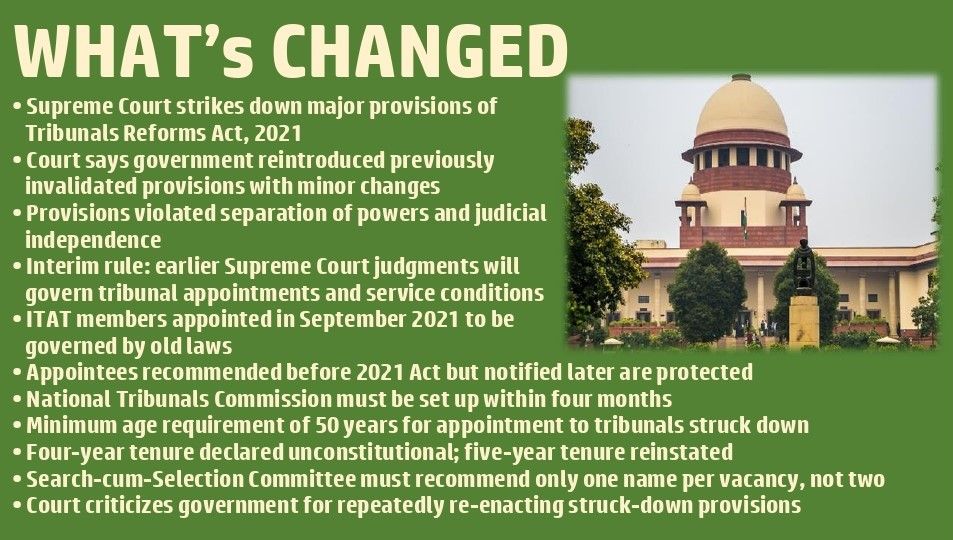
The judgment also provided significant relief for tribunal members affected by the contested 2021 law. It directed that the service conditions of all Income Tax Appellate Tribunal (ITAT) members appointed under notifications dated September 11, 2021, be governed by the older statutes and rules. Further, all appointments recommended by the search-cum-selection committee before the 2021 Act came into force — who were later notified under the new Act — were protected. Such individuals will retain the tenure and benefits prescribed by the parent statutes rather than the truncated tenure introduced by the impugned law.
‘Form Tribunals Commission’
A major direction issued in the ruling is the mandate to establish a National Tribunals Commission within four months.
“The creation of such a commission is an essential structural safeguard designed to ensure independence, transparency, and uniformity in the appointment, administrationand functioning of tribunals across the country. The repeated judicial insistence on this body reflects the Court’s recognition that piecemeal reforms cannot remedy the systemic deficiencies that have persisted for decades,” it said.
The commission, the court stressed, must function independently of the executive and guarantee a professional and transparent mechanism for appointments and oversight.
Among the key provisions struck down was Section 3 of the Tribunals Reforms Act, which required candidates to be at least 50 years of age for appointment as tribunal chairpersons or members. The court held that such a restriction was arbitrary and unjustifiably excluded younger but competent practitioners and subject-matter experts. Section 5, which limited the tenure of tribunal members and chairpersons to four years, was also declared unconstitutional. The court reiterated that security of tenure is indispensable to judicial independence and reinstated the earlier benchmark of at least five years.
The decision significantly alters the appointment procedure as well. Section 3, which required the search-cum-selection committee (SCSC) to recommend two names for each vacancy, was struck down. The court held that such a system increases executive discretion and can potentially compromise impartiality. Henceforth, the SCSC must recommend only one name per vacancy.
In its concluding remarks, the court expressed concern that recurring challenges to tribunal laws consume valuable judicial time that could otherwise be devoted to matters of public importance. It emphasized that the responsibility of reducing judicial pendency is a shared duty, requiring all branches of government to respect established constitutional standards and judicial precedent.