

Mumbai: In a major boost to bilateral economic and strategic relations, India and the United Kingdom have reaffirmed their commitment to fast-track the ratification of the India-UK Comprehensive Economic and Trade Agreement (CETA) and announced a slate of new collaborations spanning technology, defence, clean energy, and education.
The announcements came during UK Prime Minister Sir Keir Starmer’s first official visit to India from October 8-9, at the invitation of Prime Minister Narendra Modi.
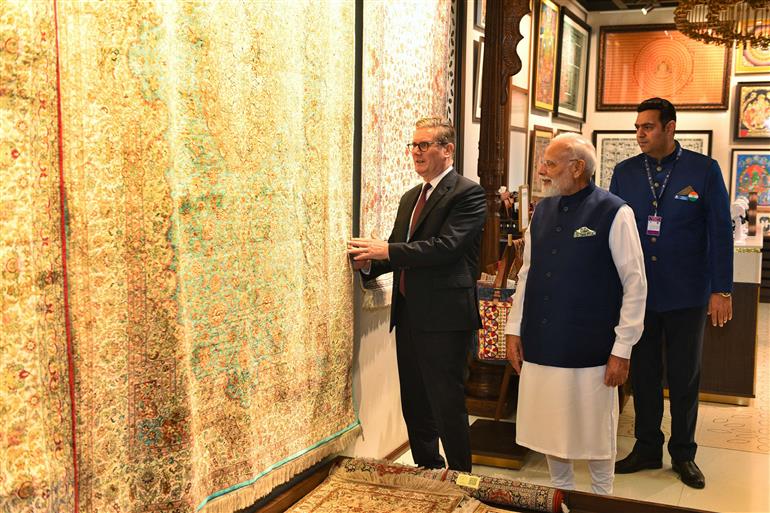
UK Prime Minister Sir Sir Keir Starmer and PM Narendra Modi toured the exhibition at the Global Fintech Fest 2025 in Mumbai.
Accompanied by a 125-member delegation of business leaders, investors, university heads and policymakers, Starmer’s visit underscored London’s intent to deepen its strategic and commercial engagement with New Delhi. The visit follows PM Modi’s trip to the UK in July 2025, during which both sides signed the landmark CETA and adopted the India-UK Vision 2035 and Defence Industrial Roadmap.
The two leaders held extensive talks in Mumbai on Thursday, alongside delivering keynote addresses at the Global Fintech Fest, highlighting the growing convergence between India’s digital innovation ecosystem and the UK’s financial services leadership.
Trade & Growth: CETA at the Core
PM Modi and Starmer placed economic cooperation at the heart of their discussions, calling for the early ratification of the CETAto unlock new opportunities in trade, investment, and market access.
The two sides also announced the resetting of the Joint Economic and Trade Committee (JETCO) to serve as a governance framework for CETA implementation and to steer broader trade policy cooperation. The India-UK CEO Forum, held on the sidelines of the Summit, featured top executives from both countries and focused on investment opportunities in infrastructure, clean energy, manufacturing, defence, education, technology, and professional services.
The visit also reinforced ongoing work under the UK-India Infrastructure Financing Bridge (UKIIFB) between Niti Aayog and the City of London Corporation, a mechanism aimed at mobilising sustainable finance for India’s infrastructure and green transition projects.
Both sides reaffirmed their commitment to improving connectivity, particularly through discussions to renew the India-UK Air Services Agreement, a move expected to facilitate greater business travel and enhance aerospace cooperation.
Tech & Innovation: Collaborations Announced
A major highlight of the visit was the announcement of several strategic technology partnerships under the India-UK Technology Security Initiative (TSI).
The leaders unveiled the India-UK Connectivity and Innovation Centre, a joint hub focused on 6G technologies, Non-Terrestrial Networks (NTNs), and telecom cybersecurity — with at least £24 million in joint funding in its first phase.
They also launched the India-UK Joint Centre for AI, designed to advance responsible artificial intelligence across health, climate, fintech, and engineering biology, and the UK-India Critical Minerals Processing and Downstream Collaboration Guild, aimed at strengthening critical mineral supply chains and promoting co-investment.
In addition, the two sides announced Phase II of the Critical Minerals Supply Chain Observatory, which will expand its research coverage and establish a satellite campus at IIT-ISM, Dhanbad.
On biotechnology, fresh institutional collaborations were signed between the UK’s Centre for Process Innovation (CPI) and India’s Biotechnology Research and Innovation Council (BRIC), the Henry Royce Institute (HRI) and IISc Bengaluru, and between Oxford Nanopore Technologies and BRIC-CDFD, focusing on bio-manufacturing, genomics and 3D bio-printing.
Defence & Security: Strengthened Ties
Defence cooperation received a significant push, with both leaders agreeing to expand joint exercises, training, and defence industrial collaboration.
India welcomed the UK’s Carrier Strike Group port call and the conduct of Exercise KONKAN with the Indian Navy, underscoring a growing convergence in Indo-Pacific maritime strategy.
The two sides also agreed to finalise an Inter-Governmental Agreement (IGA) for developing maritime electric propulsion systems for Indian naval platforms. Further, a government-to-government arrangement was announced for the initial supply of Lightweight Multirole Missiles (LMM) — bolstering India’s air defence and supporting its Atmanirbhar Bharat agenda through joint production and technology sharing.
Both leaders strongly condemned terrorism “in all forms and manifestations”, reaffirming zero tolerance for cross-border terrorism and vowing to intensify cooperation against terror financing and radicalisation.
Climate, Energy & Green Finance
The visit produced tangible outcomes in the climate and energy domain, with the announcement of the India-UK Climate Finance Initiative, aimed at scaling up green finance and enabling private sector-led climate solutions.
A new Climate Tech Startup Fund, established under an MoU between the UK government and the State Bank of India, will finance innovation in climate tech and AI-driven sustainability projects.
Both sides welcomed the creation of an offshore wind taskforce and agreed to explore further partnerships under the Global Clean Power Alliance (GCPA).
Education & People-to-People Links
Education and talent mobility emerged as another key area of cooperation. Both leaders hailed the establishment of nine UK university campuses in India, including the University of Southampton in Gurugram and upcoming campuses of the Universities of Liverpool, York, Aberdeen, Bristol, Coventry, and Lancaster across India and GIFT City.
They committed to advancing the Migration and Mobility Partnership (MMP) to enable regulated migration pathways while countering irregular migration. The leaders also praised the Indian diaspora in the UK as a vital bridge strengthening bilateral cultural, social, and economic ties.
Global & Regional Cooperation
On global issues, the two sides reaffirmed support for a rules-based international order and the reform of global governance institutions. The UK reiterated its “long-standing support” for India’s bid for permanent membership of a reformed UN Security Council.
Both leaders called for restraint and diplomacy in the Middle East, backed a lasting ceasefire in Gaza, and reaffirmed their support for a peaceful resolution in Ukraine consistent with the UN Charter.
Concluding the visit, Starmer thanked PM Modi for what he termed “a forward-looking partnership that reflects the shared ambitions of two confident, democratic nations.”
The visit cemented India-UK ties as one of the fastest-growing bilateral partnerships globally — anchored in innovation, mutual prosperity, and strategic trust.