

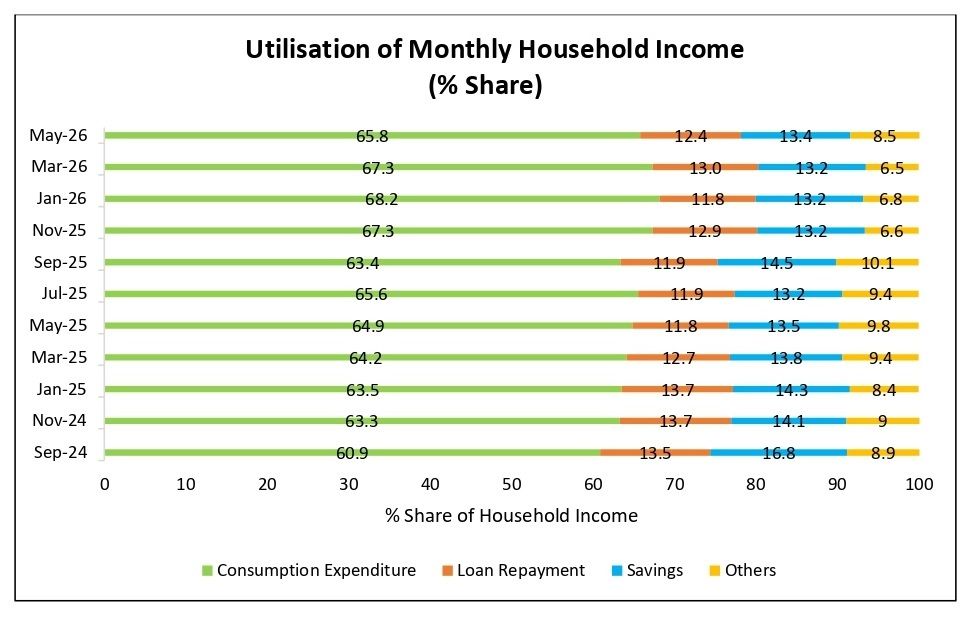
New Delhi: India’s rural economy is entering a phase of growing contradiction. Households are continuing to spend despite weaker income growth, shrinking savings and subdued investments — a trend that highlights the resilience of rural demand but also raises questions about its sustainability.
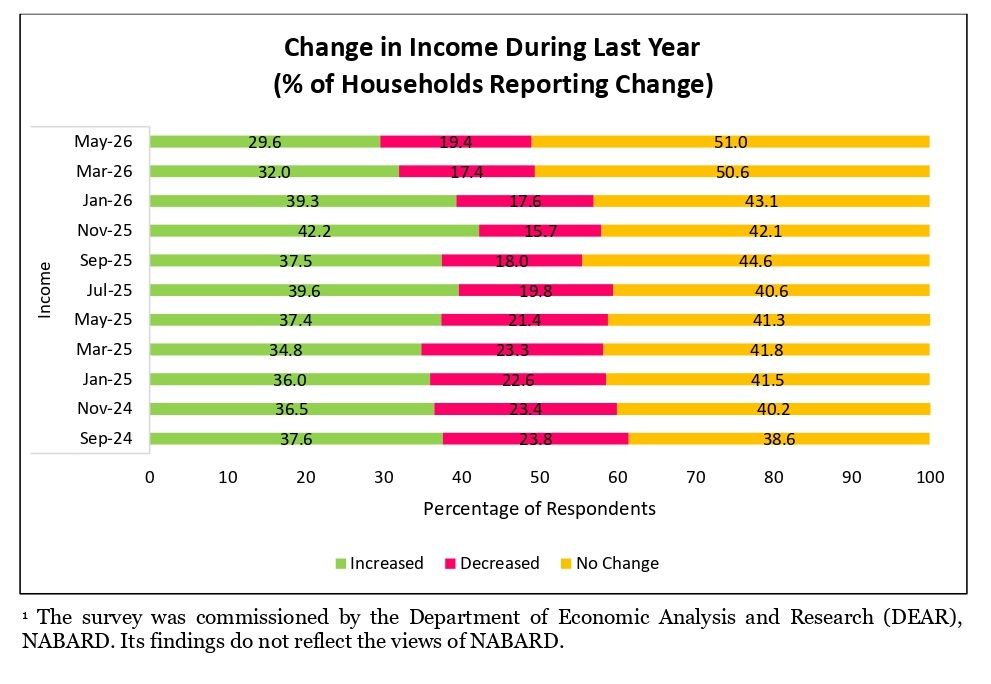
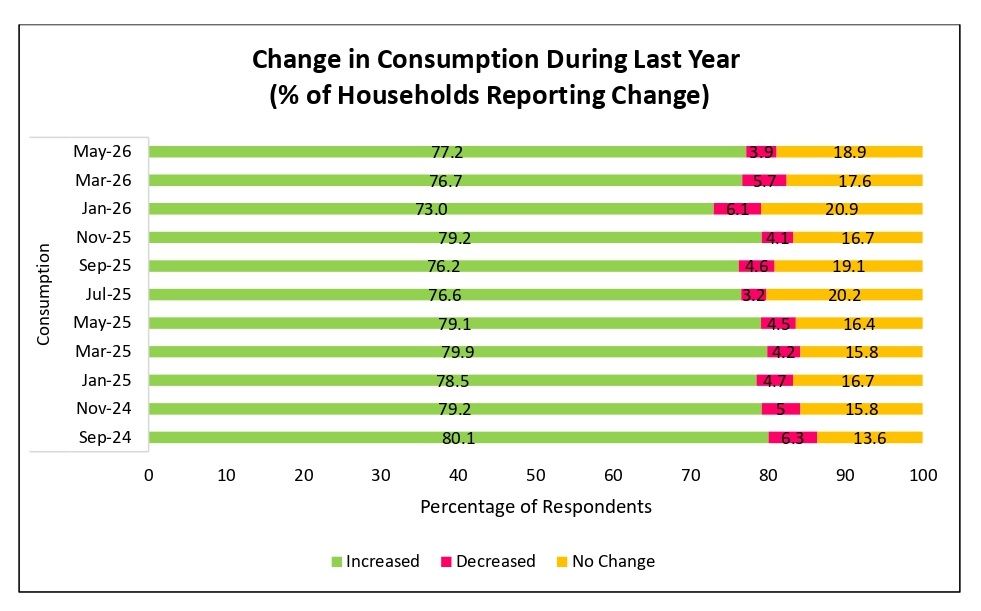
Just 29.6% of rural households reported a rise in income during the previous year, the weakest reading since September 2024. Yet, consumption remained remarkably firm, with 77.2% of households saying their monthly spending increased, indicating that families are maintaining expenditure even as financial cushions weaken.
The findings emerge from the Rural Economic Conditions and Sentiments Survey for May, released by the National Bank for Agriculture and Rural Development (Nabard), which presents a mixed picture of rural India: immediate economic stress has intensified, but confidence about the medium-term future remains intact.
According to the report, the survey was conducted at a time when rural households were exposed to concerns arising from the conflict in West Asia, including possible increases in fuel prices, fertiliser availability worries ahead of the Kharif season, and fears of slower economic growth accompanied by higher inflation.
“The responses accordingly reflect the perceived concerns of rural households, given the still unfolding but uncertain scale and nature of the spillover impact of global geopolitical developments on India,” the report noted.
The financial strain is visible in household balance sheets. Only 19.8% of respondents reported an increase in savings, while roughly 80% experienced either no improvement or an erosion of their savings. Investment activity also remained muted, with almost three-fourths of households reporting no meaningful increase in capital expenditure.
Government welfare support, another important pillar of rural purchasing power, has gradually reduced as a share of household income. The average contribution of subsidies and transfers declined to 8.04% of monthly income in May 2026, compared with levels above 10% a year earlier.
Inflation Fears Intensify
A renewed rise in inflation expectations is becoming another source of pressure for rural households and could complicate the policy outlook for the Reserve Bank of India.
Rural households assessed current inflation at an average of 4.39%, the highest level recorded since May 2025. More importantly, expectations for inflation over the next year jumped sharply to 5.53% from 4.38% in the previous survey, signalling that households expect cost pressures to become more persistent.
The shift in price expectations is already influencing consumption choices. “With gradual increase in food price inflation in recent months, consumption of non-essential food items seems to have moderated, at least by a section of rural households,” the survey observed.
Higher prices and uncertainty are also reshaping borrowing behaviour. The proportion of households reporting an increase in loans fell to 32.7%, the lowest level since September 2024, suggesting a growing reluctance to take additional debt despite income pressures.
The near-term mood in villages has turned significantly cautious. Only 40.7% of respondents expect income and employment conditions to improve over the next quarter — the lowest optimism level recorded across all rounds of the survey.
Credit Shift Continues
While short-term concerns are rising, rural households have not lost faith in their longer-term prospects. Nearly 70.7% expect their income conditions to improve over the coming year, suggesting that households see current disruptions as temporary rather than a permanent slowdown.
The survey explained this optimism by noting that households expect the impact of the West Asia conflict on employment and income prospects to remain largely a short-term phenomenon, which may also explain why rural consumption has continued to remain resilient.
The structure of rural borrowing shows a gradual movement towards institutional finance. More than half of households, or 50.9%, now depend solely on formal credit channels, while 27.2% combine bank loans with informal borrowing.
However, dependence on non-institutional lenders has not disappeared. About 21.9% of households still rely entirely on informal sources such as relatives, friends and moneylenders. The cost of such borrowing has become steeper, with the average interest rate on informal loans climbing to 18.72%, the highest level recorded since September 2024.
The survey also points to continuing gains in rural infrastructure. Roads received the highest satisfaction ranking, with 41.9% of households identifying them as the most improved area of development, substantially ahead of education at 13.5% and drinking water facilities at 10.3%.
The broader message from the survey is that rural demand remains alive but increasingly fragile. Consumption is holding up not because income growth is accelerating, but because households are adjusting their finances to preserve their living standards. Without a recovery in earnings and stronger private investment, this gap between spending and financial capacity may become difficult to maintain.
(Cover photo by Nandhu Kumar on Unsplash)