
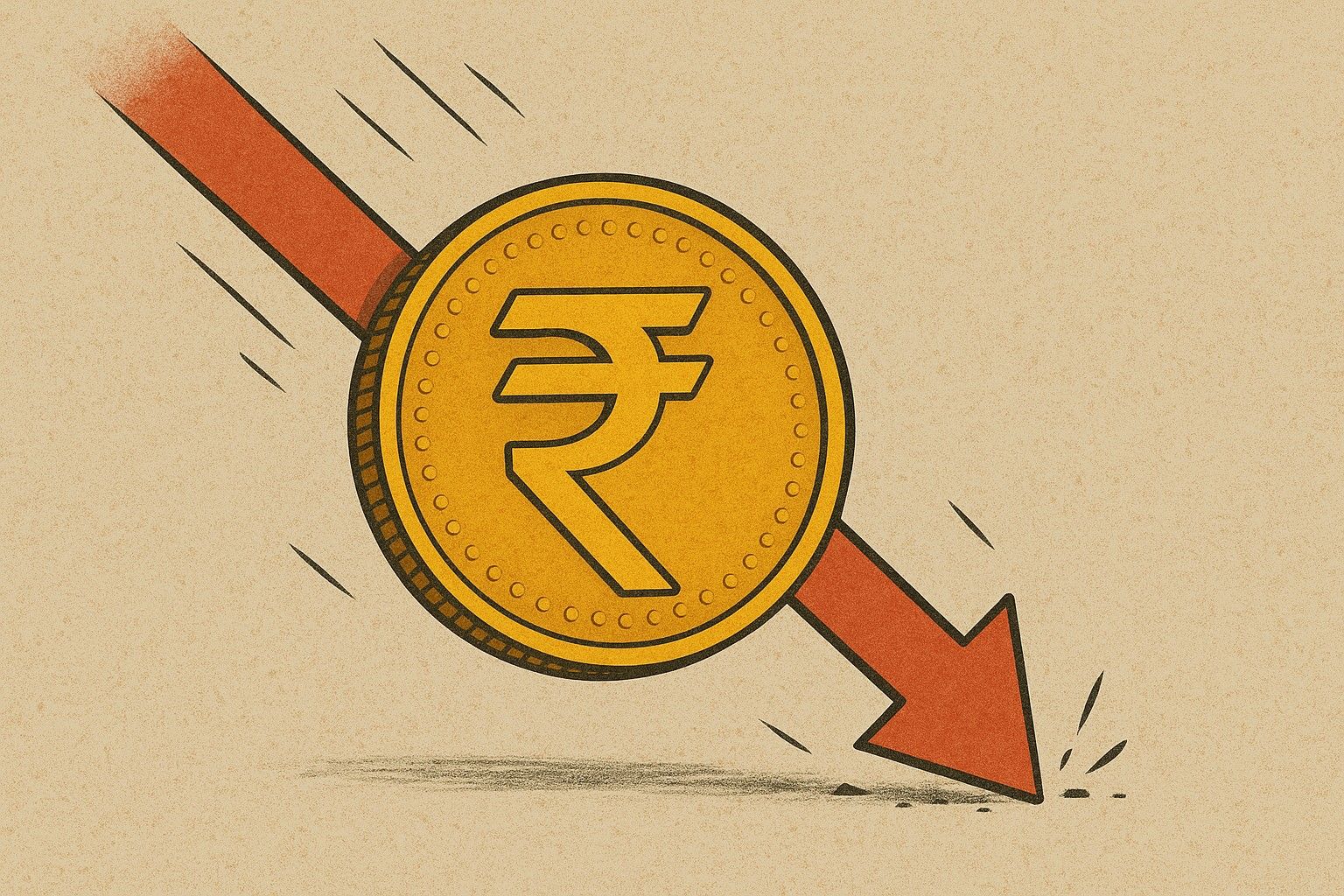

New Delhi: The rupee’s sharp slide toward the “psychologically sensitive” ₹90-per-dollar level has become the dominant theme in the Indian financial markets, even against the backdrop of strong domestic economic performance.
What is unfolding is not an isolated currency wobble, but the result of structural pressures that have been building throughout the year — widening trade imbalance, weak portfolio flows, elevated hedging demand from importers, and an unresolved trade dialogue with the United States.
Heavy dollar demand from corporate buyers has been persistent, while export receipts have not kept pace, leaving the currency chronically short of support.
Bank of Baroda, in a recent currency report tracking market flows, noted that the rupee continues to face sustained pressure due to an ongoing exodus from equities and a central-bank strategy that has eased its implicit defence of specific exchange-rate thresholds.
In BoB’s words, market behaviour suggests “a shift toward allowing a wider trading range for the rupee”, which has signalled to currency markets that gradual depreciation may not be resisted as aggressively as in earlier years. That shift has amplified the dollar’s grip on the rupee even during phases when global risk sentiment has briefly turned positive.
Investors, meanwhile, are treating the unresolved Indo-US trade framework as a major uncertainty. Exporters remain unsure of how tariff structures will evolve, while importers, especially in sectors dependent on technology and capital goods, are hoarding dollars as a precaution.
Market analyst Ajay Bagga captured the mood succinctly when he warned that the breach of the 89-mark is “a very significant issue”, stressing that participants had believed that level would be defended more strongly. His warning about “volatile days ahead” has resonated across the currency market, which now appears resigned to the possibility of the rupee testing deeper lows before any sustainable recovery.
Balance Tilted Towards Weakness
From a technical standpoint, traders are now working with a broad near-term band that stretches from roughly ₹88.80 to ₹90.00 per dollar, with the balance of probabilities tilted toward weakness rather than a sharp rebound.
The fall has been staircase-like rather than chaotic, suggesting that the pressure is structural rather than speculative. Even the flow of upbeat macroeconomic data — including a recent GDP surprise on the upside — has failed to reverse sentiment.
Foreign inflows have not meaningfully returned, and the trade deficit remains uncomfortably high, leaving the currency exposed to every spell of dollar strength.
This does not mean the rupee’s weakness has no upside. A gradual depreciation could improve export competitiveness and eventually narrow the persistent trade gap — a development some economists have argued could prove healthier than a rigid attempt to defend the currency at all costs. But in the near term, import-heavy industries may face higher landed costs, and inflation risk could re-enter the policy conversation if global commodity prices rise.
The emerging consensus across the currency market is clear: without a turnaround in foreign portfolio flows, a stronger recovery in export momentum, or a decisive breakthrough in trade negotiations with the United States, the rupee is likely to remain under strain. Both traders and economists now concede that the currency has entered a phase where slow-burn depreciation, rather than sharp rebounds, may become the default path.
For now, the rupee’s direction hinges less on India’s impressive domestic growth story and more on its external vulnerabilities. Until those reverse, pressure on the currency is unlikely to fade.