

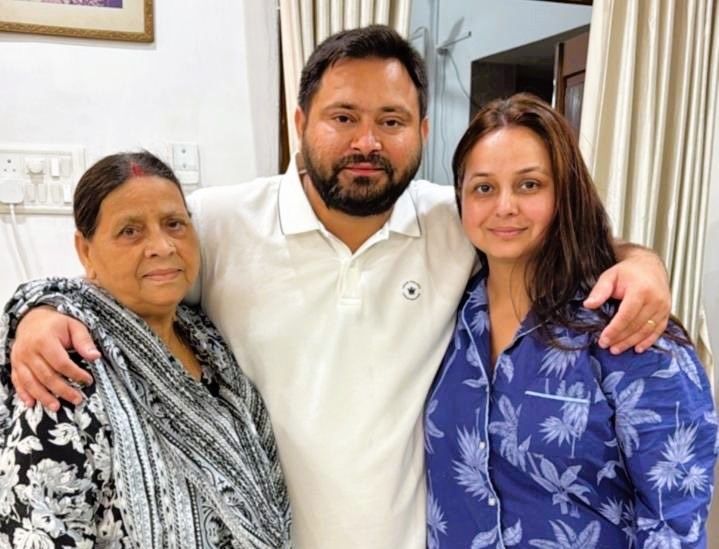
What should have remained a private in-party feud has now become a defining test for RJD, both organisationally and symbolically. (Photo from Rohini's X handle)
New Delhi: The political turbulence within Bihar’s first family has erupted into an open confrontation after Rohini Acharya, daughter of RJD patriarch Lalu Yadav, announced that she is leaving politics and “disowning” her own family.
On Saturday, she wrote on X: “I’m quitting politics and I’m disowning my family … This is what Sanjay Yadav and Rameez had asked me to do …nd I’m taking all the blame’s.” Her statement, posted just after the Mahagathbandhan’s devastating electoral loss, has transformed an internal dispute into a major political event. What might have remained a private feud has now become a defining test for RJD, both organisationally and symbolically.
Rohini’s criticism is directed at Sanjay Yadav, the influential aide of her brother and RJD leader Tejashwi Yadav, and Rameez, said to be Tejashwi’s old friend who hails from a political family in Uttar Pradesh. Her departure suggests that she believes the party’s electoral collapse cannot be separated from what she views as an over-centralised advisory structure and disproportionate influence exercised by non-family power brokers. Tensions with Sanjay Yadav had been simmering for months, first surfacing publicly when Rohini objected to him sitting in the front seat during Tejashwi’s high-profile Adhikar Yatra — a seat traditionally associated with family leadership. Her subsequent disengagement from family social-media circles hinted at deeper fault lines, which have now exploded in full public view.
On Dialogus: Syah Safed, hosted by Shanker Arnimesh, senior journalists Amitabh Bhushan and Prem Kumar described the moment as one of the most consequential internal crises in RJD’s history. “When an aide begins to ride shotgun with the family bus, the optics matter; when the daughter says she disowns her own kin, the message to the ground is devastating for party discipline,” said Bhushan.
His assessment underlined not just the symbolism of Rohini’s exit, but the degree to which internal loyalty — long considered the backbone of RJD’s cadre — is suddenly under pressure.
Prem Kumar took the argument further by placing the rupture within the broader decline in RJD’s organisational cohesion. In his words, “This is not just a family spat. For RJD, which has survived decades on disciplined social coalition and trust in dynastic continuity, such public splits are strategic liabilities.” He argued that the Bihar electorate has historically supported RJD because it projected unity, decisiveness and a distinct ideological identity. The current fissures, if left unaddressed, could corrode this brand more deeply than an electoral loss ever could, he opined.
Alliance’s collapse
The backdrop of the Mahagathbandhan’s defeat adds gravity. The alliance’s collapse — and RJD’s sharp drop in seats — has triggered an intense post-mortem. Many within the party blame confusing messaging, a narrow caste focus, poor seat-sharing choices and organisational disarray. In that climate, Rohini’s exit reinforces the narrative of an outfit unable to manage internal leadership dynamics and external political strategy at the same time.
Even among the Dialogus panelists, there was broad agreement that the NDA’s resurgence under Nitish Kumar and BJP was politically effective, not only because of governance messaging but because the opposition appeared increasingly fragmented and preoccupied with internal contradictions.
One striking description came from Bhushan, who warned that “organisations survive when the brand is greater than the individual. When a family brand begins bleeding from within, the cadre feels the shiver first.” His words captured the fear that the crisis goes beyond a domestic quarrel and touches the emotional fabric that binds voters to the RJD.
Prem Kumar echoed that concern in his observation. “RJD’s challenge now is not just to rebuild its numerical base, but to restore its moral compact with supporters — credible leadership, zero chaos, a refreshed narrative of social justice beyond Yadav-family prominence,” he said.
Whether this episode becomes a turning point or the beginning of a long decline depends on how the party responds. A swift reconciliation with Rohini, a transparent restructuring of advisory roles around Tejashwi, and a recalibrated strategy to reconnect with a wider social coalition could convert this crisis into renewal. But if introspection is replaced with blame-shifting or silence, the rift may deepen and become an easy political weapon for opponents.
Prem Kumar cautioned that “a political family quarrel in public is a warning sign to the voter: your leaders are busy with their own.”
For now, what began as a personal rupture has become a moment of reckoning for RJD — a test of leadership, credibility, cohesion and long-term viability in Bihar’s power landscape. The party has weathered electoral shocks before, but seldom under the glare of such public familial fracture. The next moves will not only shape the future of the Lalu family, but may recalibrate the trajectory of Bihar’s opposition politics for years to come.