

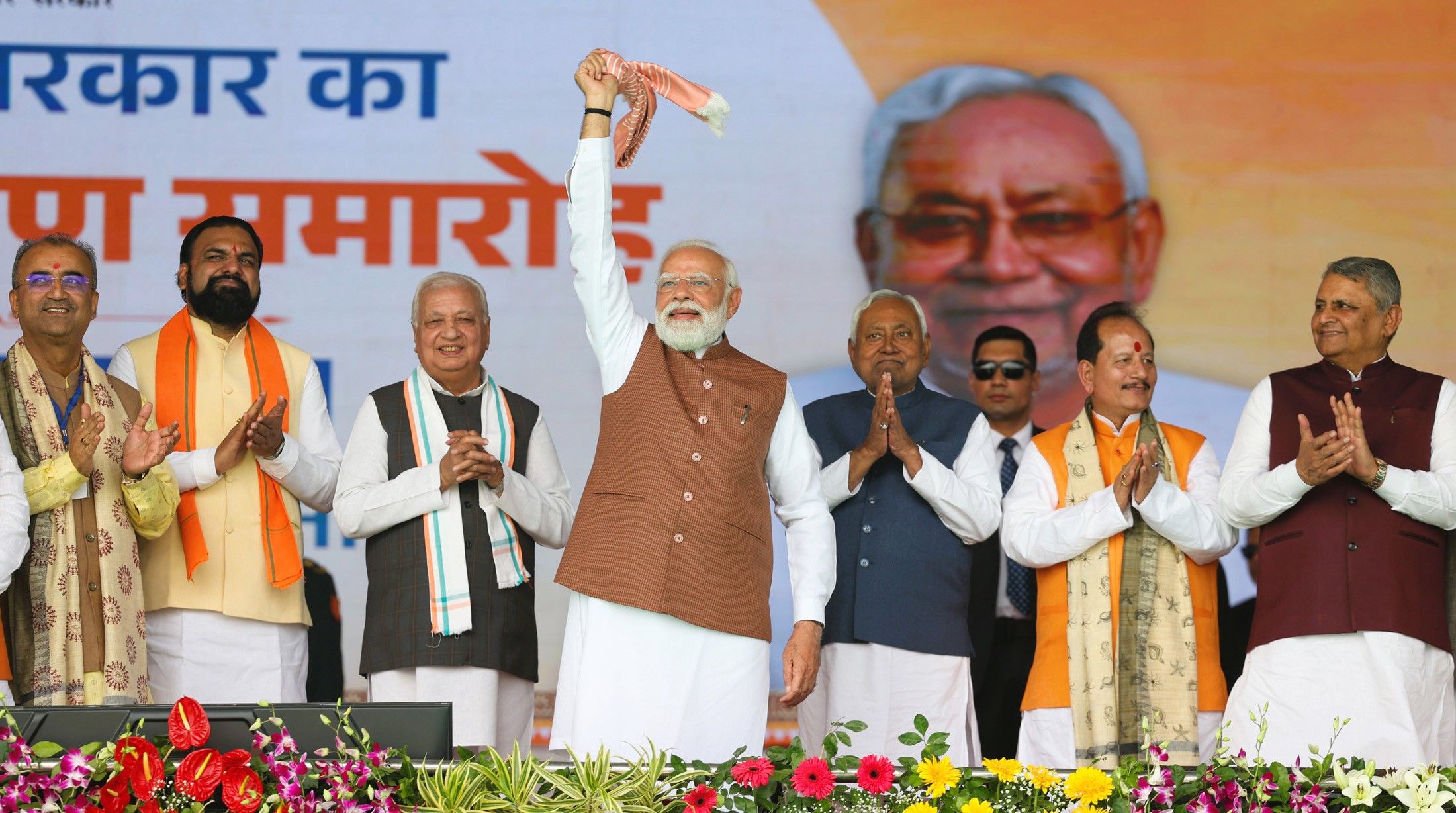
New Delhi: JD(U) chief Nitish Kumar was sworn in as Bihar chief minister for an unprecedented tenth term on Thursday, capping weeks of hectic political developments with a grand oath-taking ceremony at Gandhi Maidan in Patna.
Governor Arif Mohammad Khan administered the oath of office to the 74-year-old leader in the presence of Prime Minister Narendra Modi, Union home minister Amit Shah, BJP national president J P Nadda and a battery of NDA leaders.
The ceremony marked the beginning of a new coalition government with a 26-member council of ministers. Fourteen berths went to the BJP, eight to the JD(U), two to Lok Janshakti Party (Ram Vilas), and one each to the Hindustani Awam Morcha (Secular) and the Rashtriya Lok Morcha. Twenty-one of those sworn in are MLAs and four are members of the Legislative Council.
In a significant political message, the new team includes several fresh faces while more than a dozen former ministers — the most prominent being industries minister Nitish Mishra — have been excluded despite their record of administrative delivery.
BJP, which emerged as the single-largest party in the assembly with 89 seats, secured the largest share of portfolios. Samrat Choudhary and Vijay Kumar Sinha continue as deputy chief ministers, while influential leaders such as Mangal Pandey, Ram Kripal Yadav, Nitin Nabin, Dilip Jaiswal and Shreyashi Singh have found a place in the cabinet.
From JD(U), veterans Vijay Kumar Choudhary, Bijendra Prasad Yadav and Ashok Choudhary have been retained alongside others. LJP (Ram Vilas) is represented by Sanjay Kumar and Sanjay Kumar Singh, while Santosh Kumar Suman of HAM(S) and Deepak Prakash of the RLM have also been inducted. Prakash, who is not a member of either House, will have to secure a seat within six months to continue.
The composition of the government underscores the familiar social arithmetic that Nitish has relied on through successive terms. The cabinet includes eight ministers from the general category, six each from OBC and EBC communities, and five from Scheduled Castes. Rajputs have the largest representation among individual castes, while Brahmins, Bhumihars and Kayasthas too find a place.
The OBC category has prominent representation from Kurmi, Kushwaha and Yadav leaders, continuing the ruling coalition’s strategy of consolidating agrarian and middle-caste blocs. Among EBCs, groups such as Kahar, Mallah, Teli, Nishad and Sudhi have been included, while the SC representation spans Paasi, Mushar, Paswan and Ravidas communities.
The political messaging was unmistakable as the PM acknowledged the moment with a celebratory gesture to the crowd and later posted on X: “Congratulations to Nitish Kumar Ji on taking oath as Bihar’s Chief Minister… My best wishes to him for his tenure ahead.” He also congratulated the two Deputy CMs, saying they had “worked extensively at the grassroots in serving people”. In a separate post, Amit Shah described the new NDA dispensation as a “double-engine government” that would deliver on the goal of a “developed Bihar” and ensure progress for every section of society.
Tejashwi Skips Event
While top NDA leaders shared the stage, opposition leader Tejashwi Yadav chose to skip the ceremony, though he did issue a formal congratulatory message on social media wishing that the new government “live up to the hopes and expectations of the people” and bring “positive and qualitative changes” to their lives.
The new cabinet’s first test is imminent. A three-day session of the new assembly begins on November 26, when the Speaker is expected to be elected — Prem Kumar, a nine-time MLA from Gaya Town, is seen as the frontrunner.
For Nitish, the coming term presents both continuity and challenge. His political coalition is stronger numerically but more complex socially, and Bihar’s persistent structural concerns — employment generation, education reforms, flood management, land issues and the efficiency of the bureaucracy — remain urgent.
With BJP consolidating its internal power and JD(U) asserting its distinct space, the stability of the alliance will depend not only on caste equations but on whether governance can match the heavy expectations attached to this tenth innings of Bihar’s longest-serving chief minister.