

Indian has now set a target of increasing defence manufacturing to ₹3 lakh crore and exports to ₹50,000 crore by 2029, said Defence Minister Rajnath Singh
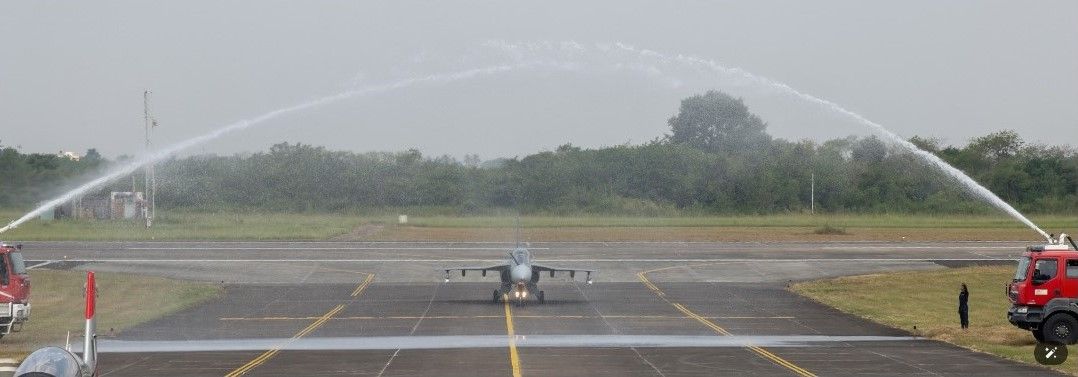
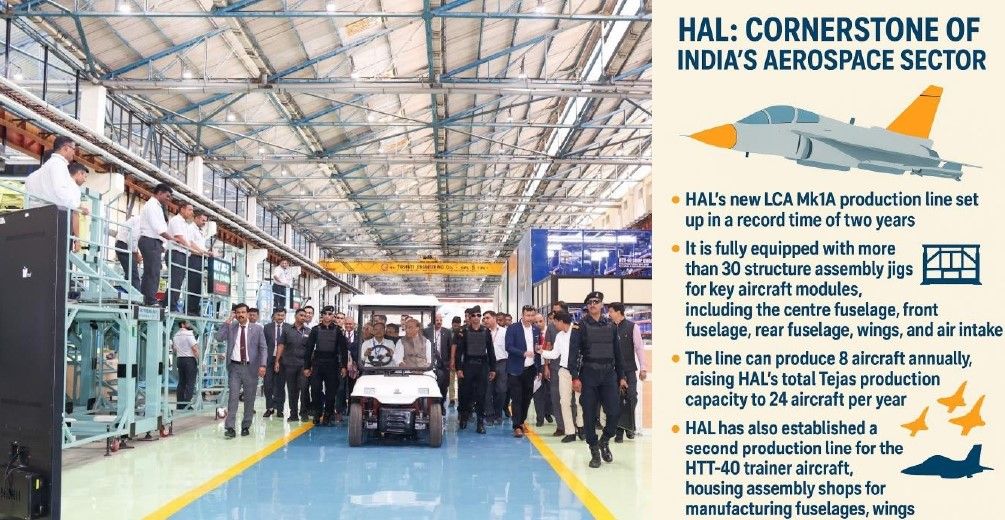
New Delhi: Defence Minister Rajnath Singh inaugurated two new aircraft production lines at Hindustan Aeronautics Limited’s (HAL) Nashik division, marking a major milestone in India’s push for self-reliance in defence manufacturing. The new facilities will produce the light combat aircraft (LCA) Mk1A and the HTT-40 basic trainer aircraft, both of which represent indigenous design and engineering excellence.
Addressing the gathering, the Defence Minister highlighted that India’s annual defence production has soared from ₹46,429 crore in 2014-15 to a record high of over ₹1.50 lakh crore in 2024-25. He also announced that defence exports have touched an unprecedented ₹25,000 crore, a steep rise from less than ₹1,000 crore a decade ago. “We have now set a target of increasing defence manufacturing to ₹3 lakh crore and exports to ₹50,000 crore by 2029,” he said, crediting this success to the government’s consistent focus on indigenisation, innovation and strategic partnerships.
Rajnath emphasized the dynamic nature of modern warfare and the need for India to remain at the forefront of technological evolution. He pointed to Ai, cyber warfare, drone systems and next-generation aircraft as defining elements of future conflicts. “India must always stay ahead in this new race and not lag behind,” he stated, urging HAL to extend its expertise beyond LCA Tejas and HTT-40 and establish a strong presence in next-generation aircraft, unmanned systems, and civil aviation.
He praised HAL for its unwavering commitment to supporting the Indian Air Force (IAF), particularly its operational support to the recently decommissioned MiG-21 fleet. He also acknowledged HAL’s critical role during Operation Sindoor, calling it a landmark moment in India’s defence preparedness. “During the operation, HAL teams worked round the clock across multiple operational sites, ensuring the IAF’s readiness by carrying out prompt maintenance on fighter jets and helicopters. The Nashik team’s integration of the BrahMos missile on the Su-30, which successfully destroyed terrorist hideouts, exemplified India’s self-reliance in defence capabilities,” he said.
Symbol of Self Reliance
The Defence Minister lauded HAL Nashik’s six-decade contribution to India’s aerospace strength, from manufacturing MiG-21 and MiG-27 fighters to assembling the Su-30MKI, describing the campus as a “glowing symbol of self-reliance.” He highlighted that the construction of the LCA Tejas and HTT-40 aircraft is a result of collaboration between HAL, the Aeronautical Development Agency, DRDO, the Indian Air Force, and several private industries. “This collaboration is proof that if the government, industry and academia work together, no challenge is too big,” he remarked, noting the growing trust of the IAF in indigenously developed platforms.
Rajnath also underlined the significance of the joint maintenance, repair, and overhaul (MRO) facility for both civil and military aviation established at Nashik. The facility, he said, will create new employment opportunities in Nashik and nearby regions while bolstering India’s aviation ecosystem. The minister praised HAL’s complete transition to digital and paperless operations, calling the Nashik complex a “true reflection of New India’s technological advancement and sustainable industrial model”.
Secretary (Defence Production) Sanjeev Kumar described the LCA Tejas Mk1 as more than just a fighter aircraft — “it is a statement of India’s design and manufacturing excellence, built indigenously through collaboration between HAL, ADA, DRDO, and the IAF.” He added that the HTT-40, fully designed and developed by HAL, showcases the organisation’s ability to conceptualise, design, and deliver critical defence platforms entirely within the country.
HAL CMD D K Sunil said, “HAL’s Nashik division has proven its ability to produce indigenous advanced fighters alongside the Su-30MKI. This expansion has created around 1,000 new jobs and developed over 40 industry partners in and around Nashik, aligning with the government’s goal of building a strong public-private partnership,” he noted.