

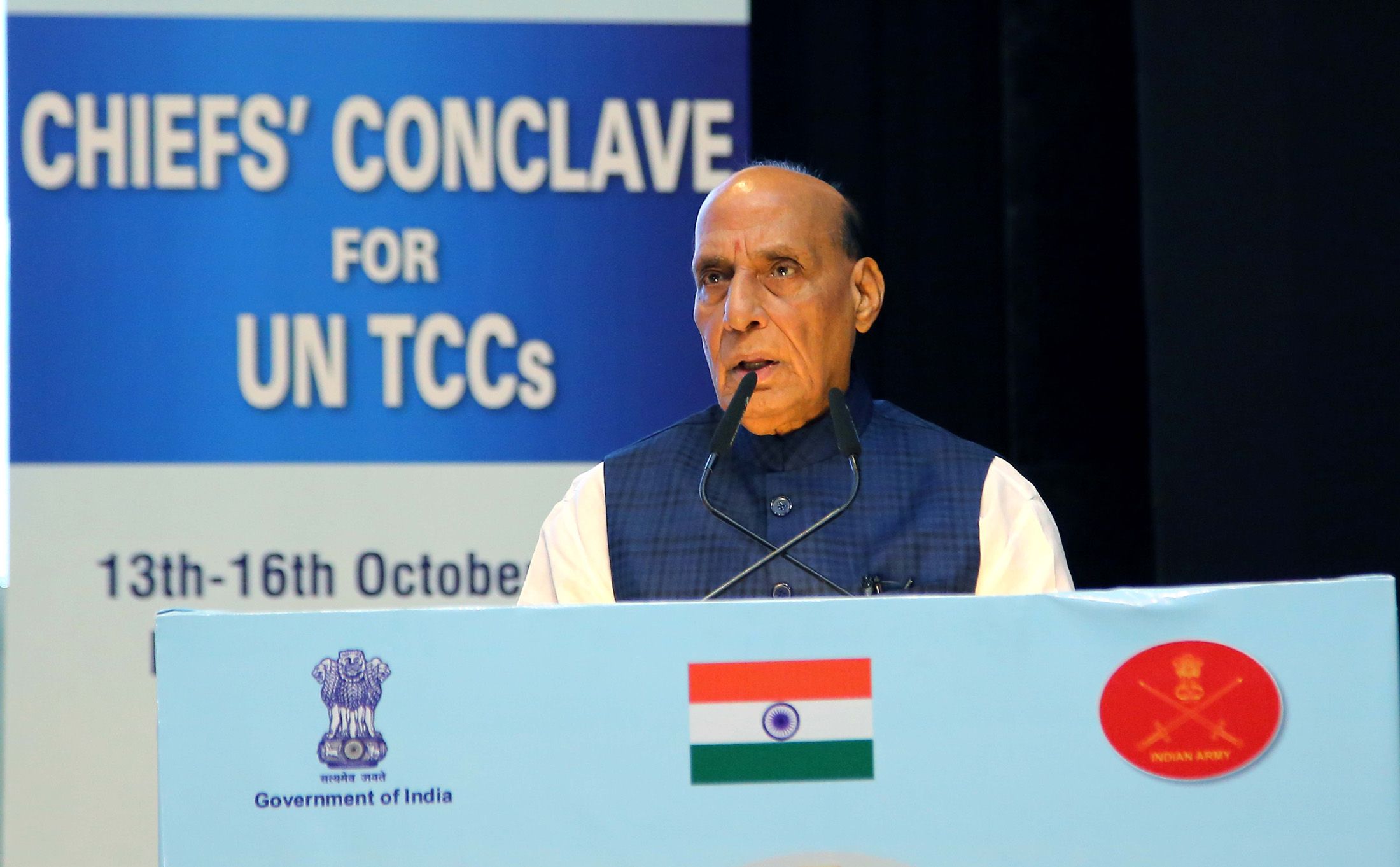
Defence Minister addressing the inaugural session of the Chiefs’ Conclave of United Nations Troop Contributing Countries (UNTCC) in New Delhi on Tuesday.
New Delhi: Defence Minister Rajnath Singh on Tuesday outlined a new ‘4C’ guiding framework — consultation, cooperation, coordination and capacity building — to enhance the effectiveness of United Nations peacekeeping operations amid evolving global challenges.
Addressing the inaugural session of the Chiefs’ Conclave of United Nations Troop Contributing Countries (UNTCC) in New Delhi, he urged the international community to adopt a more reform-oriented, technologically enabled, and collaborative approach to sustain peacekeeping missions.
Hosting the UNTCC Chiefs’ Conclave for the first time, India brought together senior military leaders from 32 nations at the Manekshaw Centre from October 14 to16 to discuss operational challenges, interoperability, and inclusivity in peacekeeping.
Highlighting the growing complexities of UN missions, Singh noted that peacekeepers today are deployed in volatile zones facing asymmetric warfare, terrorism, fragile political settlements, humanitarian crises, and misinformation campaigns. “Meeting these emerging challenges demands more than bravery — it requires adaptability, innovation, and a comprehensive mission-level approach,” he said, calling for closer coordination between troop- and finance-contributing nations and political stakeholders.
The Defence Minister cautioned that outdated multilateral structures are ill-equipped to deal with modern conflict dynamics. “Without comprehensive reforms, the UN faces a crisis of confidence. We need a reformed multilateralism that reflects present realities, gives voice to all stakeholders, and focuses on human welfare,” he asserted.
Reaffirming India’s long-standing support for UN peacekeeping, Singh said nearly 2,90,000 Indian personnel have served in over 50 missions, earning global recognition for professionalism and compassion. “We are ready to contribute troops, share expertise, and support reforms that make peacekeeping more effective and accountable,” he added.
Singh underscored India’s role in capacity building through the Centre for United Nations Peacekeeping (CUNPK) in New Delhi, which has trained participants from more than 90 countries. He also highlighted India’s Aatmanirbhar Bharat initiatives, which have yielded indigenous technologies such as land mobility platforms, secure communications, surveillance systems, unmanned aerial vehicles, and medical support equipment suited for peacekeeping operations.
Applauding the growing participation of women in peacekeeping, the Defence Minister said their presence enhances trust and operational effectiveness. Recalling India’s pioneering 2007 deployment of an all-women police unit to Liberia, he noted that Indian women officers continue to serve with distinction in missions across South Sudan, Golan Heights and Lebanon. He also cited the 2024 UN Military Gender Advocate of the Year Award won by an Indian Army woman peacekeeper in the Democratic Republic of Congo.
Singh further highlighted the humanitarian contributions of Indian medical teams operating in UN field hospitals across Africa. “Their service under adversity embodies the finest traditions of Indian peacekeeping and the UN’s spirit of humanity,” he said.
Underlining India’s commitment to a rules-based international order, Singh said the nation’s aspiration to be a Vishwa Guru represents a call for inclusive progress, not dominance. “India, the land of Mahatma Gandhi, believes peace is not just the absence of war but a state of justice, harmony, and moral strength,” he remarked.
Chief of the Army Staff General Upendra Dwivedi, in his welcome address, reaffirmed India’s resolve to advance operational excellence and interoperability through indigenous innovation and training. The event was attended by Chief of Defence Staff General Anil Chauhan, Air Chief Marshal Amar Preet Singh, UN Under-Secretary-General for Peace Operations Jean-Pierre Lacroix, and senior representatives from participating nations.
The conclave also featured a defence exhibition showcasing India’s technological capabilities and promoting shared capacity building in global peacekeeping.