
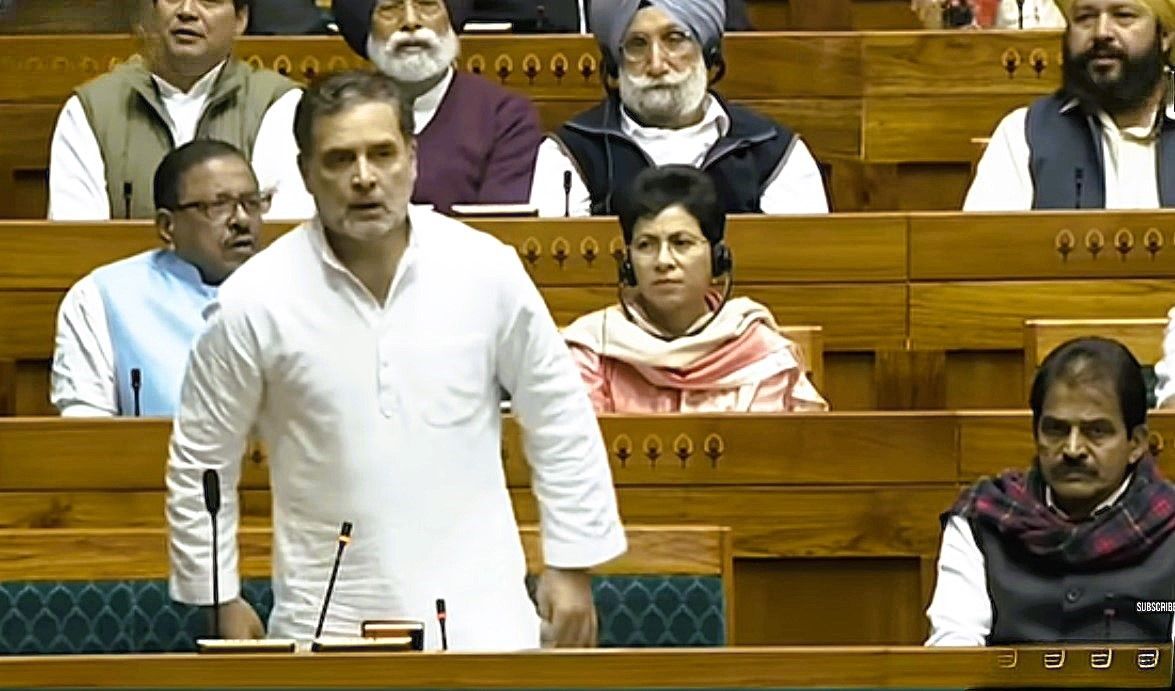

New Delhi: Leader of opposition Rahul Gandhi on Tuesday launched a blistering attack on the Election Commission during a debate on electoral reforms in the Lok Sabha, alleging large-scale irregularities in voter rolls and a systemic lack of transparency.
Citing what he claimed were “lakhs and lakhs of duplicate voters” in states such as Haryana and Bihar, Rahul reiterated his controversial assertion that a “Brazilian woman” appeared “22 times” on the Haryana rolls.
Accusing the poll body of refusing accountability, he warned that “vote chori is an anti-national act” and cautioned that a future opposition government would “change the law retroactively” and “come and find” those responsible.
His remarks came amid a full-day parliamentary confrontation over the Special Intensive Revision (SIR) of electoral rolls, which the Election Commission has launched across multiple states. The opposition alleges that the process has been rushed, opaque, and disproportionately burdensome for booth level officers (BLOs), several of whom have reportedly died by suicide under intense pressure to complete verification work in impossibly short timelines.
The debate expanded sharply beyond voter lists.
As Parliament debated the SIR exercise, political experts and regional observers flagged “deeper concerns”. In West Bengal, where SIR has sparked fierce protests by Trinamool Congress, the experts pointed out that the process is “colliding with ground realities” shaped by migration, river erosion, and unstable settlements in districts such as Malda, Murshidabad and the Sundarbans. Many residents lack the extensive documentation now demanded for verification, creating what critics say is a “serious risk that legitimate voters will be dropped from the rolls”.
BJP, meanwhile, maintains that the revision is necessary to remove alleged illegal immigrants, a charge TMC calls a “political ploy” ahead of state polls in 2026.
In Uttar Pradesh and Bihar, political scientists noted that the SIR process has been marred by low return rates of verification forms, limited time for door-to-door visits, and the addition of booth level agents’ assistants (BLAAs) nominated by political parties, raising concerns that better-resourced parties will dominate the verification pipeline.
The Supreme Court, while intervening in matters linked to the SIR exercise in Bihar, had asked state legal services authorities to assist vulnerable groups at risk of disenfranchisement, including migrants, students, daily-wage workers and the elderly. Yet implementation remained patchy, and opposition leaders argue that the Election Commission has failed to answer repeated complaints, said the experts.
In Parliament, Samajwadi Party chief Akhilesh Yadav accused the administration of orchestrating “vote chori”, citing past incidents in Rampur where, he claimed, police deployment prevented minority voters from reaching the booths. Other opposition MPs alleged that state governments could manipulate elections by using welfare funds as pre-poll cash transfers, distorting the level playing field.
Meanwhile, a parallel debate resurfaced over whether India should return to ballot-paper voting. While some opposition parties pointed to technologically-advanced nations that have discarded electronic voting, experts argued that India should strengthen safeguards within the current EVM-VVPAT framework rather than revert to earlier systems that carried their own flaws.
Despite the heated exchanges, the government has yet to offer detailed responses to the allegations regarding SIR procedures, EC appointments, and resource imbalances in electoral oversight. As the Winter Session approaches its final stretch, the opposition insists that restoring the credibility and independence of the Election Commission is essential to preserving the integrity of India’s democratic process.