

New Delhi: India has lost its position as the most represented higher education system in the QS World University Rankings: Asia 2026, with China reclaiming the top spot after two years. According to the latest rankings released on Tuesday by global higher education analyst QS Quacquarelli Symonds, China now has 395 universities on the list, while India follows with 294. This year’s edition features 1,529 institutions across the continent, the highest number since the rankings began.
India added 137 new universities to the list, reflecting the country’s rapidly expanding higher education landscape. Over the past decade, India’s representation in the QS Asia Rankings has grown more than tenfold, highlighting the deepening reach of its university system. “In just five years since the National Education Policy was launched, India has built system-level capacity that is globally relevant and locally empowering,” said Jessica Turner, CEO of QS Quacquarelli Symonds. She added that India is increasingly positioning itself not only as a study destination but as a global knowledge hub driving innovation, inclusion and sustainable growth.
IITs Disappoint
Despite this expansion, the 2026 edition brought mixed results for India’s top institutions. The Indian Institute of Technology, Delhi (IIT Delhi) remained the country’s highest-ranked university for the second consecutive year but fell 15 places to 59th in Asia, its lowest position in recent years. IIT Bombay, once India’s leading university regionally, saw the sharpest drop —falling from 48th in 2025 to 71st this year. Between 2021 and 2024, IIT Bombay consistently ranked between 37 and 42, but this year’s decline reflects tougher competition across the region rather than a fall in absolute performance.
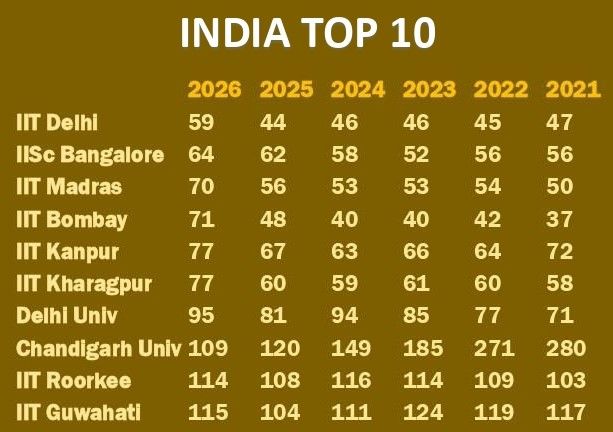
Among the top 10 Indian institutions, five IITs — Delhi, Madras, Bombay, Kanpur, and Kharagpur — recorded their weakest rankings in several years, even though their total scores improved. The only university in the Indian top ten to move up was Chandigarh University, which climbed from 120th to 109th.
India’s strengths remain rooted in research productivity and academic qualifications. The country performed exceptionally well in the ‘papers per faculty’ indicator, with five Indian universities featuring among Asia’s top ten and 28 among the top 50—more than double China’s count in the same category. Maulana Abul Kalam Azad University of Technology, West Bengal, ranked first in Asia for papers per faculty, followed by Bharathiar University, the Indian Institute of Science Bangalore, Anna University, and IIT Madras. India also excelled in the ‘staff with PhDs’ metric, where the National Institute of Technology Nagaland and Mother Teresa Women’s University, Kodaikanal, shared second place regionally, while nine other Indian institutions ranked joint fourth. These results underscore India’s growing research capacity and commitment to faculty development.
The rankings also show that Indian universities are gaining ground in employer and academic reputation. IIT Bombay ranked 11th in Asia for employer reputation, improving by five places, and 26th in academic reputation. IIT Delhi and IIT Kanpur followed at 15th and 33rd, respectively, while IIT Madras rose 13 positions to 29th. Overall, 36 Indian institutions improved their employer reputation scores this year, reflecting rising global recognition of Indian graduates and research collaborations.
Weak Global Engagement
However, internationalisation continues to be a significant weakness for India’s higher education system. Average scores for international faculty, international students, and student exchange indicators remain below global benchmarks. The average score for international faculty stood at 18.9 compared to a global average of around 31, while international students scored 14.2, inbound exchange students 8.4, and outbound exchange students 9.9. A few universities made notable progress: SIMATS and Chandigarh University ranked among Asia’s top 100 for international faculty, while Marwadi University and Amity University performed well in attracting international students. Still, India lags far behind regional leaders in building globally diverse campuses.
The QS report notes that the decline in rankings for most leading Indian universities is relative, as their overall scores improved but did not keep pace with gains made by their Asian counterparts. Areas of concern include citations per paper, faculty-student ratio, and international student ratio. In research impact, measured by citations per paper, IIT Delhi scored 31.5, IIT Bombay 20.0, and IIT Madras 20.3 — an improvement from last year but still far below top Asian universities that scored in the high 90s. Faculty-student ratios also remain a challenge, with IIT Kharagpur scoring 16.5 and IIT Delhi 40.9, indicating large class sizes and limited teaching resources compared to leading institutions across Asia. Similarly, the international student ratio remains low, with IITs scoring between 2.5 and 12.3, despite marginal progress.
At the continental level, universities from Hong Kong, Mainland China, and Singapore dominate the top of the table. The University of Hong Kong emerged as Asia’s best university this year, pushing China’s Peking University to second place. Singapore’s National University of Singapore and Nanyang Technological University shared third place. South Korea and Malaysia also showed strong upward momentum, with Yonsei University and Korea University moving into the top 20, while Universiti Malaya and Universiti Putra Malaysia climbed steadily due to better faculty-student ratios and greater internationalisation efforts.
While India’s leading institutions face growing regional competition, the country’s expanding participation in the QS Asia Rankings signals a maturing education ecosystem. With continued investment in research, faculty development, and global partnerships, experts believe India has the potential to regain its leadership position in the years ahead. The challenge now, observers say, is not quantity but quality — ensuring that India’s vast higher education network delivers excellence that matches its scale on the world stage.