

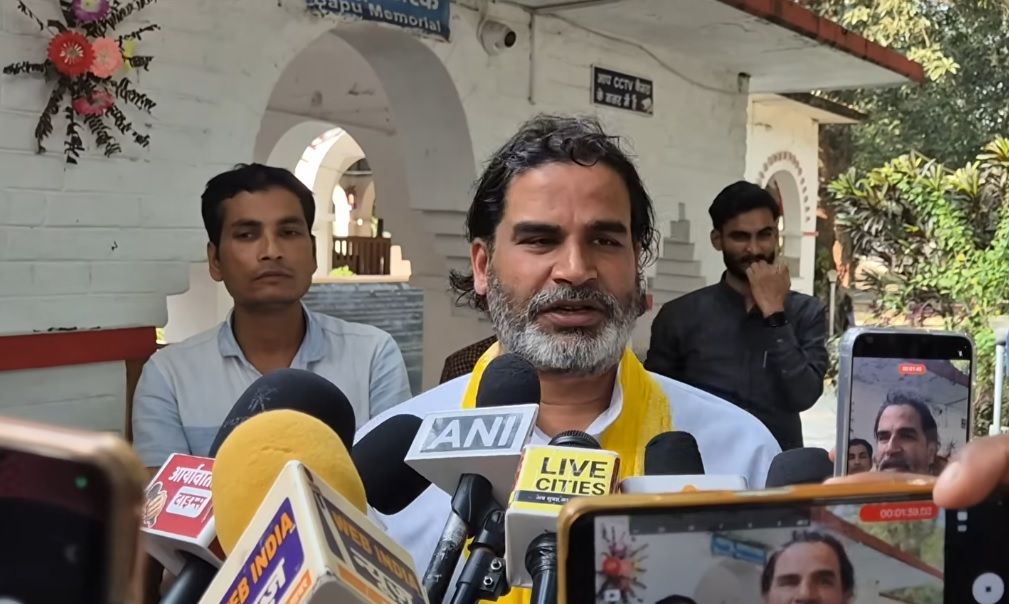
For years, Prashant Kishor shaped political destinies from behind the curtains — a mastermind whose playbooks helped craft historic election victories across India. But when he turned his focus to Bihar, his home state, he didn’t come to advise. He came to overturn the status quo. His message was simple, almost confrontational: Bihar was a “failed state” and politics as practiced for decades could never fix it. The solution, he claimed, lay in a movement powered not by caste, not by patronage, but by governance and education.
His party Jan Suraaj was designed to embody this new logic. It promised a future where classrooms mattered more than factories, because — as Kishor said — “factories do not come to weak societies; strong societies build factories”. The idea was idealistic, disruptive, and for many, inspiring. But the question that hovered from the beginning was whether Bihar’s political soil was fertile enough for such a vision.
A Movement on Foot
If Kishor was launching a revolution, he would do it in sneakers rather than boardrooms. The Jan Suraaj padyatra — hundreds of kilometers, months of walking, and thousands of village meetings — was unlike anything Bihar had seen from a new political entrant.
Crowds gathered. Young people listened. Disillusioned voters, especially among the urban classes, found in him a language of aspiration that rarely entered Bihar’s political vocabulary. Through all of this, Kishor repeated two commitments: Jan Suraaj would not form an alliance with any bloc before or after the election, and he himself would not be a candidate.
To many, this sounded like sheer courage. To others, it echoed political idealism untested by electoral realities.
Prediction That Created Pressure
Kishor is no stranger to numbers. So when he announced that Jan Suraaj would either win more than 150 seats or fewer than 10, and that there would be no “middle ground” for his party, the political class took notice.
It was a prophecy that electrified supporters and sharpened the knives of critics. Suddenly, the election was a referendum not only on Jan Suraaj but on Kishor himself — the strategist known for precision now betting everything on a dream.
But even before votes were cast, exit polls poured cold water on the grand narrative. Multiple agencies estimated Jan Suraaj would win between zero and five seats. Some earlier surveys had predicted up to 7% vote share and 2-5 seats, especially because of Kishor’s high popularity among first-time voters. The interest was real, the energy was real… but the arithmetic, it seemed, was unforgiving.
Reality Arrives With No Mercy
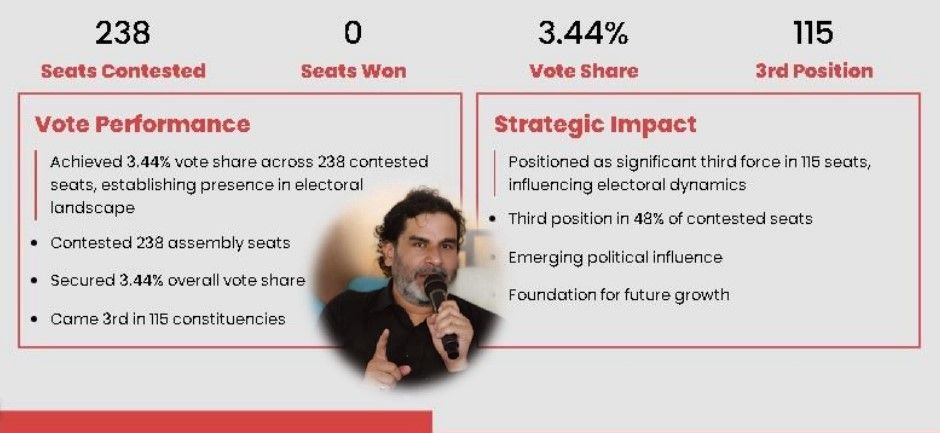
When the votes were counted, Bihar delivered its verdict with ruthless clarity. Jan Suraaj failed to win even a single seat.
There was no middle ground. No consolation prize. The prediction Kishor had issued months earlier had materialized… on its bleakest end.
Within minutes, postmortems began.
Analysts argued that although the padyatra generated excitement, the party lacked a booth-level political apparatus capable of mobilizing votes in a state still shaped profoundly by caste networks and local patronage. Jan Suraaj’s narrative of education and governance resonated with segments of society, but for many others, it was too abstract compared to the concrete certainties of identity-based politics.
Reports also suggested that in many constituencies the initial buzz was not followed by sustained engagement; the movement was louder than its organization. Some candidates were also unable to fund competitive campaigns, leaving gaps in the final weeks of the race.
The movement had captured attention. But attention had not translated into votes.
Ideas Bihar Accepted & the Ones It Didn’t
Even in defeat, Jan Suraaj surfaced certain truths about Bihar’s political heartbeat.
Many young voters embraced Kishor’s rejection of alliance politics. In a state where coalition-switching is often a cynical art form, Jan Suraaj’s refusal to bargain was widely praised. His language of governance and development offered a refreshing departure from traditional rhetoric. And the party’s digital presence — driven by its “Digital Yoddhas” — outperformed most new regional movements in India.
But Bihar, like most democracies, does not vote based only on inspiration. Politics here is intimate, community-rooted, and built from the bottom up. And while Jan Suraaj shaped a conversation, it did not build a machinery. It dreamed of changing Bihar but could not persuade enough voters that it could govern Bihar.
What Comes After Hope & Humbling?
Some political debuts are meant to become breakthroughs. Others become beginnings.
For Jan Suraaj and Prashant Kishor, the next phase will depend less on speeches and symbolism and more on stamina. If the party continues, it must do what the padyatra alone could not: transform a message into an organization. That means panchayat-level committees, constituency-tailored development agendas, ward engagement, and candidate pipelines. The slow and unglamorous work that wins power before ideals can be executed.
Observers are divided. Some believe Jan Suraaj can grow from this defeat the way the Aam Aadmi Party grew from its 2013 disappointment. Others argue that Bihar’s political structure leaves limited room for an ideology-first party, and that a refusal to engage in alliances may cap its ceiling indefinitely.
What is certain is this: Kishor has time, visibility, and a platform, but his movement now needs proof, not poetry.
The Man & the Mandate That Wasn’t
In the end, Kishor’s journey in Bihar has been a story of tension — between vision and realism, idealism and pragmatism, inspiration and arithmetic. His bold gamble delivered neither seats nor silence. The election humbled him but did not erase him.
For some, he remains a dreamer trying to rewrite Bihar’s political grammar. For others, he misread a society whose complexities run deeper than policy manifestos.
Perhaps both readings are true.
Beyond the numbers, the Jan Suraaj saga has forced Bihar to confront a larger question: Can a politics of governance ever triumph over a politics of identity? And if so, how long must it fight before it wins?